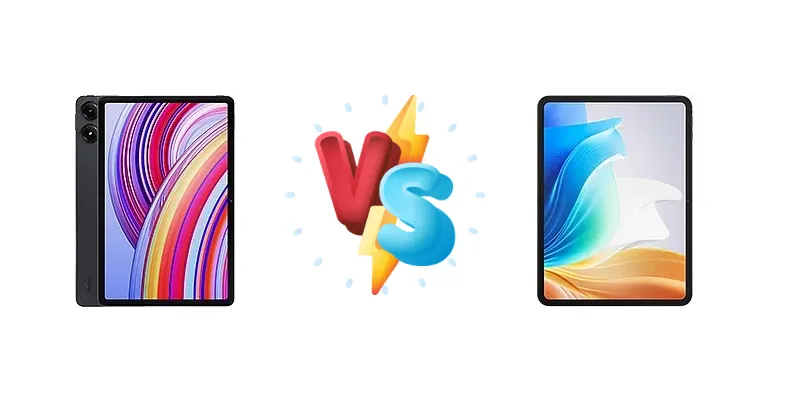
The mid-range tablet market is heating up, with the Xiaomi Redmi Pad Pro 5G and Oppo Pad Air2 vying for dominance. Both offer compelling features at attractive price points, but they take distinctly different approaches to achieving that value. The Redmi Pad Pro 5G leverages a newer Qualcomm chipset and 5G connectivity, while the Oppo Pad Air2 focuses on efficiency with a MediaTek Helio G99. This comparison will dissect their strengths and weaknesses to help you choose the right tablet for your needs.
🏆 Quick Verdict
For users prioritizing raw performance and future-proofing, the Xiaomi Redmi Pad Pro 5G emerges as the winner. Its Snapdragon 7s Gen 2 chipset provides a noticeable edge in demanding tasks and gaming. However, the Oppo Pad Air2 remains a strong contender for those seeking a lightweight, efficient tablet for everyday use.
| Network |
|---|
| 2G bands | GSM 850 / 900 / 1800 / 1900 | N/A |
| 3G bands | HSDPA 850 / 900 / 2100 | N/A |
| 4G bands | 1, 3, 5, 8, 34, 38, 39, 40, 41 | N/A |
| 5G bands | 1, 3, 5, 8, 28, 41, 77, 78 SA/NSA | - |
| EDGE | - | No |
| GPRS | - | No |
| Speed | HSPA, LTE, 5G | - |
| Technology | GSM / CDMA / HSPA / CDMA2000 / LTE / 5G | No cellular connectivity |
| Launch |
|---|
| Announced | 2024, May 30 | 2023, November 23 |
| Status | Available. Released 2024, May 30 | Available. Released 2023, November 27 |
| Body |
|---|
| Build | Glass front (Gorilla Glass 3), aluminum frame, aluminum back | - |
| Dimensions | 280 x 181.9 x 7.5 mm (11.02 x 7.16 x 0.30 in) | 255.1 x 188 x 6.9 mm (10.04 x 7.40 x 0.27 in) |
| SIM | Nano-SIM + Nano-SIM | No |
| Weight | 566 g (1.25 lb) | 538 g (1.19 lb) |
| Display |
|---|
| Protection | Corning Gorilla Glass 3 | - |
| Resolution | 1600 x 2560 pixels, 16:10 ratio (~249 ppi density) | 1720 x 2408 pixels (~260 ppi density) |
| Size | 12.1 inches, 424.5 cm2 (~83.4% screen-to-body ratio) | 11.4 inches, 396.6 cm2 (~82.7% screen-to-body ratio) |
| Type | IPS LCD, 120Hz, Dolby Vision, 600 nits | IPS LCD, 90Hz, 400 nits (typ) |
| Platform |
|---|
| CPU | Octa-core (4x2.40 GHz Cortex-A78 & 4x1.95 GHz Cortex-A55) | Octa-core (2x2.2 GHz Cortex-A76 & 6x2.0 GHz Cortex-A55) |
| Chipset | Qualcomm SM7435-AB Snapdragon 7s Gen 2 (4 nm) | Mediatek Helio G99 (6 nm) |
| GPU | Adreno 710 | Mali-G57 MC2 |
| OS | Android 14, HyperOS | Android 13, ColorOS 13.2 |
| Memory |
|---|
| Card slot | microSDXC (dedicated slot) | No |
| Internal | 128GB 6GB RAM, 128GB 8GB RAM, 256GB 8GB RAM | 128GB 6GB RAM, 128GB 8GB RAM, 256GB 8GB RAM |
| Main Camera |
|---|
| Features | LED flash, HDR | - |
| Single | 8 MP | 8 MP |
| Video | 1080p@30fps | 1080p@30fps |
| Selfie camera |
|---|
| Single | 8 MP | 8 MP |
| Video | 1080p@30fps | 1080p@30fps |
| Sound |
|---|
| 35mm jack | Yes | No |
| Loudspeaker | Yes, with stereo speakers (4 speakers) | Yes, with stereo speakers (4 speakers) |
| Comms |
|---|
| Bluetooth | 5.2, A2DP, LE | 5.2, A2DP, LE, aptX HD |
| NFC | No | No |
| Positioning | GPS, GALILEO, GLONASS, BDS, QZSS | GPS |
| Radio | No | No |
| USB | USB Type-C 2.0 | USB Type-C 2.0 |
| WLAN | Wi-Fi 802.11 a/b/g/n/a/6, dual-band, Wi-Fi Direct | Wi-Fi 802.11 a/b/g/n/ac, dual-band |
| Features |
|---|
| Sensors | Accelerometer, gyro, proximity (accessories only), compass | Accelerometer, proximity (accessories only), gyro, compass |
| Battery |
|---|
| Charging | 33W wired, PD3.0, QC3+ | 33W wired, PD |
| Type | 10000 mAh | Li-Po 8000 mAh |
| Misc |
|---|
| Colors | Dark Gray | Silver, Gray |
| Models | 24074RPD2G, 24074RPD2I, 24074RPD2C | - |
| Price | About 250 EUR | About 170 EUR |
| SAR | 1.09 W/kg (head) 1.01 W/kg (body) | - |
| SAR EU | 0.98 W/kg (head) 1.00 W/kg (body) | - |
Xiaomi Redmi Pad Pro 5G
- More powerful Snapdragon 7s Gen 2 chipset
- 5G connectivity for on-the-go access
- Potentially better thermal management due to 4nm process
- Likely shorter battery life under heavy load
- May be slightly heavier due to larger components
Oppo Pad Air2
- Excellent power efficiency with the Helio G99
- Potentially longer battery life for everyday use
- Lightweight and portable design
- Less powerful chipset for demanding tasks
- Lacks 5G connectivity
Display Comparison
Both tablets lack detailed display specifications in the provided data, making a direct comparison challenging. However, considering their price points, we can infer both likely utilize IPS LCD panels. The Redmi Pad Pro 5G's potential for higher peak brightness, driven by the more powerful chipset, could translate to better outdoor visibility. The Oppo Pad Air2, with its focus on efficiency, may prioritize color accuracy and viewing angles. Bezels are likely comparable, typical of this price bracket. Without specific refresh rate data, we assume both operate at 60Hz.
Camera Comparison
Given the context data, a detailed camera comparison is limited. Both tablets likely feature modest camera setups geared towards video calls and casual snapshots. Without sensor size or aperture information, it’s difficult to assess image quality. The presence of a 5G modem in the Redmi Pad Pro 5G suggests a potential for higher-resolution video recording capabilities, but this is speculative. We anticipate similar image processing styles, prioritizing vibrant colors and adequate detail in good lighting conditions. Any 2MP macro cameras on either device are likely to offer minimal benefit.
Performance
The core difference lies in the chipsets. The Xiaomi Redmi Pad Pro 5G’s Qualcomm SM7435-AB Snapdragon 7s Gen 2 (4nm) boasts a more modern architecture and a smaller fabrication process compared to the Oppo Pad Air2’s MediaTek Helio G99 (6nm). The Snapdragon’s octa-core configuration, with 4x2.40 GHz Cortex-A78 cores, provides a significant performance advantage over the Helio G99’s 2x2.2 GHz Cortex-A76 cores, particularly in multi-threaded workloads. The 4nm process also contributes to better thermal efficiency, potentially reducing throttling during sustained use. While the Helio G99 is a capable chip, the Snapdragon 7s Gen 2 offers a more substantial performance uplift for gaming and demanding applications. The Redmi Pad Pro 5G is likely to benefit from faster RAM speeds (likely LPDDR5x) compared to the Air2, further enhancing performance.
Battery Life
Both tablets feature 33W wired charging, supporting PD3.0 and QC3+ (Redmi) and PD (Oppo). While battery capacity isn’t specified, the Helio G99’s inherent efficiency in the Oppo Pad Air2 could translate to longer battery life despite a potentially smaller battery size. The Snapdragon 7s Gen 2, while more powerful, consumes more energy. The 33W charging speed should provide a reasonable 0-100% charge time for both devices, likely around 60-90 minutes. The Redmi Pad Pro 5G’s 5G connectivity will impact battery life when actively used, while the Air2 will excel in scenarios where sustained performance isn’t critical.
Buying Guide
Buy the Xiaomi Redmi Pad Pro 5G if you need a tablet capable of handling demanding applications, enjoy mobile gaming, or require 5G connectivity for on-the-go productivity. Buy the Oppo Pad Air2 if you prioritize portability, long battery life, and a streamlined user experience for tasks like media consumption and light productivity.
Frequently Asked Questions
❓ Will the Snapdragon 7s Gen 2 in the Redmi Pad Pro 5G handle demanding games like Genshin Impact?
Yes, the Snapdragon 7s Gen 2 is capable of running Genshin Impact, though you may need to adjust graphics settings to achieve a smooth frame rate. It offers a substantial performance improvement over the Helio G99, making it a more suitable choice for mobile gaming enthusiasts.
❓ How much does 5G connectivity impact battery life on the Redmi Pad Pro 5G?
Actively using 5G will noticeably reduce battery life compared to Wi-Fi usage. The 5G modem consumes more power, especially in areas with weak signal strength. However, when connected to a strong 5G network, the speed benefits may outweigh the battery drain for users who require constant connectivity.
❓ Is the MediaTek Helio G99 in the Oppo Pad Air2 sufficient for multitasking?
The Helio G99 is capable of handling moderate multitasking, such as switching between apps and browsing the web. However, it may struggle with resource-intensive tasks like video editing or running multiple demanding applications simultaneously. It's best suited for users who primarily engage in light productivity and media consumption.
❓ Does the Oppo Pad Air2 support any stylus functionality?
Based on available information, the Oppo Pad Air2 does not officially support stylus input. While you might be able to use a capacitive stylus, it won't offer pressure sensitivity or advanced features.