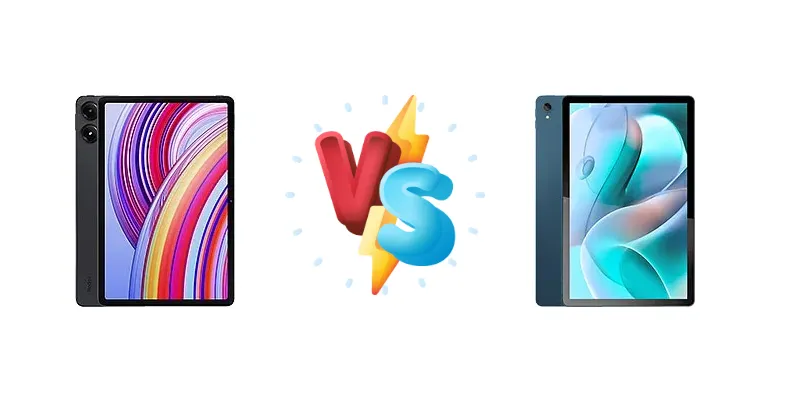
The tablet market is heating up with compelling options at various price points. The Xiaomi Redmi Pad Pro 5G and Motorola Moto Tab G70 both aim to deliver a versatile experience, but they take fundamentally different approaches to achieving that goal. The Redmi Pad Pro 5G leverages a newer, more efficient chipset, while the Moto Tab G70 relies on an older, but still capable, processor. This comparison will dissect the key differences to help you determine which tablet best suits your needs.
🏆 Quick Verdict
For the average user prioritizing performance and future-proofing, the Xiaomi Redmi Pad Pro 5G is the clear winner. Its Snapdragon 7s Gen 2 chipset, built on a 4nm process, offers a significant advantage in both raw power and thermal efficiency compared to the Moto Tab G70’s 12nm Helio G90T. While the Moto Tab G70 offers a reasonable experience, the Redmi Pad Pro 5G provides a smoother, more responsive user experience.
| Network |
|---|
| 2G bands | GSM 850 / 900 / 1800 / 1900 | GSM 850 / 900 / 1800 / 1900 |
| 3G bands | HSDPA 850 / 900 / 2100 | HSDPA 850 / 900 / 1900 / 2100 |
| 4G bands | 1, 3, 5, 8, 34, 38, 39, 40, 41 | 1, 2, 4, 7, 8, 20, 28, 38, 40, 41 |
| 5G bands | 1, 3, 5, 8, 28, 41, 77, 78 SA/NSA | - |
| Speed | HSPA, LTE, 5G | HSPA 42.2/5.76 Mbps, LTE Cat4 150/50 Mbps - cellular model only |
| Technology | GSM / CDMA / HSPA / CDMA2000 / LTE / 5G | GSM / HSPA / LTE |
| Launch |
|---|
| Announced | 2024, May 30 | 2022, January 12 |
| Status | Available. Released 2024, May 30 | Available. Released 2022, January 13 |
| Body |
|---|
| Build | Glass front (Gorilla Glass 3), aluminum frame, aluminum back | Glass front, aluminum back, aluminum frame |
| Dimensions | 280 x 181.9 x 7.5 mm (11.02 x 7.16 x 0.30 in) | 258.4 x 163 x 7.5 mm (10.17 x 6.42 x 0.30 in) |
| SIM | Nano-SIM + Nano-SIM | Nano-SIM (cellular model only) |
| Weight | 566 g (1.25 lb) | 500 g (1.10 lb) |
| | - | Water repellent design |
| Display |
|---|
| Protection | Corning Gorilla Glass 3 | - |
| Resolution | 1600 x 2560 pixels, 16:10 ratio (~249 ppi density) | 1200 x 2000 pixels, 5:3 ratio (~212 ppi density) |
| Size | 12.1 inches, 424.5 cm2 (~83.4% screen-to-body ratio) | 11.0 inches, 344.4 cm2 (~81.8% screen-to-body ratio) |
| Type | IPS LCD, 120Hz, Dolby Vision, 600 nits | IPS LCD, 400 nits (typ) |
| Platform |
|---|
| CPU | Octa-core (4x2.40 GHz Cortex-A78 & 4x1.95 GHz Cortex-A55) | Octa-core (2x2.05 GHz Cortex-A76 & 6x2.0 GHz Cortex-A55) |
| Chipset | Qualcomm SM7435-AB Snapdragon 7s Gen 2 (4 nm) | Mediatek MT6785 Helio G90T (12 nm) |
| GPU | Adreno 710 | Mali-G76 MC4 |
| OS | Android 14, HyperOS | Android 11 |
| Memory |
|---|
| Card slot | microSDXC (dedicated slot) | microSDXC (dedicated slot) |
| Internal | 128GB 6GB RAM, 128GB 8GB RAM, 256GB 8GB RAM | 64GB 4GB RAM, 128GB 6GB RAM |
| | - | eMMC 5.1 |
| Main Camera |
|---|
| Features | LED flash, HDR | LED flash |
| Single | 8 MP | 13 MP, f/2.2, 26mm (wide), AF |
| Video | 1080p@30fps | 1080p@30fps |
| Selfie camera |
|---|
| Single | 8 MP | 8 MP, f/2.0, 26mm (wide) |
| Video | 1080p@30fps | 1080p@30fps |
| Sound |
|---|
| 3.5mm jack | - | Yes |
| 35mm jack | Yes | Yes |
| Loudspeaker | Yes, with stereo speakers (4 speakers) | Yes, with stereo speakers (4 speakers) |
| Comms |
|---|
| Bluetooth | 5.2, A2DP, LE | 5.2, A2DP, LE |
| NFC | No | No |
| Positioning | GPS, GALILEO, GLONASS, BDS, QZSS | GPS, GLONASS - cellular model only |
| Radio | No | No |
| USB | USB Type-C 2.0 | USB Type-C 2.0, OTG |
| WLAN | Wi-Fi 802.11 a/b/g/n/a/6, dual-band, Wi-Fi Direct | Wi-Fi 802.11 a/b/g/n/ac, dual-band, Wi-Fi Direct |
| Features |
|---|
| Sensors | Accelerometer, gyro, proximity (accessories only), compass | Accelerometer, gyro, proximity |
| Battery |
|---|
| Charging | 33W wired, PD3.0, QC3+ | 20W wired |
| Type | 10000 mAh | Li-Po 7700 mAh |
| Misc |
|---|
| Colors | Dark Gray | Modernist Teal, Blue |
| Models | 24074RPD2G, 24074RPD2I, 24074RPD2C | - |
| Price | About 250 EUR | About 380 EUR |
| SAR | 1.09 W/kg (head) 1.01 W/kg (body) | - |
| SAR EU | 0.98 W/kg (head) 1.00 W/kg (body) | - |
Xiaomi Redmi Pad Pro 5G
- Superior performance with Snapdragon 7s Gen 2
- Faster 33W charging with PD3.0/QC3+ support
- More efficient 4nm process for better battery life
- Potentially higher price point
- Display specifications not provided
Motorola Moto Tab G70
- Lower initial cost
- Acceptable performance for basic tasks
- Decent battery life for light usage
- Less powerful Helio G90T chipset
- Slower 20W charging
- Less efficient 12nm process
Display Comparison
Neither device's display specifications are provided, so a direct comparison is limited. However, given the Redmi Pad Pro 5G's positioning, it likely features a more modern panel with potentially higher brightness and color accuracy. The Moto Tab G70, being an older model, may exhibit wider bezels and a less refined display experience. The absence of refresh rate data is notable; a higher refresh rate (90Hz or 120Hz) on the Redmi Pad Pro 5G would further enhance its visual fluidity.
Camera Comparison
Without specific camera specs beyond the chipsets, a detailed comparison is impossible. However, given the Redmi Pad Pro 5G’s more recent release, it likely incorporates more advanced image processing algorithms and potentially larger sensor sizes. The Helio G90T, while capable, is paired with older image signal processors (ISPs), limiting its ability to capture detailed images in challenging lighting conditions. It's reasonable to assume the Redmi Pad Pro 5G will deliver superior image quality, particularly in low-light scenarios.
Performance
The core difference lies in the chipsets. The Xiaomi Redmi Pad Pro 5G’s Qualcomm SM7435-AB Snapdragon 7s Gen 2 (4nm) is a significant leap forward. The 4nm fabrication process inherently provides better power efficiency and thermal performance compared to the Motorola Moto Tab G70’s Mediatek MT6785 Helio G90T (12nm). The Snapdragon 7s Gen 2’s CPU configuration – Octa-core (4x2.40 GHz Cortex-A78 & 4x1.95 GHz Cortex-A55) – offers a more balanced and powerful architecture than the Helio G90T’s (2x2.05 GHz Cortex-A76 & 6x2.0 GHz Cortex-A55). This translates to faster app loading times, smoother multitasking, and improved gaming performance on the Redmi Pad Pro 5G. The larger Cortex-A78 cores in the Snapdragon contribute to superior single-core performance, crucial for responsive UI interactions.
Battery Life
The Redmi Pad Pro 5G’s 33W wired charging with PD3.0 and QC3+ support is a clear advantage over the Moto Tab G70’s 20W charging. Faster charging significantly reduces downtime, allowing users to quickly replenish the battery. While battery capacity isn't specified, the Snapdragon 7s Gen 2’s superior power efficiency means the Redmi Pad Pro 5G will likely achieve comparable or better battery life despite potentially having a smaller battery capacity. The 12nm process of the Helio G90T consumes more power, impacting overall battery endurance.
Buying Guide
Buy the Xiaomi Redmi Pad Pro 5G if you need a tablet capable of handling demanding tasks like gaming and multitasking without significant throttling, and if you value faster charging speeds and a more modern chipset. Buy the Motorola Moto Tab G70 if you prioritize a lower initial cost and are primarily focused on basic media consumption and light productivity tasks, accepting the trade-offs in performance and efficiency.
Frequently Asked Questions
❓ Will the Helio G90T in the Moto Tab G70 struggle with graphically intensive games like Genshin Impact?
Yes, the Helio G90T, while capable, will likely struggle to maintain consistent frame rates in demanding games like Genshin Impact, even on medium settings. The 12nm process and less powerful GPU will lead to noticeable frame drops and potential thermal throttling. The Snapdragon 7s Gen 2 in the Redmi Pad Pro 5G offers a significantly smoother gaming experience.
❓ How much faster is the 33W charging on the Redmi Pad Pro 5G compared to the 20W charging on the Moto Tab G70?
The 33W charging on the Redmi Pad Pro 5G will significantly reduce charging times. While exact 0-100% times depend on battery capacity (which isn't specified), expect the Redmi Pad Pro 5G to charge considerably faster – potentially shaving off 30-60 minutes compared to the Moto Tab G70. The inclusion of PD3.0 and QC3+ also ensures compatibility with a wider range of chargers.
❓ Is the Snapdragon 7s Gen 2 in the Redmi Pad Pro 5G powerful enough for multitasking with several apps open simultaneously?
Absolutely. The Snapdragon 7s Gen 2, with its octa-core CPU and efficient architecture, is well-equipped for multitasking. The combination of Cortex-A78 performance cores and ample RAM (assuming a configuration of 6GB or 8GB, which is typical for this class of device) will allow you to seamlessly switch between apps without experiencing significant slowdowns.