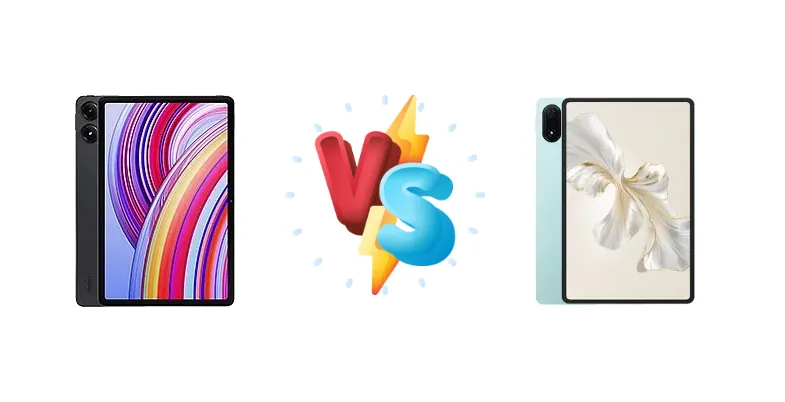
The mid-range tablet space is heating up, with both Xiaomi and Honor offering compelling options. The Redmi Pad Pro 5G aims to deliver 5G connectivity and solid performance at an accessible price, while the Honor Pad 9 Pro focuses on raw processing power with its Dimensity 8100 chipset. This comparison dissects the key differences to help you determine which tablet best suits your needs.
🏆 Quick Verdict
For the average user prioritizing overall performance and future-proofing, the Honor Pad 9 Pro is the better choice. Its Dimensity 8100 chipset, built on a 5nm process, provides a noticeable performance advantage over the Redmi Pad Pro 5G’s Snapdragon 7s Gen 2. However, the Redmi Pad Pro 5G remains a strong contender for budget-conscious users.
| Network |
|---|
| 2G bands | GSM 850 / 900 / 1800 / 1900 | N/A |
| 3G bands | HSDPA 850 / 900 / 2100 | N/A |
| 4G bands | 1, 3, 5, 8, 34, 38, 39, 40, 41 | - |
| 5G bands | 1, 3, 5, 8, 28, 41, 77, 78 SA/NSA | - |
| EDGE | - | No |
| GPRS | - | No |
| Speed | HSPA, LTE, 5G | - |
| Technology | GSM / CDMA / HSPA / CDMA2000 / LTE / 5G | No cellular connectivity |
| Launch |
|---|
| Announced | 2024, May 30 | 2024, July 12 |
| Status | Available. Released 2024, May 30 | Available. Released 2024, July 12 |
| Body |
|---|
| Build | Glass front (Gorilla Glass 3), aluminum frame, aluminum back | Glass front, aluminum frame, aluminum back |
| Dimensions | 280 x 181.9 x 7.5 mm (11.02 x 7.16 x 0.30 in) | 277 x 179.9 x 6.6 mm (10.91 x 7.08 x 0.26 in) |
| SIM | Nano-SIM + Nano-SIM | No |
| Weight | 566 g (1.25 lb) | 589 g (1.30 lb) |
| Display |
|---|
| Protection | Corning Gorilla Glass 3 | - |
| Resolution | 1600 x 2560 pixels, 16:10 ratio (~249 ppi density) | 1600 x 2560 pixels, 16:10 ratio (~249 ppi density) |
| Size | 12.1 inches, 424.5 cm2 (~83.4% screen-to-body ratio) | 12.1 inches, 424.5 cm2 (~85.2% screen-to-body ratio) |
| Type | IPS LCD, 120Hz, Dolby Vision, 600 nits | IPS LCD, 1B colors, 144Hz |
| Platform |
|---|
| CPU | Octa-core (4x2.40 GHz Cortex-A78 & 4x1.95 GHz Cortex-A55) | Octa-core (4x2.85 GHz Cortex-A78 & 4x2.0 GHz Cortex-A55) |
| Chipset | Qualcomm SM7435-AB Snapdragon 7s Gen 2 (4 nm) | Mediatek Dimensity 8100 (5 nm) |
| GPU | Adreno 710 | Mali-G610 MC6 |
| OS | Android 14, HyperOS | Android 14, Magic OS 8.1 |
| Memory |
|---|
| Card slot | microSDXC (dedicated slot) | No |
| Internal | 128GB 6GB RAM, 128GB 8GB RAM, 256GB 8GB RAM | 256GB 12GB RAM, 256GB 8GB RAM |
| Main Camera |
|---|
| Features | LED flash, HDR | HDR |
| Single | 8 MP | 13 MP, f/2.0, (wide), AF |
| Video | 1080p@30fps | 4K@30fps, 1080p@30fps |
| Selfie camera |
|---|
| Single | 8 MP | 5 MP, f/2.2, (wide) |
| Video | 1080p@30fps | 1080p@30fps |
| Sound |
|---|
| 35mm jack | Yes | No |
| Loudspeaker | Yes, with stereo speakers (4 speakers) | Yes, with stereo speakers (8 speakers) |
| Comms |
|---|
| Bluetooth | 5.2, A2DP, LE | 5.2, A2DP, LE |
| NFC | No | No |
| Positioning | GPS, GALILEO, GLONASS, BDS, QZSS | No |
| Radio | No | No |
| USB | USB Type-C 2.0 | USB Type-C 2.0, OTG |
| WLAN | Wi-Fi 802.11 a/b/g/n/a/6, dual-band, Wi-Fi Direct | Wi-Fi 802.11 a/b/g/n/ac/6, dual-band, Wi-Fi Direct |
| Features |
|---|
| Sensors | Accelerometer, gyro, proximity (accessories only), compass | Accelerometer |
| Battery |
|---|
| Charging | 33W wired, PD3.0, QC3+ | 35W wired |
| Type | 10000 mAh | Li-Po 10050 mAh |
| Misc |
|---|
| Colors | Dark Gray | Sky Blue, Star Gray |
| Models | 24074RPD2G, 24074RPD2I, 24074RPD2C | - |
| Price | About 250 EUR | About 290 EUR |
| SAR | 1.09 W/kg (head) 1.01 W/kg (body) | - |
| SAR EU | 0.98 W/kg (head) 1.00 W/kg (body) | - |
Xiaomi Redmi Pad Pro 5G
- Potentially lower price point
- 5G connectivity for on-the-go access
- Support for PD3.0 and QC3+ fast charging
- Less powerful Snapdragon 7s Gen 2 chipset
- May exhibit more throttling under heavy load
Honor Pad 9 Pro
- More powerful MediaTek Dimensity 8100 chipset
- 5nm process for improved efficiency and reduced throttling
- Faster charging (35W)
- Potentially higher price
- May lack 5G connectivity (data not provided)
Display Comparison
While both tablets likely feature LCD panels (data not provided), the core difference lies in the processing power driving them. Display quality details like resolution and refresh rate are missing, but the chipset impacts UI smoothness. The Honor Pad 9 Pro’s Dimensity 8100 will render animations and transitions more fluidly, especially noticeable when multitasking. Bezels and color accuracy are unknown, but a more powerful chipset can assist with image processing for improved color representation.
Camera Comparison
Without specific camera sensor details, a direct comparison is limited. However, given the tablet segment, camera performance is rarely a primary focus. Both devices likely feature similar camera setups geared towards casual photography. The absence of information regarding sensor size, aperture, or OIS suggests neither tablet will excel in low-light conditions. Image processing will be handled by the respective chipsets, with the Dimensity 8100 potentially offering slightly faster processing speeds.
Performance
The Honor Pad 9 Pro’s MediaTek Dimensity 8100 (5nm) significantly outperforms the Redmi Pad Pro 5G’s Qualcomm Snapdragon 7s Gen 2 (4nm) in raw CPU and GPU power. The Dimensity 8100 boasts a higher clock speed (2.85 GHz vs 2.40 GHz) on its Cortex-A78 cores, translating to faster application loading and smoother multitasking. The 5nm fabrication process also contributes to better thermal efficiency, potentially reducing throttling during sustained workloads. While the Snapdragon 7s Gen 2 is efficient, it’s positioned a tier below in terms of peak performance. The impact is most noticeable in graphically intensive games and demanding applications.
Battery Life
The Redmi Pad Pro 5G supports 33W wired charging with PD3.0 and QC3+, while the Honor Pad 9 Pro offers 35W wired charging. The slightly higher wattage of the Honor Pad 9 Pro suggests marginally faster charging times, but the difference is unlikely to be substantial. Battery capacity is unknown for both devices. However, the more efficient 5nm process of the Dimensity 8100 in the Honor Pad 9 Pro could translate to longer battery life during typical usage, offsetting any potential capacity differences.
Buying Guide
Buy the Xiaomi Redmi Pad Pro 5G if you need a reliable tablet with 5G connectivity and prioritize value for money. It’s ideal for everyday tasks like browsing, streaming, and light productivity. Buy the Honor Pad 9 Pro if you prefer a smoother experience with demanding applications, enjoy mobile gaming, and value a more powerful processor for long-term usability. It’s the better choice for power users and those who anticipate needing more processing headroom.
Frequently Asked Questions
❓ Will the Snapdragon 7s Gen 2 in the Redmi Pad Pro 5G struggle with demanding games like Genshin Impact?
The Snapdragon 7s Gen 2 is capable of running Genshin Impact, but you'll likely need to lower the graphics settings to achieve a consistently smooth frame rate. The Dimensity 8100 in the Honor Pad 9 Pro will provide a significantly better gaming experience with higher settings and more stable performance.
❓ Does the Dimensity 8100 in the Honor Pad 9 Pro generate excessive heat during prolonged use?
The Dimensity 8100 is built on a 5nm process, which is known for its improved thermal efficiency compared to older nodes. While it can still generate heat under heavy load, the Honor Pad 9 Pro is less likely to experience significant throttling than the Redmi Pad Pro 5G, thanks to the more efficient chipset.
❓ Is the 33W charging on the Redmi Pad Pro 5G slow compared to other tablets?
33W charging is fairly standard for mid-range tablets. While not the fastest available, it should still provide a reasonable charging speed. The Honor Pad 9 Pro's 35W charging offers a slight advantage, but the difference in charging time will likely be minimal.