
Redmi Pad 2 vs Samsung Galaxy Tab A9+: Which Budget Tablet Reigns Supreme?
| Phones Images | |||||
|---|---|---|---|---|---|
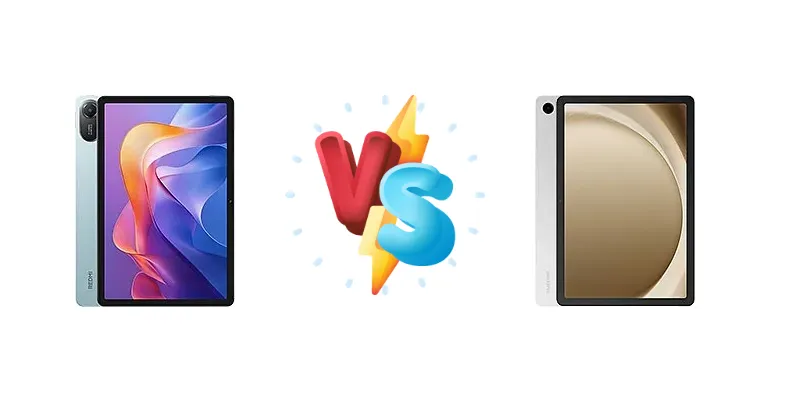
|
🏆 Quick Verdict
For most users, the Xiaomi Redmi Pad 2 emerges as the stronger choice. Its Mediatek Helio G100 Ultra chipset delivers comparable CPU performance to the Snapdragon 695, coupled with a significantly longer active use battery life of 11:09 hours. While the Tab A9+ boasts 5G connectivity, the Redmi Pad 2’s superior battery life and faster charging make it a more practical daily driver.
| PHONES | ||
|---|---|---|
| Phone Names | Xiaomi Redmi Pad 2 | Samsung Galaxy Tab A9+ |
| Network | ||
|---|---|---|
| 2G bands | GSM 850 / 900 / 1800 / 1900 - cellular model only | GSM 850 / 900 / 1800 / 1900 |
| 3G bands | HSDPA 800 / 850 / 900 / 1700(AWS) / 1900 / 2100 - cellular model only | HSDPA 850 / 900 / 1700(AWS) / 1900 / 2100 |
| 4G bands | 1, 2, 3, 4, 5, 7, 8, 13, 18, 19, 20, 26, 28, 38, 40, 41, 66 - cellular model only | 1, 2, 3, 4, 5, 7, 8, 12, 13, 17, 20, 26, 28, 38, 40, 41, 66 |
| 5G bands | - | 1, 3, 5, 7, 8, 20, 28, 38, 40, 41, 66, 77, 78 SA/NSA/Sub6 |
| Speed | HSPA, LTE - cellular model only | HSPA, LTE, 5G - cellular model only |
| Technology | GSM / HSPA / LTE | GSM / HSPA / LTE / 5G |
| Launch | ||
|---|---|---|
| Announced | 2025, June 05 | 2023, October 05 |
| Status | Available. Released 2025, June 05 | Available. Released 2023, October 17 |
| Body | ||
|---|---|---|
| Build | Glass front, aluminum back, plastic frame | - |
| Dimensions | 254.6 x 166 x 7.4 mm (10.02 x 6.54 x 0.29 in) | 257.1 x 168.7 x 6.9 mm (10.12 x 6.64 x 0.27 in) |
| SIM | Nano-SIM + Nano-SIM (cellular model only) | Nano-SIM + eSIM (cellular model only) |
| Weight | 510 g or 519 g (1.12 lb) | 480 g or 492 g (1.06 lb) |
| Display | ||
|---|---|---|
| Protection | Corning Gorilla Glass 3 or Panda glass | - |
| Resolution | 1600 x 2560 pixels, 16:10 ratio (~274 ppi density) | 1200 x 1920 pixels, 16:10 ratio (~206 ppi density) |
| Size | 11.0 inches, 350.9 cm2 (~83.0% screen-to-body ratio) | 11.0 inches, 350.9 cm2 (~80.9% screen-to-body ratio) |
| Type | IPS LCD, 1B colors, 90Hz, 600 nits (HBM) | TFT LCD, 90Hz |
| Platform | ||
|---|---|---|
| CPU | Octa-core (2x2.2 GHz Cortex-A76 & 6x2.0 GHz Cortex-A55) | Octa-core (2x2.2 GHz Kryo 660 Gold & 6x1.8 GHz Kryo 660 Silver) |
| Chipset | Mediatek Helio G100 Ultra (6 nm) | Qualcomm SM6375 Snapdragon 695 5G (6 nm) |
| GPU | Mali-G57 MC2 | Adreno 619 |
| OS | Android 15, HyperOS 2 | Android 13, upgradable to Android 15, One UI 7 |
| Memory | ||
|---|---|---|
| Card slot | microSDXC (uses shared SIM slot) | microSDXC (dedicated slot) |
| Internal | 128GB 4GB RAM, 128GB 6GB RAM, 256GB 8GB RAM | 64GB 4GB RAM, 128GB 4GB RAM, 128GB 8GB RAM, 256GB 8GB RAM |
| Main Camera | ||
|---|---|---|
| Features | HDR | - |
| Single | 8 MP, f/2.0, (wide), 1/4.0", 1.12µm | 8 MP, AF |
| Video | 1080p@30fps | 1080p@30fps |
| Selfie camera | ||
|---|---|---|
| Features | HDR | - |
| Single | 5 MP, f/2.2, (wide), 1/5.0", 1.12µm | 5 MP |
| Video | 1080p@30fps | 1080p@30fps |
| Sound | ||
|---|---|---|
| 35mm jack | Yes | Yes |
| Loudspeaker | Yes, with stereo speakers (4 speakers, with Dolby Atmos) | Yes, with stereo speakers (4 speakers) |
| Comms | ||
|---|---|---|
| Bluetooth | 5.3, A2DP, LE, aptX HD | 5.1, A2DP, LE |
| NFC | No | No |
| Positioning | GPS, GALILEO, GLONASS, BDS, QZSS (cellular model only) | GPS, GLONASS, GALILEO, BDS, QZSS - cellular model only |
| Radio | FM radio | No |
| USB | USB Type-C 2.0, OTG | USB Type-C 2.0 |
| WLAN | Wi-Fi 802.11 a/b/g/n/ac, dual-band, Wi-Fi Direct | Wi-Fi 802.11 a/b/g/n/ac, dual-band, Wi-Fi Direct |
| Features | ||
|---|---|---|
| Sensors | Accelerometer, gyro/compass (cellular model only) | Accelerometer, gyro, proximity (accessories only), compass |
| Battery | ||
|---|---|---|
| Charging | 18W wired, PD2, QC2.0 | 15W wired |
| Type | Li-Po 9000 mAh | Li-Po 7040 mAh |
| Misc | ||
|---|---|---|
| Colors | Graphite Gray, Mint Green, Lavender Purple | Graphite, Silver, Navy |
| Models | 25040RP0AG, 25040RP0AI | SM-X210, SM-X215, SM-X216B |
| Price | About 230 EUR | $ 199.99 |
| SAR | - | 0.42 W/kg (body) |
| SAR EU | - | 1.19 W/kg (body) |
Xiaomi Redmi Pad 2
- Longer battery life (11:09h active use)
- Faster 18W charging with PD2/QC2.0
- Potentially slightly better CPU performance
- Lacks 5G connectivity
- Camera specs are unknown
Samsung Galaxy Tab A9+
- Integrated 5G connectivity
- Qualcomm’s established software support
- Samsung’s brand recognition
- Slower 15W charging
- Likely shorter battery life
- Potentially lower CPU performance
Display Comparison
Both tablets feature large displays suitable for media consumption, but detailed display specs are missing. Given the price point, we can assume both utilize IPS LCD panels. The focus here shifts to performance, as display quality is likely similar. Bezels are expected to be moderate on both, typical for this segment. Color accuracy will likely be adequate for general use, but not professional color work.
Camera Comparison
Camera performance is unlikely to be a deciding factor for either tablet. Details are missing, but given the price bracket, expect basic camera setups. Focusing on the chipsets, the image signal processors (ISPs) within the Helio G100 and Snapdragon 695 will likely deliver similar image quality in good lighting conditions. Low-light performance will likely be limited on both devices. The absence of detailed camera specs suggests neither tablet is geared towards serious photography.
Performance
The core difference lies in the chipsets. The Redmi Pad 2’s Mediatek Helio G100 Ultra (6nm) and the Tab A9+'s Qualcomm Snapdragon 695 5G (6nm) both employ octa-core architectures with similar peak clock speeds (2.2 GHz). However, the CPU core composition differs: the Helio G100 uses 2x Cortex-A76 and 6x Cortex-A55, while the Snapdragon 695 utilizes 2x Kryo 660 Gold and 6x Kryo 660 Silver. While clock speeds are similar, the Cortex-A76 generally offers slightly better single-core performance than the Kryo 660 Gold. The 6nm process node is shared, suggesting comparable efficiency. The Snapdragon 695’s integrated 5G modem is a key advantage for users needing cellular connectivity, but it also consumes additional power.
Battery Life
The Redmi Pad 2 shines in battery life, achieving 11:09 hours of active use. The Galaxy Tab A9+’s battery capacity is unknown, but its 15W charging and the power draw of the 5G modem suggest a shorter runtime. The Redmi Pad 2’s 18W charging with PD2 and QC2.0 support offers faster charging speeds and broader compatibility with existing chargers. This faster charging is a significant advantage for users who need to quickly top up their tablet.
Buying Guide
Buy the Xiaomi Redmi Pad 2 if you prioritize long battery life for media consumption, casual gaming, and productivity tasks. Its efficient chipset and larger battery capacity provide a more reliable experience for extended use. Buy the Samsung Galaxy Tab A9+ if 5G connectivity is essential for your workflow, and you frequently need mobile data access on the go. However, be prepared for shorter battery life and slower charging speeds.