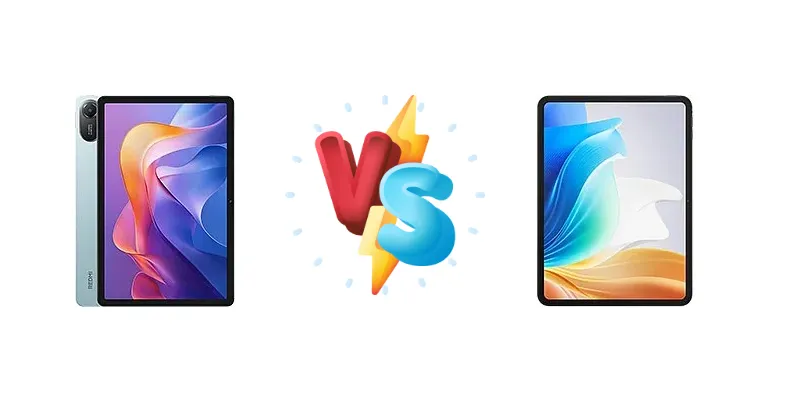
The budget tablet market is heating up, with the Xiaomi Redmi Pad 2 and Oppo Pad Air2 vying for dominance. Both devices aim to deliver a compelling experience without breaking the bank, but they take slightly different approaches. The Redmi Pad 2 focuses on maximizing runtime, while the Oppo Pad Air2 prioritizes faster charging and a streamlined user experience. This comparison dives deep into the specs to determine which tablet offers the best value.
🏆 Quick Verdict
For the average user prioritizing longevity, the Xiaomi Redmi Pad 2 emerges as the winner. Its significantly longer 11:09-hour active use battery life provides a tangible advantage over the Oppo Pad Air2. While the Air2’s 33W charging is faster, the Redmi Pad 2’s endurance makes it ideal for extended use without constant access to a power outlet.
| Network |
|---|
| 2G bands | GSM 850 / 900 / 1800 / 1900 - cellular model only | N/A |
| 3G bands | HSDPA 800 / 850 / 900 / 1700(AWS) / 1900 / 2100 - cellular model only | N/A |
| 4G bands | 1, 2, 3, 4, 5, 7, 8, 13, 18, 19, 20, 26, 28, 38, 40, 41, 66 - cellular model only | N/A |
| EDGE | - | No |
| GPRS | - | No |
| Speed | HSPA, LTE - cellular model only | - |
| Technology | GSM / HSPA / LTE | No cellular connectivity |
| Launch |
|---|
| Announced | 2025, June 05 | 2023, November 23 |
| Status | Available. Released 2025, June 05 | Available. Released 2023, November 27 |
| Body |
|---|
| Build | Glass front, aluminum back, plastic frame | - |
| Dimensions | 254.6 x 166 x 7.4 mm (10.02 x 6.54 x 0.29 in) | 255.1 x 188 x 6.9 mm (10.04 x 7.40 x 0.27 in) |
| SIM | Nano-SIM + Nano-SIM (cellular model only) | No |
| Weight | 510 g or 519 g (1.12 lb) | 538 g (1.19 lb) |
| Display |
|---|
| Protection | Corning Gorilla Glass 3 or Panda glass | - |
| Resolution | 1600 x 2560 pixels, 16:10 ratio (~274 ppi density) | 1720 x 2408 pixels (~260 ppi density) |
| Size | 11.0 inches, 350.9 cm2 (~83.0% screen-to-body ratio) | 11.4 inches, 396.6 cm2 (~82.7% screen-to-body ratio) |
| Type | IPS LCD, 1B colors, 90Hz, 600 nits (HBM) | IPS LCD, 90Hz, 400 nits (typ) |
| Platform |
|---|
| CPU | Octa-core (2x2.2 GHz Cortex-A76 & 6x2.0 GHz Cortex-A55) | Octa-core (2x2.2 GHz Cortex-A76 & 6x2.0 GHz Cortex-A55) |
| Chipset | Mediatek Helio G100 Ultra (6 nm) | Mediatek Helio G99 (6 nm) |
| GPU | Mali-G57 MC2 | Mali-G57 MC2 |
| OS | Android 15, HyperOS 2 | Android 13, ColorOS 13.2 |
| Memory |
|---|
| Card slot | microSDXC (uses shared SIM slot) | No |
| Internal | 128GB 4GB RAM, 128GB 6GB RAM, 256GB 8GB RAM | 128GB 6GB RAM, 128GB 8GB RAM, 256GB 8GB RAM |
| Main Camera |
|---|
| Features | HDR | - |
| Single | 8 MP, f/2.0, (wide), 1/4.0", 1.12µm | 8 MP |
| Video | 1080p@30fps | 1080p@30fps |
| Selfie camera |
|---|
| Features | HDR | - |
| Single | 5 MP, f/2.2, (wide), 1/5.0", 1.12µm | 8 MP |
| Video | 1080p@30fps | 1080p@30fps |
| Sound |
|---|
| 35mm jack | Yes | No |
| Loudspeaker | Yes, with stereo speakers (4 speakers, with Dolby Atmos) | Yes, with stereo speakers (4 speakers) |
| Comms |
|---|
| Bluetooth | 5.3, A2DP, LE, aptX HD | 5.2, A2DP, LE, aptX HD |
| NFC | No | No |
| Positioning | GPS, GALILEO, GLONASS, BDS, QZSS (cellular model only) | GPS |
| Radio | FM radio | No |
| USB | USB Type-C 2.0, OTG | USB Type-C 2.0 |
| WLAN | Wi-Fi 802.11 a/b/g/n/ac, dual-band, Wi-Fi Direct | Wi-Fi 802.11 a/b/g/n/ac, dual-band |
| Features |
|---|
| Sensors | Accelerometer, gyro/compass (cellular model only) | Accelerometer, proximity (accessories only), gyro, compass |
| Battery |
|---|
| Charging | 18W wired, PD2, QC2.0 | 33W wired, PD |
| Type | Li-Po 9000 mAh | Li-Po 8000 mAh |
| Misc |
|---|
| Colors | Graphite Gray, Mint Green, Lavender Purple | Silver, Gray |
| Models | 25040RP0AG, 25040RP0AI | - |
| Price | About 230 EUR | About 170 EUR |
Xiaomi Redmi Pad 2
- Exceptional battery life (11:09h active use)
- Supports PD2 and QC2.0 fast charging standards
- Competitive price point
- Slower charging speed (18W)
- Detailed display specs unknown
Oppo Pad Air2
- Faster 33W charging
- Potentially slightly better GPU performance with Helio G99
- Streamlined user experience (typical of Oppo)
- Likely shorter battery life compared to Redmi Pad 2
- Detailed display specs unknown
Display Comparison
Both tablets utilize 6nm chipsets, suggesting similar power efficiency in display operation. However, detailed display specs (resolution, panel type, brightness) are missing. Given the price point, both likely employ IPS LCD panels. The key difference will be color calibration and viewing angles, which require hands-on testing. Without this data, it's difficult to declare a clear winner, but we can assume similar visual experiences.
Camera Comparison
Camera performance is unlikely to be a deciding factor for either tablet, given their target market. Detailed camera specs are unavailable, but we can expect basic sensors suitable for video calls and casual snapshots. Without information on sensor size, aperture, or image processing algorithms, a meaningful comparison is impossible. Focusing on the core strengths – performance and battery – is more relevant.
Performance
Both the Redmi Pad 2 and Oppo Pad Air2 are powered by Mediatek Helio chipsets featuring the same CPU configuration: an octa-core setup with 2x2.2 GHz Cortex-A76 cores and 6x2.0 GHz Cortex-A55 cores. The Redmi Pad 2 uses the Helio G100 Ultra, while the Oppo Pad Air2 employs the Helio G99. While the core architecture is identical, the G99 generally offers slightly improved GPU performance and efficiency. This translates to a potentially smoother experience in graphically demanding tasks like gaming, favoring the Oppo Pad Air2. However, the difference is likely marginal for everyday use.
Battery Life
The Redmi Pad 2 boasts a significant advantage in battery life, achieving 11:09 hours of active use. The Oppo Pad Air2’s battery life is not specified, but its 33W charging capability is a key differentiator. The Redmi Pad 2 is limited to 18W charging, supporting PD2 and QC2.0 standards. This means the Oppo Pad Air2 will replenish its battery much faster, potentially adding hours of use in a short amount of time. However, the Redmi Pad 2’s longer runtime minimizes the need for frequent charging, making it ideal for users on the go.
Buying Guide
Buy the Xiaomi Redmi Pad 2 if you need a tablet that can last through a full day of work or entertainment on a single charge, and you value maximizing screen-on time. Buy the Oppo Pad Air2 if you prioritize quick top-ups and appreciate a faster charging experience, even if it means slightly less overall battery life. The Air2 is also a better fit for users who frequently switch between tasks and appreciate a more responsive feel.
Frequently Asked Questions
❓ Does the Redmi Pad 2’s 18W charging feel slow compared to other tablets?
While 18W is slower than the Oppo Pad Air2’s 33W, the Redmi Pad 2’s exceptional battery life mitigates this. You’ll likely find yourself charging less frequently, reducing the impact of the slower charging speed. Furthermore, the support for PD2 and QC2.0 ensures compatibility with a wide range of chargers.
❓ Will the Helio G99 in the Oppo Pad Air2 provide a noticeable gaming advantage?
The Helio G99 offers a slight GPU performance edge over the Helio G100 Ultra. However, this difference will likely be most noticeable in demanding games at higher settings. For casual gaming and everyday tasks, the performance difference will be minimal.
❓ How does the software experience differ between Xiaomi and Oppo?
Xiaomi’s MIUI and Oppo’s ColorOS are both based on Android, but offer distinct user interfaces and features. ColorOS is generally considered to be cleaner and more streamlined, while MIUI offers greater customization options. User preference will play a significant role in determining which software experience is preferred.