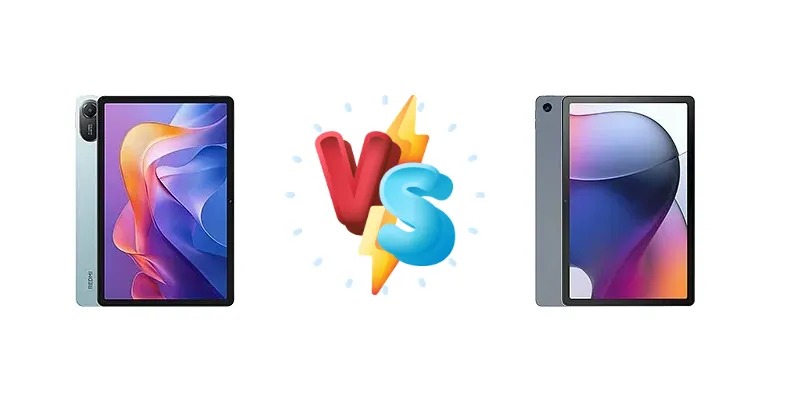
The budget tablet market is heating up, with the Xiaomi Redmi Pad 2 and Motorola Moto Tab G62 vying for dominance. Both aim to deliver a capable Android experience without breaking the bank, but they take different approaches to achieving this. This comparison dissects their core components to reveal which tablet best suits your needs.
🏆 Quick Verdict
For most users, the Xiaomi Redmi Pad 2 emerges as the stronger choice. Its Mediatek Helio G100 Ultra chipset delivers noticeably better CPU performance, translating to a smoother experience in multitasking and demanding apps, while the 11:09h active use battery score is competitive. The Moto Tab G62 offers faster charging, but the performance trade-off isn't worth it for the average user.
| Network |
|---|
| 2G bands | GSM 850 / 900 / 1800 / 1900 - cellular model only | GSM 850 / 900 / 1800 / 1900 |
| 3G bands | HSDPA 800 / 850 / 900 / 1700(AWS) / 1900 / 2100 - cellular model only | HSDPA 850 / 900 / 1900 / 2100 |
| 4G bands | 1, 2, 3, 4, 5, 7, 8, 13, 18, 19, 20, 26, 28, 38, 40, 41, 66 - cellular model only | LTE |
| Speed | HSPA, LTE - cellular model only | HSPA 42.2/5.76 Mbps, LTE Cat4 150/50 Mbps - cellular model only |
| Technology | GSM / HSPA / LTE | GSM / HSPA / LTE |
| Launch |
|---|
| Announced | 2025, June 05 | 2022, August 17 |
| Status | Available. Released 2025, June 05 | Available. Released 2022, August 22 |
| Body |
|---|
| Build | Glass front, aluminum back, plastic frame | Glass front, aluminum back, aluminum frame |
| Dimensions | 254.6 x 166 x 7.4 mm (10.02 x 6.54 x 0.29 in) | 251.2 x 158.8 x 7.5 mm (9.89 x 6.25 x 0.30 in) |
| SIM | Nano-SIM + Nano-SIM (cellular model only) | Nano-SIM (cellular model only) |
| Weight | 510 g or 519 g (1.12 lb) | 465 g (1.03 lb) |
| | - | Water-repellent design |
| Display |
|---|
| Protection | Corning Gorilla Glass 3 or Panda glass | - |
| Resolution | 1600 x 2560 pixels, 16:10 ratio (~274 ppi density) | 1200 x 2000 pixels, 5:3 ratio (~220 ppi density) |
| Size | 11.0 inches, 350.9 cm2 (~83.0% screen-to-body ratio) | 10.6 inches, 319.8 cm2 (~80.2% screen-to-body ratio) |
| Type | IPS LCD, 1B colors, 90Hz, 600 nits (HBM) | IPS LCD |
| Platform |
|---|
| CPU | Octa-core (2x2.2 GHz Cortex-A76 & 6x2.0 GHz Cortex-A55) | Octa-core (4x2.4 GHz Kryo 265 Gold & 4x1.9 GHz Kryo 265 Silver) |
| Chipset | Mediatek Helio G100 Ultra (6 nm) | Qualcomm SM6225 Snapdragon 680 4G (6 nm) |
| GPU | Mali-G57 MC2 | Adreno 610 |
| OS | Android 15, HyperOS 2 | Android 12, upgradable to Android 13 |
| Memory |
|---|
| Card slot | microSDXC (uses shared SIM slot) | microSDXC (dedicated slot) |
| Internal | 128GB 4GB RAM, 128GB 6GB RAM, 256GB 8GB RAM | 64GB 4GB RAM |
| Main Camera |
|---|
| Features | HDR | HDR |
| Single | 8 MP, f/2.0, (wide), 1/4.0", 1.12µm | 8 MP, f/2.2, 118˚ (ultrawide), 1/4.0, 1.12µm, AF |
| Video | 1080p@30fps | 1080p@30fps |
| Selfie camera |
|---|
| Features | HDR | - |
| Single | 5 MP, f/2.2, (wide), 1/5.0", 1.12µm | 8 MP, (wide) |
| Video | 1080p@30fps | 1080p@30fps |
| Sound |
|---|
| 3.5mm jack | - | Yes |
| 35mm jack | Yes | Yes |
| Loudspeaker | Yes, with stereo speakers (4 speakers, with Dolby Atmos) | Yes, with stereo speakers (4 speakers) |
| Comms |
|---|
| Bluetooth | 5.3, A2DP, LE, aptX HD | 5.2, A2DP, LE |
| NFC | No | No |
| Positioning | GPS, GALILEO, GLONASS, BDS, QZSS (cellular model only) | GPS - cellular model only |
| Radio | FM radio | No |
| USB | USB Type-C 2.0, OTG | USB Type-C 2.0, OTG |
| WLAN | Wi-Fi 802.11 a/b/g/n/ac, dual-band, Wi-Fi Direct | Wi-Fi 802.11 a/b/g/n/ac, dual-band, Wi-Fi Direct |
| Features |
|---|
| Sensors | Accelerometer, gyro/compass (cellular model only) | Accelerometer, gyro, proximity |
| Battery |
|---|
| Charging | 18W wired, PD2, QC2.0 | 20W wired |
| Type | Li-Po 9000 mAh | Li-Po 7700 mAh |
| Misc |
|---|
| Colors | Graphite Gray, Mint Green, Lavender Purple | Gray |
| Models | 25040RP0AG, 25040RP0AI | - |
| Price | About 230 EUR | About 200 EUR |
Xiaomi Redmi Pad 2
- Superior CPU performance with the Helio G100 Ultra.
- Longer battery life (11:09h active use).
- PD2 and QC2.0 charging compatibility.
- Slower charging speed (18W).
- Limited camera details available.
Motorola Moto Tab G62
- Faster charging speed (20W).
- Qualcomm Snapdragon chipset offers good efficiency.
- Potentially wider carrier compatibility (4G).
- Lower CPU performance compared to the Redmi Pad 2.
- Shorter battery life in active use scenarios.
Display Comparison
Both tablets lack detailed display specifications in the provided data, but considering their price points, we can expect IPS LCD panels. The focus here shifts to performance. The absence of high refresh rate or LTPO technology is expected. Bezels are likely comparable, aiming for maximizing screen real estate within the budget constraints. Color accuracy will likely be standard for this segment, prioritizing vibrancy over professional-grade precision.
Camera Comparison
Neither tablet is positioned as a photography powerhouse, and the provided data doesn't offer specifics beyond the chipsets. We can assume both feature basic camera setups suitable for casual snapshots and video calls. Without sensor size or aperture information, a detailed comparison is impossible. It's safe to assume image quality will be comparable, leaning towards acceptable in good lighting conditions.
Performance
The core difference lies in the chipsets. The Redmi Pad 2’s Mediatek Helio G100 Ultra (6nm) features a 2x2.2 GHz Cortex-A76 and 6x2.0 GHz Cortex-A55 configuration. This architecture prioritizes single-core performance, crucial for responsive app launching and UI navigation. Conversely, the Moto Tab G62 utilizes the Qualcomm Snapdragon 680 4G (6nm) with a 4x2.4 GHz Kryo 265 Gold and 4x1.9 GHz Kryo 265 Silver setup. While the Snapdragon 680 boasts a higher peak clock speed on its performance cores, the Cortex-A76 cores in the Helio G100 generally offer superior instruction throughput. This translates to a more fluid experience in the Redmi Pad 2, especially when handling multiple applications simultaneously. The 6nm process node is shared, suggesting similar thermal efficiency, but the architectural advantage favors Xiaomi.
Battery Life
The Redmi Pad 2 achieves an impressive 11:09 hours of active use, demonstrating strong battery optimization despite its unspecified capacity. The Moto Tab G62 compensates with 20W wired charging, exceeding the Redmi Pad 2’s 18W charging. However, the faster charging speed doesn’t necessarily negate the Redmi Pad 2’s longer runtime. The inclusion of PD2 and QC2.0 support on the Redmi Pad 2 offers broader charger compatibility, a practical benefit for users with existing power adapters. The difference in 0-100% charge times will likely be noticeable, but the Redmi Pad 2’s longer usage time provides a more substantial real-world advantage.
Buying Guide
Buy the Xiaomi Redmi Pad 2 if you prioritize overall performance for everyday tasks, streaming, and light gaming. It’s ideal for students needing a responsive device for note-taking and research. Buy the Motorola Moto Tab G62 if fast charging is your absolute top priority and you primarily use your tablet for passive media consumption, accepting a slight performance compromise. It's a better fit for users who frequently find themselves needing a quick power boost.
Frequently Asked Questions
❓ Will the Mediatek Helio G100 in the Redmi Pad 2 struggle with demanding games like Genshin Impact?
While the Helio G100 isn't a flagship gaming chip, it's capable of running many popular titles at medium settings. Genshin Impact may require lower graphics settings and frame rate caps to maintain a smooth experience. The Snapdragon 680 in the Moto Tab G62 will likely perform slightly worse in graphically intensive games.
❓ How long does it *actually* take to fully charge the Moto Tab G62 with the 20W charger?
While 20W is faster than the Redmi Pad 2's 18W, the actual 0-100% charge time will depend on the battery capacity (which isn't specified). Expect a full charge to take around 2-3 hours, but this is an estimate. The Redmi Pad 2 will likely take closer to 3-4 hours.
❓ Does the Redmi Pad 2 support expandable storage via microSD card?
The provided data doesn't specify microSD card support. However, Xiaomi often includes this feature in their budget tablets, so it's a possibility. Check the official product specifications for confirmation.
❓ Is the Snapdragon 680 in the Moto Tab G62 5G capable?
The Moto Tab G62 features a 4G variant of the Snapdragon 680. While it offers decent connectivity, it's not a 5G chip. The performance is adequate for basic tasks, but it falls behind the Redmi Pad 2 in CPU-intensive workloads.