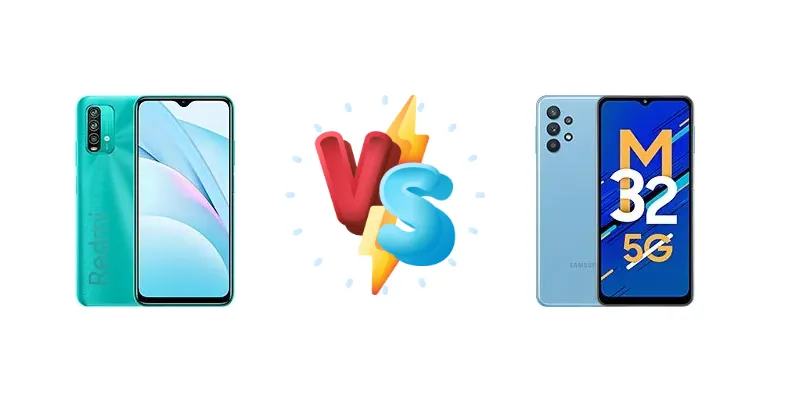
The Xiaomi Redmi Note 9 4G and Samsung Galaxy M32 5G represent compelling options in the crowded budget smartphone market. While both aim to deliver value, they take different approaches: the Redmi Note 9 4G prioritizes a refined, efficient experience with a proven chipset, while the Galaxy M32 5G bets on future-proofing with 5G connectivity and a newer, though not necessarily more powerful, processor. This comparison dissects their key differences to help you choose the right device.
🏆 Quick Verdict
For the average user prioritizing efficiency and a stable experience, the Xiaomi Redmi Note 9 4G is the better choice. Its Snapdragon 662 chipset offers a well-optimized experience. However, if 5G connectivity is a must-have and you're willing to potentially trade some performance consistency, the Samsung Galaxy M32 5G is a viable option.
| Network |
|---|
| 2G bands | GSM 850 / 900 / 1800 / 1900 | GSM 850 / 900 / 1800 / 1900 |
| 3G bands | HSDPA 850 / 900 / 2100 | HSDPA 850 / 900 / 1700(AWS) / 1900 / 2100 |
| 4G bands | 1, 3, 5, 8, 34, 38, 39, 40, 41 | 1, 2, 3, 4, 5, 7, 8, 12, 17, 20, 26, 28, 38, 40, 41, 66 |
| 5G bands | - | 1, 3, 5, 7, 8, 20, 28, 38, 40, 41, 66, 78 SA/NSA/Sub6 |
| Speed | HSPA, LTE | HSPA, LTE, 5G |
| Technology | GSM / CDMA / HSPA / LTE | GSM / HSPA / LTE / 5G |
| | CDMA 800 | - |
| Launch |
|---|
| Announced | 2020, November 26 | 2021, August 25 |
| Status | Available. Released 2020, November 26 | Available. Released 2021, September 02 |
| Body |
|---|
| Build | Glass front (Gorilla Glass 3), plastic frame, plastic back | - |
| Dimensions | 162.3 x 77.3 x 9.6 mm (6.39 x 3.04 x 0.38 in) | 164.2 x 76.1 x 9.1 mm (6.46 x 3.00 x 0.36 in) |
| SIM | Nano-SIM + Nano-SIM | Nano-SIM + Nano-SIM |
| Weight | 198 g (6.98 oz) | 205 g (7.23 oz) |
| | Water-repellent coating | - |
| Display |
|---|
| Protection | Corning Gorilla Glass 3 | - |
| Resolution | 1080 x 2340 pixels, 19.5:9 ratio (~395 ppi density) | 720 x 1600 pixels, 20:9 ratio (~270 ppi density) |
| Size | 6.53 inches, 104.7 cm2 (~83.4% screen-to-body ratio) | 6.5 inches, 102.0 cm2 (~81.6% screen-to-body ratio) |
| Type | IPS LCD, 400 nits (typ) | TFT LCD |
| Platform |
|---|
| CPU | Octa-core (4x2.0 GHz Kryo 260 Gold & 4x1.8 GHz Kryo 260 Silver) | Octa-core (2x2.0 GHz Cortex-A76 & 6x2.0 GHz Cortex-A55) |
| Chipset | Qualcomm SM6115 Snapdragon 662 (11 nm) | Mediatek Dimensity 720 (7 nm) |
| GPU | Adreno 610 | Mali-G57 MC3 |
| OS | Android 10, upgradable to Android 12, MIUI 14 | Android 11, upgradable to Android 13, One UI 5 |
| Memory |
|---|
| Card slot | microSDXC (dedicated slot) | microSDXC (uses shared SIM slot) |
| Internal | 128GB 4GB RAM, 128GB 6GB RAM, 128GB 8GB RAM, 256GB 8GB RAM | 128GB 6GB RAM, 128GB 8GB RAM |
| | UFS 2.2 | eMMC 5.1 |
| Main Camera |
|---|
| Features | LED flash, HDR, panorama | LED flash, panorama, HDR |
| Quad | - | 48 MP, f/1.8, 26mm (wide), PDAF
8 MP, f/2.2, 123˚ (ultrawide)
5 MP (macro)
Auxiliary lens |
| Triple | 48 MP, f/1.8, 26mm (wide), 1/2.0", 0.8µm, PDAF
8 MP, f/2.2, 120˚ (ultrawide), 1/4.0", 1.12µm
Auxiliary lens | - |
| Video | 1080p@30fps | 4K@30fps, 1080p@30fps |
| Selfie camera |
|---|
| Single | 8 MP, f/2.0, 27mm (wide), 1/4.0", 1.12µm | 13 MP, f/2.2, (wide) |
| Video | 1080p@30fps | 1080p@30fps |
| Sound |
|---|
| 3.5mm jack | Yes | Yes |
| 35mm jack | Yes | Yes |
| Loudspeaker | Yes, with stereo speakers | Yes |
| | 24-bit/192kHz audio | - |
| Comms |
|---|
| Bluetooth | 4.2, A2DP | 5.0, A2DP, LE, aptX |
| Infrared port | Yes | - |
| NFC | No | Yes |
| Positioning | GPS, GLONASS, GALILEO, BDS | GPS, GLONASS, BDS, GALILEO |
| Radio | FM radio | Unspecified |
| USB | USB Type-C 2.0, OTG | USB Type-C 2.0, OTG |
| WLAN | Wi-Fi 802.11 a/b/g/n/ac, dual-band, Wi-Fi Direct | Wi-Fi 802.11 a/b/g/n/ac, dual-band, Wi-Fi Direct |
| Features |
|---|
| Sensors | Fingerprint (side-mounted), accelerometer, proximity, compass | Fingerprint (side-mounted), accelerometer, gyro, compass |
| | - | Virtual proximity sensing |
| Battery |
|---|
| Charging | 18W wired
2.5W reverse wired | 15W wired |
| Type | Li-Po 6000 mAh | Li-Ion 5000 mAh |
| Misc |
|---|
| Colors | Gray, Green, Blue, Orange | Slate Black, Sky Blue |
| Models | M2010J19SC | SM-M326B, SM-M326B/DS |
| Price | About 130 EUR | About 220 EUR |
| SAR | - | 0.48 W/kg (head) |
Xiaomi Redmi Note 9 4G
- More efficient Snapdragon 662 chipset
- Faster 18W charging
- Potentially more color-accurate display
- Lacks 5G connectivity
- Older chipset architecture
Samsung Galaxy M32 5G
- 5G connectivity for future-proofing
- Newer Mediatek Dimensity 720 chipset
- Potentially brighter display
- Slower 15W charging
- Potentially less consistent performance under load
Display Comparison
Neither device boasts a standout display. Both likely utilize LCD panels, a common trait in this price bracket. The key difference lies under the hood. While specific display specs are missing, the Redmi Note 9 4G's focus on efficiency suggests a potentially more color-accurate panel, optimized for power consumption. The M32 5G, aiming for broader appeal, may prioritize brightness, but at the cost of efficiency. Bezels are likely comparable, reflecting the budget nature of both devices.
Camera Comparison
Camera performance is likely to be similar, with both devices relying on budget sensors. Without specific sensor details, it's difficult to make a definitive judgment. However, Samsung’s image processing algorithms generally lean towards more saturated colors, while Xiaomi tends to aim for a more natural look. The presence of a 2MP macro camera on both devices is largely a marketing gimmick, offering limited practical benefit. The aperture and sensor size of the main camera will be the determining factors, but this information is unavailable.
Performance
The performance gap is where the core difference lies. The Samsung Galaxy M32 5G’s Mediatek Dimensity 720, fabricated on a 7nm process, theoretically offers better power efficiency than the Xiaomi Redmi Note 9 4G’s Snapdragon 662 (11nm). However, the Snapdragon 662 is a mature chipset with excellent software optimization. The Dimensity 720’s Cortex-A76 cores provide a performance boost over the Kryo 260 Gold cores in the Snapdragon 662, but the six Cortex-A55 cores in the Dimensity 720 are clocked at the same speed as the four Kryo 260 Silver cores, suggesting a more balanced, but not overwhelmingly superior, multi-core performance. Users engaging in sustained gaming or demanding applications will likely see more consistent performance from the Snapdragon 662 due to its thermal efficiency.
Battery Life
The Samsung Galaxy M32 5G’s 15W charging is slower than the Redmi Note 9 4G’s 18W charging. While the M32 5G’s 5G modem consumes more power, the Dimensity 720’s 7nm process should partially offset this. The Redmi Note 9 4G’s more efficient chipset and faster charging give it an edge in real-world battery endurance and quicker top-ups. Expect both phones to comfortably last a full day with moderate use, but the Redmi Note 9 4G will likely require less frequent charging.
Buying Guide
Buy the Xiaomi Redmi Note 9 4G if you need a reliable daily driver with good battery life and a smooth, responsive user experience, even without 5G. It's ideal for users who prioritize efficiency and don't anticipate needing 5G in the immediate future. Buy the Samsung Galaxy M32 5G if you prioritize future-proofing with 5G connectivity and are comfortable with potentially slightly less consistent performance in demanding tasks. This is a good choice for users in areas with growing 5G infrastructure.
Frequently Asked Questions
❓ Does the Mediatek Dimensity 720 in the Galaxy M32 5G overheat during prolonged gaming sessions?
While the Dimensity 720 is a capable chipset, its thermal management isn't as refined as the Snapdragon 662. Expect some throttling during extended gaming, potentially leading to frame rate drops. The Redmi Note 9 4G is likely to maintain more consistent performance over longer periods.
❓ Is the 5G connectivity on the Galaxy M32 5G actually useful right now?
The usefulness of 5G depends heavily on your location and carrier coverage. If you live in an area with limited 5G infrastructure, you won't see any benefit. However, if 5G is available, it offers significantly faster download and upload speeds, making it a worthwhile investment for future-proofing.
❓ How significant is the difference in charging speed between 18W and 15W?
While 3W may not seem like much, it translates to a noticeable difference in charging time. The Redmi Note 9 4G's 18W charging will top up the battery faster, reducing downtime. Expect a roughly 15-20% faster charge time with the Redmi Note 9 4G.