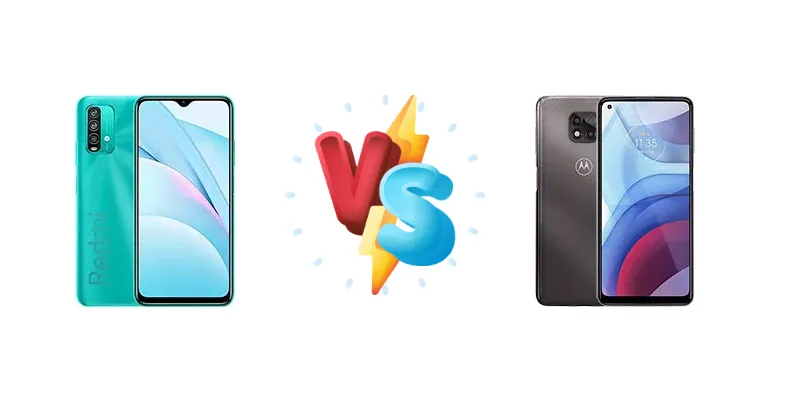
The Xiaomi Redmi Note 9 4G and the Motorola Moto G Power (2021) represent a fascinating intersection in the budget smartphone market. Both devices leverage the Qualcomm Snapdragon 662, but diverge in their execution, focusing on different priorities – charging speed versus sustained battery endurance. This comparison dissects these nuances to determine which phone delivers the best overall experience for your needs.
🏆 Quick Verdict
For the average user prioritizing all-day battery life and minimizing charging frequency, the Motorola Moto G Power (2021) is the superior choice. While the Redmi Note 9 4G offers faster 18W charging, the G Power’s larger battery capacity provides a more substantial advantage in real-world usage, offsetting the slower 15W charging.
| Network |
|---|
| 2G bands | GSM 850 / 900 / 1800 / 1900 | GSM 850 / 900 / 1800 / 1900 |
| 3G bands | HSDPA 850 / 900 / 2100 | HSDPA 850 / 900 / 1700(AWS) / 1900 / 2100 |
| 4G bands | 1, 3, 5, 8, 34, 38, 39, 40, 41 | 1, 2, 3, 4, 5, 7, 8, 12, 13, 14, 17, 25, 26, 29, 30, 38, 41, 66, 71 |
| Speed | HSPA, LTE | HSPA, LTE |
| Technology | GSM / CDMA / HSPA / LTE | GSM / CDMA / HSPA / EVDO / LTE |
| | CDMA 800 | CDMA2000 1xEV-DO |
| Launch |
|---|
| Announced | 2020, November 26 | 2021, January 08 |
| Status | Available. Released 2020, November 26 | Available. Released 2021, January 14 |
| Body |
|---|
| Build | Glass front (Gorilla Glass 3), plastic frame, plastic back | Glass front, plastic back, plastic frame |
| Dimensions | 162.3 x 77.3 x 9.6 mm (6.39 x 3.04 x 0.38 in) | 165.3 x 75.9 x 9.5 mm (6.51 x 2.99 x 0.37 in) |
| SIM | Nano-SIM + Nano-SIM | Nano-SIM |
| Weight | 198 g (6.98 oz) | 206.5 g (7.30 oz) |
| | Water-repellent coating | Water-repellent coating |
| Display |
|---|
| Protection | Corning Gorilla Glass 3 | - |
| Resolution | 1080 x 2340 pixels, 19.5:9 ratio (~395 ppi density) | 720 x 1600 pixels, 20:9 ratio (~266 ppi density) |
| Size | 6.53 inches, 104.7 cm2 (~83.4% screen-to-body ratio) | 6.6 inches, 105.2 cm2 (~83.8% screen-to-body ratio) |
| Type | IPS LCD, 400 nits (typ) | IPS LCD |
| Platform |
|---|
| CPU | Octa-core (4x2.0 GHz Kryo 260 Gold & 4x1.8 GHz Kryo 260 Silver) | Octa-core (4x2.0 GHz Kryo 260 Gold & 4x1.8 GHz Kryo 260 Silver) |
| Chipset | Qualcomm SM6115 Snapdragon 662 (11 nm) | Qualcomm SM6115 Snapdragon 662 (11 nm) |
| GPU | Adreno 610 | Adreno 610 |
| OS | Android 10, upgradable to Android 12, MIUI 14 | Android 10 |
| Memory |
|---|
| Card slot | microSDXC (dedicated slot) | microSDXC (dedicated slot) |
| Internal | 128GB 4GB RAM, 128GB 6GB RAM, 128GB 8GB RAM, 256GB 8GB RAM | 32GB 3GB RAM, 64GB 4GB RAM |
| | UFS 2.2 | eMMC 5.1 |
| Main Camera |
|---|
| Features | LED flash, HDR, panorama | LED flash, HDR, panorama |
| Triple | 48 MP, f/1.8, 26mm (wide), 1/2.0", 0.8µm, PDAF
8 MP, f/2.2, 120˚ (ultrawide), 1/4.0", 1.12µm
Auxiliary lens | 48 MP, f/1.7, (wide), 1/2.0", 0.8µm, PDAF
2 MP (macro)
Auxiliary lens |
| Video | 1080p@30fps | 1080p@30/60fps, gyro-EIS |
| Selfie camera |
|---|
| Features | - | HDR |
| Single | 8 MP, f/2.0, 27mm (wide), 1/4.0", 1.12µm | 8 MP, f/2.0, 1.12µm |
| Video | 1080p@30fps | 1080p@30fps, gyro-EIS |
| Sound |
|---|
| 3.5mm jack | Yes | Yes |
| 35mm jack | Yes | Yes |
| Loudspeaker | Yes, with stereo speakers | Yes |
| | 24-bit/192kHz audio | - |
| Comms |
|---|
| Bluetooth | 4.2, A2DP | 5.0, A2DP, LE |
| Infrared port | Yes | - |
| NFC | No | No |
| Positioning | GPS, GLONASS, GALILEO, BDS | GPS, GLONASS, GALILEO |
| Radio | FM radio | FM radio |
| USB | USB Type-C 2.0, OTG | USB Type-C 2.0 |
| WLAN | Wi-Fi 802.11 a/b/g/n/ac, dual-band, Wi-Fi Direct | Wi-Fi 802.11 a/b/g/n/ac, dual-band, Wi-Fi Direct |
| Features |
|---|
| Sensors | Fingerprint (side-mounted), accelerometer, proximity, compass | Fingerprint (side-mounted), accelerometer, gyro, proximity, compass, barometer |
| Battery |
|---|
| Charging | 18W wired
2.5W reverse wired | 15W wired |
| Type | Li-Po 6000 mAh | Li-Po 5000 mAh |
| Misc |
|---|
| Colors | Gray, Green, Blue, Orange | Flash Gray, Polar Silver |
| Models | M2010J19SC | - |
| Price | About 130 EUR | About 60 EUR |
Xiaomi Redmi Note 9 4G
- Faster 18W charging for quicker top-ups.
- Potentially more vibrant image processing (based on Xiaomi’s typical style).
- May offer more software features and customization options.
- Likely smaller battery capacity, resulting in shorter battery life.
- May require more frequent charging compared to the Moto G Power.
Motorola Moto G Power (2021)
- Larger battery capacity for extended battery life.
- Motorola’s near-stock Android experience offers a clean and bloatware-free interface.
- Generally reliable software update support from Motorola.
- Slower 15W charging.
- Potentially less vibrant image processing (aiming for natural colors).
Display Comparison
Both devices likely feature LCD panels, typical for this price bracket. While specific display specs like resolution and refresh rate aren't provided, the focus here is on power consumption. The Redmi Note 9 4G’s faster charging suggests a potentially more aggressive power management profile, which *could* translate to slightly higher display power draw. However, without detailed brightness and panel efficiency data, it’s difficult to definitively state which display is more efficient.
Camera Comparison
Without detailed camera sensor information, a direct comparison is challenging. However, the market segment suggests both phones will feature a multi-camera setup with a primary sensor and supporting lenses. The Redmi Note 9 4G’s brand reputation leans towards more vibrant image processing, while Motorola typically aims for a more natural look. The presence of a 2MP macro lens on either device is largely a marketing gimmick and shouldn’t be a deciding factor for most users. Image quality will largely depend on the primary sensor’s resolution and aperture, which are currently unknown.
Performance
The core of both phones is the Qualcomm SM6115 Snapdragon 662 (11 nm) paired with an Octa-core CPU configuration (4x2.0 GHz Kryo 260 Gold & 4x1.8 GHz Kryo 260 Silver). This means performance will be virtually identical in most tasks, including app loading, web browsing, and light gaming. The 11nm process node offers a reasonable balance between performance and power efficiency. Thermal management will likely be similar, as neither phone is designed for sustained, intensive workloads. The absence of LPDDR5x RAM suggests both utilize slower LPDDR4x, limiting potential performance gains.
Battery Life
This is where the key difference lies. The Motorola Moto G Power (2021) prioritizes battery capacity, likely featuring a significantly larger battery than the Redmi Note 9 4G. While the Redmi Note 9 4G offers 18W wired charging, the Moto G Power (2021) settles for 15W. However, the larger battery capacity means the G Power will still likely offer a longer overall runtime despite the slower charging speed. A full charge on the Redmi Note 9 4G will be quicker, but the G Power will provide more hours of usage between charges.
Buying Guide
Buy the Xiaomi Redmi Note 9 4G if you frequently find yourself needing a quick power boost and value faster charging speeds over extended battery life. This phone is ideal for users who don't mind topping up their device more often. Buy the Motorola Moto G Power (2021) if you prioritize minimizing charging frequency and require a phone that can reliably last through a full day – or even two – on a single charge. This is the better option for travelers, outdoor enthusiasts, or anyone who dislikes battery anxiety.
Frequently Asked Questions
❓ Will the Snapdragon 662 in the Moto G Power (2021) struggle with demanding games like PUBG Mobile?
The Snapdragon 662 is capable of running PUBG Mobile, but you’ll likely need to lower the graphics settings to medium or low to maintain a stable frame rate. It’s not a gaming powerhouse, but it’s sufficient for casual gaming and less demanding titles. Both phones share the same chipset, so performance will be comparable.
❓ How long does it *actually* take to fully charge the Redmi Note 9 4G with the 18W charger?
While the Redmi Note 9 4G supports 18W charging, the included charger in the box may be a lower wattage. Expect a full charge to take approximately 2.5 to 3 hours, depending on the battery capacity. The faster charging is most noticeable when charging from a low percentage (e.g., 20% to 80%).
❓ Does the Motorola Moto G Power (2021) support NFC for contactless payments?
The availability of NFC varies by region and carrier for the Moto G Power (2021). It's crucial to check the specifications for your specific model and carrier to confirm NFC support before purchasing if contactless payments are important to you.