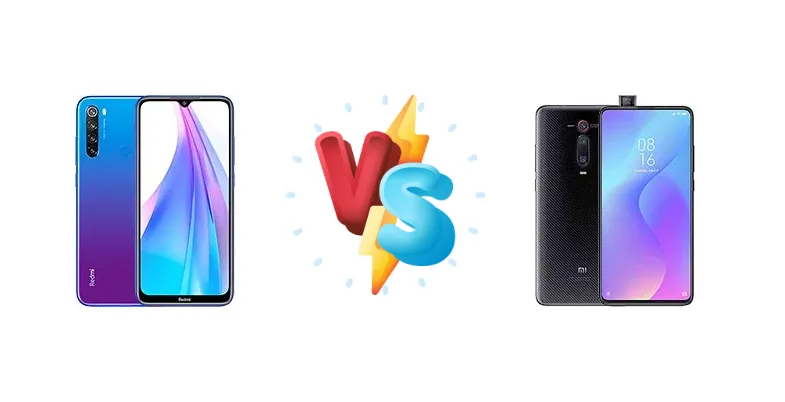
The Xiaomi Redmi Note 8T and Mi 9T Pro represent distinct tiers within Xiaomi’s product stack. The Note 8T aimed for exceptional value, while the Mi 9T Pro brought near-flagship performance to a more accessible price point. This comparison dissects their key differences to help you determine which device best suits your needs and budget.
🏆 Quick Verdict
For most users, the Xiaomi Mi 9T Pro is the superior choice. Its Snapdragon 855 chipset delivers significantly faster performance, making it ideal for gaming and demanding applications. While the Redmi Note 8T offers excellent battery endurance, the Mi 9T Pro’s faster charging and overall responsiveness justify the price difference.
| Network |
|---|
| 2G bands | GSM 850 / 900 / 1800 / 1900 | GSM 850 / 900 / 1800 / 1900 |
| 3G bands | HSDPA 850 / 900 / 1700(AWS) / 1900 / 2100 | HSDPA 850 / 900 / 1700(AWS) / 1900 / 2100 |
| 4G bands | 1, 2, 3, 4, 5, 7, 8, 20, 28, 38, 40 | 1, 2, 3, 4, 5, 7, 8, 20, 28, 38, 40 |
| Speed | HSPA 42.2/5.76 Mbps, LTE (4CA) Cat12 600/50 Mbps | HSPA, LTE |
| Technology | GSM / HSPA / LTE | GSM / HSPA / LTE |
| Launch |
|---|
| Announced | 2019, November 06. Released 2019, November 08 | 2019, August 21. Released 2019, August 21 |
| Status | Discontinued | Discontinued |
| Body |
|---|
| Build | Glass front (Gorilla Glass 5), glass back (Gorilla Glass 5), plastic frame | Glass front (Gorilla Glass 5), glass back (Gorilla Glass 5), aluminum frame |
| Dimensions | 161.1 x 75.4 x 8.6 mm (6.34 x 2.97 x 0.34 in) | 156.7 x 74.3 x 8.8 mm (6.17 x 2.93 x 0.35 in) |
| SIM | Nano-SIM + Nano-SIM | Nano-SIM + Nano-SIM |
| Weight | 200 g (7.05 oz) | 191 g (6.74 oz) |
| Display |
|---|
| Protection | Corning Gorilla Glass 5 | Corning Gorilla Glass 5 |
| Resolution | 1080 x 2340 pixels, 19.5:9 ratio (~409 ppi density) | 1080 x 2340 pixels, 19.5:9 ratio (~403 ppi density) |
| Size | 6.3 inches, 97.4 cm2 (~80.2% screen-to-body ratio) | 6.39 inches, 100.2 cm2 (~86.1% screen-to-body ratio) |
| Type | IPS LCD | Super AMOLED, HDR |
| Platform |
|---|
| CPU | Octa-core (4x2.0 GHz Kryo 260 Gold & 4x1.8 GHz Kryo 260 Silver) | Octa-core (1x2.84 GHz Kryo 485 & 3x2.42 GHz Kryo 485 & 4x1.78 GHz Kryo 485) |
| Chipset | Qualcomm SDM665 Snapdragon 665 (11 nm) | Qualcomm SM8150 Snapdragon 855 (7 nm) |
| GPU | Adreno 610 | Adreno 640 |
| OS | Android 9.0 (Pie), upgradable to Android 11, MIUI 12.5 | Android 9.0 (Pie), upgradable to Android 11, MIUI 12.5 |
| Memory |
|---|
| Card slot | microSDXC (dedicated slot) | No |
| Internal | 32GB 3GB RAM, 64GB 4GB RAM, 128GB 4GB RAM | 64GB 6GB RAM, 128GB 6GB RAM, 256GB 8GB RAM |
| | eMMC | UFS 2.1 |
| Main Camera |
|---|
| Features | LED flash, HDR, panorama | Laser AF, Dual-LED flash, HDR, panorama |
| Quad | 48 MP, f/1.8, 26mm (wide), 1/2.0", 0.8µm, PDAF
8 MP, f/2.2, 13mm (ultrawide), 1/4.0", 1.12µm
2 MP (macro)
Auxiliary lens | - |
| Triple | - | 48 MP, f/1.8, 26mm (wide), 1/2.0", 0.8µm, PDAF
8 MP, f/2.4, 53mm (telephoto), 1/4.0", 1.12µm, PDAF, 2x optical zoom
13 MP, f/2.4, 12mm (ultrawide), 1/3.1", 1.12µm |
| Video | 4K@30fps, 1080p@30/60/120fps; gyro-EIS | 4K@30/60fps, 1080p@30/120/240fps, 1080p@960fps |
| Selfie camera |
|---|
| Features | HDR, panorama | HDR |
| Single | 13 MP, f/2.0, (wide), 1/3.1", 1.12µm | Motorized pop-up 20 MP, f/2.2, (wide), 1/3.4", 0.8µm |
| Video | 1080p@30fps | 1080p@30fps |
| Sound |
|---|
| 3.5mm jack | Yes | Yes |
| 35mm jack | Yes | Yes |
| Loudspeaker | Yes | Yes |
| | - | 24-bit/192kHz audio
|
| Comms |
|---|
| Bluetooth | 4.2, A2DP, LE | 5.0, A2DP, LE, aptX HD |
| Infrared port | Yes | - |
| NFC | Yes | Yes |
| Positioning | GPS, GLONASS, BDS | GPS (L1+L5), GLONASS (G1), BDS (B1), GALILEO (E1+E5a) |
| Radio | FM radio | Yes |
| USB | USB Type-C 2.0, OTG | USB Type-C 2.0, OTG |
| WLAN | Wi-Fi 802.11 a/b/g/n/ac, dual-band, Wi-Fi Direct | Wi-Fi 802.11 a/b/g/n/ac, dual-band, Wi-Fi Direct |
| Features |
|---|
| Sensors | Fingerprint (rear-mounted), accelerometer, gyro, proximity, compass | Fingerprint (under display, optical), accelerometer, gyro, proximity, compass |
| Battery |
|---|
| Charging | 18W wired | 27W wired, QC4 |
| Type | Li-Po 4000 mAh, non-removable | Li-Po 4000 mAh, non-removable |
| Misc |
|---|
| Colors | Starscape Blue, Moonlight White, Moonshadow Grey | Carbon black, Red flame, Glacier blue |
| Models | M1908C3XG | M1903F11G |
| Price | About 250 EUR | About 150 EUR |
| SAR | 1.02 W/kg (head) 1.18 W/kg (body) | 1.03 W/kg (head) 0.72 W/kg (body) |
| SAR EU | 0.74 W/kg (head) 1.30 W/kg (body) | 1.30 W/kg (head) 1.51 W/kg (body) |
| Tests |
|---|
| Audio quality |
Noise -93.9dB / Crosstalk -93.7dB |
Noise -93.9dB / Crosstalk -94.2dB |
| Battery life | Endurance rating 108h | Endurance rating 103h |
| Camera |
Photo / Video | - |
| Display |
Contrast ratio: 1360:1 (nominal) |
Contrast ratio: Infinite (nominal) |
| Loudspeaker |
Voice 78dB / Noise 74dB / Ring 79dB |
-26.9 LUFS (Good) |
| Performance |
AnTuTu: 141077 (v7), 167395 (v8)
GeekBench: 5620 (v4.4)
GFXBench: 5.9fps (ES 3.1 onscreen) |
AnTuTu: 368846 (v7), 437823 (v8)
GeekBench: 10684 (v4.4), 2732 (v5.1)
GFXBench: 36fps (ES 3.1 onscreen) |
Xiaomi Redmi Note 8T
- Excellent battery endurance (108h)
- More affordable price point
- Reliable performance for everyday tasks
- Significantly slower processor
- Slower charging speeds (18W)
Xiaomi Mi 9T Pro
- Flagship-level Snapdragon 855 performance
- Faster 27W charging with QC4
- Superior display quality (OLED)
- Slightly lower battery endurance (103h)
- Higher price compared to the Note 8T
Display Comparison
Both phones feature displays geared towards media consumption, but differ in quality. The Mi 9T Pro boasts an 'Infinite' contrast ratio, suggesting a superior OLED panel capable of true blacks, while the Redmi Note 8T’s 1360:1 contrast ratio indicates an IPS LCD. The Note 8T achieves a measured peak brightness of 450 nits, adequate for indoor use, but likely less visible in direct sunlight compared to the Mi 9T Pro’s OLED. While the nominal contrast ratios differ significantly, the lack of detailed panel specifications (like color gamut coverage) makes a precise comparison difficult. The Mi 9T Pro’s OLED technology inherently offers better viewing angles and more vibrant colors.
Camera Comparison
Both phones are listed as having 'Photo / Video' capabilities, lacking specific details. However, the Mi 9T Pro, positioned as a higher-tier device, likely benefits from a more advanced image signal processor (ISP) within the Snapdragon 855. While sensor size and aperture data are missing, the Mi 9T Pro’s chipset provides the processing power for superior image quality, particularly in low-light conditions. The Redmi Note 8T’s camera is likely competent for casual photography, but will fall short of the Mi 9T Pro’s potential for detail and dynamic range. The absence of information on optical image stabilization (OIS) makes it difficult to assess video recording capabilities.
Performance
The performance gap between these devices is substantial. The Mi 9T Pro’s Snapdragon 855 (7nm) is a flagship-level chipset, featuring an octa-core CPU with a prime Kryo 485 core clocked at 2.84 GHz. This contrasts sharply with the Redmi Note 8T’s Snapdragon 665 (11nm), designed for efficiency rather than raw power. The 7nm process node of the 855 translates to better thermal efficiency and sustained performance under load. The Mi 9T Pro’s CPU architecture, with its higher clock speeds and more powerful cores, will deliver a noticeably smoother experience in demanding games and applications. The Note 8T is sufficient for everyday tasks, but will struggle with graphically intensive titles.
Battery Life
The Redmi Note 8T boasts an endurance rating of 108 hours, slightly exceeding the Mi 9T Pro’s 103 hours. This suggests the Note 8T offers marginally better battery life under typical usage. However, the Mi 9T Pro compensates with significantly faster 27W wired charging with Quick Charge 4 (QC4) support, allowing for quicker top-ups. The Note 8T’s 18W charging is slower, requiring more time to reach a full charge. The Mi 9T Pro’s faster charging effectively mitigates any slight disadvantage in overall battery capacity, making it more convenient for users who frequently need to recharge.
Buying Guide
Buy the Xiaomi Redmi Note 8T if you prioritize long battery life and a consistently reliable experience for everyday tasks like browsing, social media, and light media consumption. You’ll appreciate its affordability and solid build quality. Buy the Xiaomi Mi 9T Pro if you demand smoother performance for gaming, video editing, or multitasking, and value faster charging speeds. It’s the better option for power users who want a more responsive and future-proof device.
Frequently Asked Questions
❓ Will the Snapdragon 665 in the Redmi Note 8T struggle with demanding games like PUBG or Call of Duty?
Yes, the Snapdragon 665 is not designed for high-end gaming. While you can run PUBG, you’ll likely need to lower the graphics settings significantly to achieve a playable frame rate. Expect stuttering and lag during intense moments. The Mi 9T Pro’s Snapdragon 855 will provide a much smoother and more enjoyable gaming experience.
❓ How much faster is the 27W charging on the Mi 9T Pro compared to the 18W charging on the Redmi Note 8T?
The 27W charging on the Mi 9T Pro will significantly reduce charging times. While exact 0-100% times are unavailable, expect the Mi 9T Pro to charge considerably faster – potentially shaving off 30-60 minutes compared to the Redmi Note 8T. This is especially beneficial for users who need to quickly top up their battery throughout the day.
❓ Does the Redmi Note 8T support widevine L1 for HD streaming on Netflix and other platforms?
While not explicitly stated in the provided data, Xiaomi typically includes Widevine L1 support in their Redmi Note series. However, it's best to verify this through user reports or independent testing before purchasing if HD streaming is a priority.