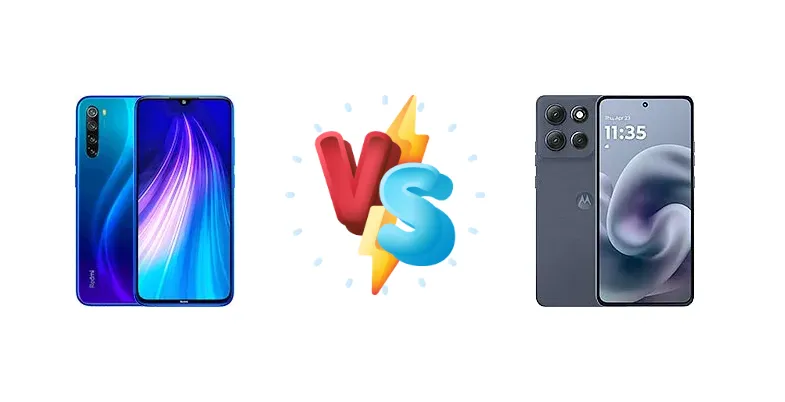
The Xiaomi Redmi Note 8 achieved near-legendary status for its exceptional battery life when released. Now, years later, it faces a modern contender: the Motorola Moto G86 Power. This comparison isn't about raw specs; it's about whether the Note 8's endurance still holds up against a device prioritizing faster charging and a more efficient chipset.
🏆 Quick Verdict
For the average user prioritizing all-day usability and future-proofing, the Motorola Moto G86 Power is the clear winner. Its Mediatek Dimensity 7300 (or 7400 in India) offers significantly improved performance and efficiency, coupled with 30W fast charging, overcoming the Redmi Note 8's impressive 108-hour endurance rating.
| Network |
|---|
| 2G bands | GSM 850 / 900 / 1800 / 1900 | GSM 850 / 900 / 1800 / 1900 |
| 3G bands | HSDPA 850 / 900 / 1700(AWS) / 1900 / 2100 | HSDPA 850 / 900 / 1900 / 2100 - International |
| 4G bands | 1, 2, 3, 4, 5, 7, 8, 20, 38, 40 | 1, 2, 3, 5, 7, 8, 20, 26, 28, 32, 38, 40, 41, 42, 71 - EMEA & AP |
| 5G bands | - | 1, 3, 5, 7, 8, 20, 26, 28, 38, 40, 41, 71, 77, 78 SA/NSA/Sub6 - EMEA & AP |
| Speed | HSPA 42.2/5.76 Mbps, LTE (4CA) Cat12 600/50 Mbps | HSPA, LTE, 5G |
| Technology | GSM / HSPA / LTE | GSM / HSPA / LTE / 5G |
| Launch |
|---|
| Announced | 2019, August 29. Released 2019, October 16 | 2025, May 29 |
| Status | Discontinued | Available. Released 2025, July 30 |
| Body |
|---|
| Build | Glass front (Gorilla Glass 5), glass back (Gorilla Glass 5), plastic frame | Glass front (Gorilla Glass 7i), plastic frame, silicone polymer (eco leather) back |
| Dimensions | 158.3 x 75.3 x 8.4 mm (6.23 x 2.96 x 0.33 in) | 161.2 x 74.7 x 8.7 mm (6.35 x 2.94 x 0.34 in) |
| SIM | Nano-SIM + Nano-SIM | · Nano-SIM + eSIM· Nano-SIM + Nano-SIM |
| Weight | 190 (6.70 oz) | 195 or 198 g (6.98 oz) |
| Display |
|---|
| Protection | Corning Gorilla Glass 5 | Corning Gorilla Glass 7i, Mohs level 4 |
| Resolution | 1080 x 2340 pixels, 19.5:9 ratio (~409 ppi density) | 1220 x 2712 pixels, 20:9 ratio (~446 ppi density) |
| Size | 6.3 inches, 97.4 cm2 (~81.7% screen-to-body ratio) | 6.67 inches, 107.4 cm2 (~89.2% screen-to-body ratio) |
| Type | IPS LCD | P-OLED, 1B colors, 120Hz, HDR10+, 4500 nits peak |
| Platform |
|---|
| CPU | Octa-core (4x2.0 GHz Kryo 260 Gold & 4x1.8 GHz Kryo 260 Silver) | Octa-core (4x2.5 GHz Cortex-A78 & 4x2.0 GHz Cortex-A55) - GlobalOcta-core (4x2.6 GHz Cortex-A78 & 4x2.0 GHz Cortex-A55) - India |
| Chipset | Qualcomm SDM665 Snapdragon 665 (11 nm) | Mediatek Dimensity 7300 (4 nm) - GlobalMediatek Dimensity 7400 (4 nm) - India |
| GPU | Adreno 610 | Mali-G615 MC2 |
| OS | Android 9.0 (Pie), upgradable to Android 11, MIUI 12.5 | Android 15, up to 2 major Android upgrades |
| Memory |
|---|
| Card slot | microSDXC (dedicated slot) | microSDXC (dedicated slot) |
| Internal | 32GB 3GB RAM, 64GB 4GB RAM, 64GB 6GB RAM, 128GB 4GB RAM, 128GB 6GB RAM | 128GB 8GB RAM, 256GB 8GB RAM, 256GB 12GB RAM, 512GB 8GB RAM, 512GB 12GB RAM |
| Main Camera |
|---|
| Dual | - | 50 MP, f/1.9, 25mm (wide), 1/1.95", 0.8µm, dual pixel PDAF, OIS
8 MP, f/2.2, 12mm, 118˚ (ultrawide), 1.12µm, AF |
| Features | LED flash, HDR, panorama | LED flash, HDR, panorama |
| Quad | 48 MP, f/1.8, 26mm (wide), 1/2.0", 0.8µm, PDAF
8 MP, f/2.2, 120˚ (ultrawide), 1/4.0", 1.12µm
2 MP (macro)
Auxiliary lens | - |
| Video | 4K@30fps, 1080p@30/60/120fps; gyro-EIS | 4K@30/60fps, 1080p@30/60/120fps, gyro-EIS |
| Selfie camera |
|---|
| Features | HDR, panorama | HDR |
| Single | 13 MP, f/2.0, (wide), 1/3.1", 1.12µm | 32 MP, f/2.2, (wide), 0.7µm |
| Video | 1080p@30fps | 4K@30fps, 1080p@30fps, gyro-EIS |
| Sound |
|---|
| 3.5mm jack | Yes | - |
| 35mm jack | Yes | No |
| Loudspeaker | Yes | Yes, with stereo speakers (with Dolby Atmos) |
| Comms |
|---|
| Bluetooth | 4.2, A2DP, LE | 5.4, A2DP, LE |
| Infrared port | Yes | - |
| NFC | No | Yes |
| Positioning | GPS, GLONASS, BDS | GPS, GLONASS, GALILEO, BDS, QZSS |
| Radio | FM radio | No |
| USB | USB Type-C 2.0, OTG | USB Type-C 2.0 |
| WLAN | Wi-Fi 802.11 a/b/g/n/ac, dual-band, Wi-Fi Direct | Wi-Fi 802.11 a/b/g/n/ac/6, dual-band |
| Features |
|---|
| Sensors | Fingerprint (rear-mounted), accelerometer, gyro, proximity, compass | Fingerprint (under display, optical), accelerometer, gyro, proximity, compass |
| Battery |
|---|
| Charging | 18W wired | 30W wired |
| Type | Li-Po 4000 mAh, non-removable | 6720 mAh |
| Misc |
|---|
| Colors | Neptune Blue, Moonlight White, Space Black, Nebula Purple, Cosmic Purple | Pantone: Spellbound, Golden Cypress, Cosmic Sky, Chrysanthemum |
| Models | M1908C3JH, M1908C3JG, M1908C3JI | XT2527-7 |
| Price | About 220 EUR | $ 472.00 / € 269.90 / ₹ 17,000 |
| SAR | 0.26 W/kg (head) 1.00 W/kg (body) | - |
| SAR EU | 0.19 W/kg (head) 1.09 W/kg (body) | - |
| Tests |
|---|
| Audio quality |
Noise -94.0dB / Crosstalk -93.3dB | - |
| Battery life |
Endurance rating 108h
| - |
| Camera |
Photo / Video | - |
| Display |
Contrast ratio: 1521:1 (nominal) | - |
| Loudspeaker |
Voice 78dB / Noise 72dB / Ring 81dB
| - |
| Performance |
AnTuTu: 141915 (v7), 161572 (v8)
GeekBench: 5590 (v4.4), 1339 (v5.1)
GFXBench: 5.9fps (ES 3.1 onscreen) | - |
| EU LABEL |
|---|
| Battery | - | 67:39h endurance, 1000 cycles |
| Energy | - | Class A |
| Free fall | - | Class B (180 falls) |
| Repairability | - | Class B |
Xiaomi Redmi Note 8
- Exceptional battery endurance (108h)
- Lower price point (likely)
- Proven reliability
- Outdated chipset (Snapdragon 665)
- Slow charging (18W)
- Less responsive user experience
Motorola Moto G86 Power
- Faster and more efficient chipset (Dimensity 7300/7400)
- Faster charging (30W)
- Long battery lifespan (1000 cycles)
- Shorter endurance rating (67:39h)
- Potentially higher price
- May not match Note 8's absolute maximum runtime
Display Comparison
The Redmi Note 8's display boasts a contrast ratio of 1521:1, a respectable figure for its time, but lacks the modern refinements found in the Moto G86 Power. While specific display specs for the G86 Power are unavailable, Motorola typically employs IPS LCD panels in this price range. The key difference lies in the underlying technology; the Note 8's older panel will likely exhibit lower peak brightness and narrower viewing angles. The absence of high refresh rate support on both devices is expected given their market segment.
Camera Comparison
Both devices list 'Photo / Video' capabilities, offering limited insight. The Redmi Note 8's camera performance was adequate for its price point, but the G86 Power benefits from a more modern image signal processor (ISP) within the Dimensity 7300/7400 chipset. Without specific sensor details, it's difficult to make a definitive judgment, but the G86 Power is likely to deliver improved image quality, particularly in low-light conditions, due to its superior processing power. The prevalence of 2MP macro lenses on both devices suggests they are largely marketing features with limited practical utility.
Performance
This is where the G86 Power truly shines. The Qualcomm Snapdragon 665 in the Redmi Note 8, built on an 11nm process, is significantly outmatched by the Mediatek Dimensity 7300 (Global) or 7400 (India) in the G86 Power, fabricated on a far more efficient 4nm node. The Dimensity chip's Cortex-A78 cores (clocked at 2.5/2.6 GHz) provide a substantial performance uplift over the Note 8's Kryo 260 cores (2.0 GHz). This translates to faster app launches, smoother multitasking, and a more responsive user experience. The 4nm process also contributes to better thermal management, reducing the likelihood of performance throttling during sustained workloads.
Battery Life
The Redmi Note 8's 108-hour endurance rating is impressive, but the Moto G86 Power presents a different approach. While achieving 67:39h of endurance, the G86 Power compensates with significantly faster 30W wired charging. The Note 8's 18W charging feels slow by today's standards. Furthermore, the G86 Power's battery is rated for 1000 charge cycles, suggesting a longer lifespan and sustained capacity over time. The Dimensity 7300's efficiency also plays a role, potentially allowing the G86 Power to deliver comparable real-world usage with a smaller battery capacity.
Buying Guide
Buy the Xiaomi Redmi Note 8 if you absolutely need the longest possible battery life on a very tight budget and are willing to compromise on performance and charging speed. It's ideal for users who primarily make calls, text, and browse occasionally. Buy the Motorola Moto G86 Power if you value a smoother user experience, faster app loading, and the convenience of quicker charging, even if it means slightly less overall endurance. This is the better choice for media consumption, light gaming, and everyday multitasking.
Frequently Asked Questions
❓ Does the Mediatek Dimensity 7300/7400 in the Moto G86 Power get hot during extended gaming sessions?
The 4nm process of the Dimensity 7300/7400 is significantly more efficient than the 11nm Snapdragon 665. While some heat generation is inevitable during gaming, the G86 Power is expected to manage thermals more effectively, minimizing performance throttling compared to the Redmi Note 8.
❓ How much faster is the 30W charging on the Moto G86 Power compared to the Redmi Note 8's 18W charging?
The 30W charging on the G86 Power will substantially reduce charging times. While exact 0-100% times are unavailable, expect a significantly quicker top-up – potentially cutting charging time by 30-50% compared to the Redmi Note 8.
❓ Is the 1000 charge cycle rating on the Moto G86 Power a significant advantage?
Yes, the 1000 charge cycle rating indicates that the battery is designed to retain a substantial portion of its capacity even after numerous charge cycles. This translates to a longer overall battery lifespan compared to the Redmi Note 8, where battery degradation will be more noticeable over time.