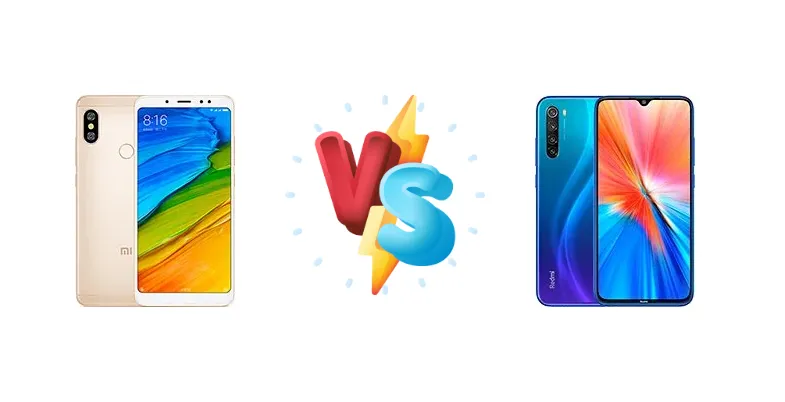
The Xiaomi Redmi series consistently delivers impressive value in the budget smartphone market. Today, we're pitting two popular contenders against each other: the Redmi Note 5 AI Dual Camera and the Redmi Note 8 2021. Which one offers the best blend of features and performance for your needs?
🏆 Quick Verdict
The Redmi Note 8 2021 edges out the Note 5 AI thanks to its slightly better battery life, brighter display, and more modern chipset. While the Note 5 AI boasts exceptional sunlight visibility, the Note 8 2021’s overall improvements make it the more compelling choice for most users.
| Network |
|---|
| 2G bands | GSM 850 / 900 / 1800 / 1900 | GSM 850 / 900 / 1800 / 1900 |
| 3G bands | HSDPA 850 / 900 / 1900 / 2100 | HSDPA 850 / 900 / 1700(AWS) / 1900 / 2100 |
| 4G bands | 1, 3, 5, 7, 8, 34, 38, 39, 40, 41 - China | 1, 2, 3, 4, 5, 7, 8, 20, 28, 38, 40 |
| Speed | HSPA, LTE | HSPA, LTE |
| Technology | GSM / CDMA / HSPA / LTE | GSM / HSPA / LTE |
| | 1, 2, 3, 4, 5, 7, 8, 20, 28, 38, 40 - Taiwan | - |
| Launch |
|---|
| Announced | 2018, March. Released 2018, March | 2021, May 25 |
| Status | Discontinued | Available. Released 2021, May 27 |
| Body |
|---|
| Build | Glass front (Gorilla Glass), aluminum back, aluminum frame | Glass front (Gorilla Glass 5), glass back (Gorilla Glass 5), plastic frame |
| Dimensions | 158.6 x 75.4 x 8.1 mm (6.24 x 2.97 x 0.32 in) | 158.3 x 75.3 x 8.4 mm (6.23 x 2.96 x 0.33 in) |
| SIM | Nano-SIM + Nano-SIM | Nano-SIM + Nano-SIM |
| Weight | 181 g (6.38 oz) | 190 g (6.70 oz) |
| Display |
|---|
| Protection | Corning Gorilla Glass (unspecified version) | Corning Gorilla Glass 5 |
| Resolution | 1080 x 2160 pixels, 18:9 ratio (~403 ppi density) | 1080 x 2340 pixels, 19.5:9 ratio (~409 ppi density) |
| Size | 5.99 inches, 92.6 cm2 (~77.4% screen-to-body ratio) | 6.3 inches, 97.4 cm2 (~81.7% screen-to-body ratio) |
| Type | IPS LCD | IPS LCD, 500 nits (typ) |
| Platform |
|---|
| CPU | Octa-core (4x1.8 GHz Kryo 260 Gold & 4x1.6 GHz Kryo 260 Silver) | Octa-core (2x2.0 GHz Cortex-A75 & 6x1.8 GHz Cortex-A55) |
| Chipset | Qualcomm SDM636 Snapdragon 636 (14 nm) | Mediatek MT6769Z Helio G85 (12 nm) |
| GPU | Adreno 509 | Mali-G52 MC2 |
| OS | Android 8.0 (Oreo), MIUI 9 | Android 11, MIUI 12.5 |
| Memory |
|---|
| Card slot | microSDXC (uses shared SIM slot) | microSDXC (dedicated slot) |
| Internal | 32GB 3GB RAM, 64GB 4GB RAM, 64GB 6GB RAM | 64GB 3GB RAM, 64GB 4GB RAM, 128GB 4GB RAM |
| | eMMC 5.1 | eMMC 5.1 |
| Main Camera |
|---|
| Dual | 12 MP, f/1.9, 1/2.55", 1.4µm, dual pixel PDAF
Auxiliary lens | - |
| Features | Dual-LED flash, panorama, HDR | LED flash, HDR, panorama |
| Quad | - | 48 MP, f/1.8, 26mm (wide), 1/2.0", 0.8µm, PDAF
8 MP, f/2.2, 120˚ (ultrawide), 1/4.0", 1.12µm
2 MP (macro)
Auxiliary lens |
| Single | - | 13 MP, f/2.0, (wide), 1/3.1", 1.12µm |
| Video | 1080p@30fps | 1080p@30/120fps; gyro-EIS |
| Selfie camera |
|---|
| Features | LED flash | HDR, panorama |
| Single | 13 MP, f/2.0, (wide), 1/3.1", 1.12µm | 13 MP, f/2.0, (wide), 1/3.1", 1.12µm |
| Video | 1080p@30fps | 1080p@30fps |
| Sound |
|---|
| 3.5mm jack | Yes | Yes |
| 35mm jack | Yes | Yes |
| Loudspeaker | Yes | Yes |
| Comms |
|---|
| Bluetooth | 5.0, A2DP, LE | 5.2, A2DP, LE |
| Infrared port | Yes | Yes |
| NFC | No | No |
| Positioning | GPS, GLONASS, BDS | GPS, GLONASS, GALILEO, BDS |
| Radio | FM radio | FM radio |
| USB | microUSB 2.0 | USB Type-C 2.0, OTG |
| WLAN | Wi-Fi 802.11 a/b/g/n/ac, dual-band, Wi-Fi Direct | Wi-Fi 802.11 a/b/g/n/ac, dual-band, Wi-Fi Direct |
| Features |
|---|
| Sensors | Fingerprint (rear-mounted), accelerometer, gyro, proximity, compass | Fingerprint (rear-mounted), accelerometer, gyro, proximity, compass |
| Battery |
|---|
| Charging | 18W wired, QC3 | 18W wired |
| Type | Li-Po 4000 mAh, non-removable | Li-Po 4000 mAh |
| Misc |
|---|
| Colors | Black, Gold, Rose Gold, Blue, Flame Red | Neptune Blue, Moonlight White, Space Black |
| Models | M1803E7SG, M1803E7SH | M1908C3JGG |
| Price | About 180 EUR | About 160 EUR |
| SAR | 0.79 W/kg (head) 1.03 W/kg (body) | 0.97 W/kg (head) 0.75 W/kg (body) |
| SAR EU | - | 0.57 W/kg (head) 0.94 W/kg (body) |
| Tests |
|---|
| Audio quality |
Noise -89.4dB / Crosstalk -90.5dB | - |
| Battery life |
Endurance rating 92h
|
Endurance rating 102h
|
| Camera |
Photo / Video |
Photo / Video |
| Display |
Contrast ratio: 1893 (nominal), 3.393 (sunlight) |
Contrast ratio: 1487:1 (nominal) |
| Loudspeaker |
Voice 68dB / Noise 71dB / Ring 84dB
|
-28.6 LUFS (Average)
|
| Performance |
AnTuTu: 115195 (v7)
GeekBench: 4918 (v4.4)
GFXBench: 6fps (ES 3.1 onscreen) |
AnTuTu: 180195 (v8), 165779 (v9)
GeekBench: 5259 (v4.4), 1314 (v5.1)
GFXBench: 8.7fps (ES 3.1 onscreen) |
Xiaomi Redmi Note 5 AI Dual Camera
- Exceptional sunlight display visibility
- Long battery life (92h)
- Good value for money
- Older chipset
- Potentially less refined camera compared to Note 8
- Lower display brightness
Xiaomi Redmi Note 8 2021
- Brighter and more vibrant display (620 nits)
- More modern chipset (Helio G85)
- Slightly longer battery life (102h)
- Improved performance
- Contrast ratio slightly lower than Note 5 AI
- May not offer significant camera upgrade over older models
Display Comparison
The Redmi Note 8 2021 features a contrast ratio of 1487:1 and a measured peak brightness of 620 nits, offering a noticeably brighter and more vibrant display compared to the Note 5 AI's 1893:1 contrast ratio and unspecified brightness. While the Note 5 AI shines in direct sunlight (3.393 contrast ratio), the Note 8 2021's overall display quality is superior.
Camera Comparison
Both phones feature dual camera setups. While specific camera specs are not detailed, the Note 8 2021 likely benefits from software improvements and a more modern image processing pipeline. Expect slightly better image quality and dynamic range from the Note 8 2021, particularly in challenging lighting conditions. Both offer decent video recording capabilities.
Performance
The Redmi Note 8 2021's Mediatek Helio G85 chipset (12nm) provides a performance boost over the Note 5 AI's Snapdragon 636 (14nm). The G85's Cortex-A75 cores offer improved responsiveness and smoother multitasking, especially in gaming. The Note 5 AI is still capable for everyday tasks, but the Note 8 2021 feels more modern and fluid.
Battery Life
The Redmi Note 8 2021 takes the lead in battery life with an endurance rating of 102 hours, slightly surpassing the Note 5 AI's 92 hours. Both phones support 18W wired charging, ensuring relatively quick top-ups.
Buying Guide
The Redmi Note 5 AI Dual Camera is a good option for users prioritizing exceptional sunlight readability and long battery life on a tight budget. The Redmi Note 8 2021 is ideal for those seeking a brighter display, a more recent chipset for improved performance, and slightly longer battery endurance, all while maintaining excellent value.
Frequently Asked Questions
❓ Is the Redmi Note 8 2021 worth upgrading from the Redmi Note 5 AI?
Yes, the Note 8 2021 offers a brighter display, a more modern chipset, and slightly better battery life, making it a worthwhile upgrade for most users.
❓ Which phone is better for gaming?
The Redmi Note 8 2021's Helio G85 chipset provides better gaming performance than the Note 5 AI's Snapdragon 636.