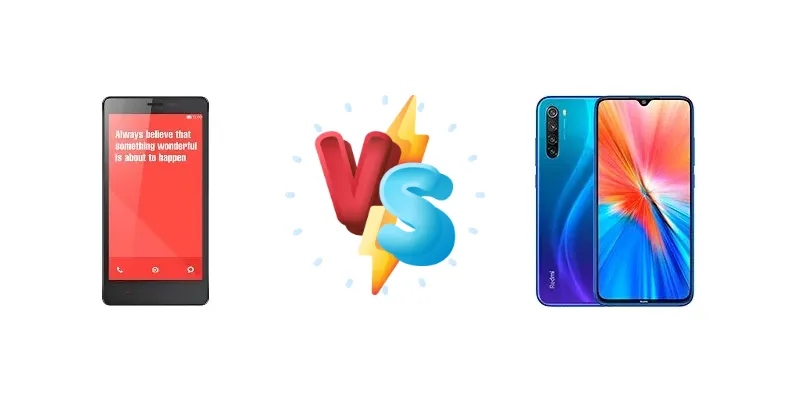
The Xiaomi Redmi Note series has long been a staple for budget-conscious smartphone users. Today, we're pitting two generations against each other: the Redmi Note 4G, a classic, and the Redmi Note 8 2021, a more modern offering. Let's see how they stack up.
🏆 Quick Verdict
The Redmi Note 8 2021 is the clear winner. Its significantly more powerful chipset, improved camera, brighter display, and impressive battery life outweigh the Note 4G's nostalgic appeal. While the 4G offers a budget-friendly entry, the 8 2021 provides a much better overall experience.
| Network |
|---|
| 2G bands | GSM 900 / 1800 - India | GSM 850 / 900 / 1800 / 1900 |
| 3G bands | HSDPA 900 / 2100 - India | HSDPA 850 / 900 / 1700(AWS) / 1900 / 2100 |
| 4G bands | 3, 40 - India | 1, 2, 3, 4, 5, 7, 8, 20, 28, 38, 40 |
| Speed | HSPA, LTE Cat4 150/50 Mbps | HSPA, LTE |
| Technology | GSM / HSPA / LTE | GSM / HSPA / LTE |
| | 1, 2, 3, 4, 7 - Malaysia, Singapore | - |
| Launch |
|---|
| Announced | 2014, August. Released 2014, August | 2021, May 25 |
| Status | Discontinued | Available. Released 2021, May 27 |
| Body |
|---|
| Build | - | Glass front (Gorilla Glass 5), glass back (Gorilla Glass 5), plastic frame |
| Dimensions | 154 x 78.7 x 9.5 mm (6.06 x 3.10 x 0.37 in) | 158.3 x 75.3 x 8.4 mm (6.23 x 2.96 x 0.33 in) |
| SIM | Mini-SIM | Nano-SIM + Nano-SIM |
| Weight | 185 g (6.53 oz) | 190 g (6.70 oz) |
| Display |
|---|
| Protection | - | Corning Gorilla Glass 5 |
| Resolution | 720 x 1280 pixels, 16:9 ratio (~267 ppi density) | 1080 x 2340 pixels, 19.5:9 ratio (~409 ppi density) |
| Size | 5.5 inches, 83.4 cm2 (~68.8% screen-to-body ratio) | 6.3 inches, 97.4 cm2 (~81.7% screen-to-body ratio) |
| Type | IPS LCD | IPS LCD, 500 nits (typ) |
| Platform |
|---|
| CPU | Quad-core 1.6 GHz Cortex-A7 | Octa-core (2x2.0 GHz Cortex-A75 & 6x1.8 GHz Cortex-A55) |
| Chipset | Qualcomm MSM8928 Snapdragon 400 (28 nm) | Mediatek MT6769Z Helio G85 (12 nm) |
| GPU | Adreno 305 | Mali-G52 MC2 |
| OS | Android 4.2 (Jelly Bean), upgradable to 4.4.2 (KitKat), MIUI 5 | Android 11, MIUI 12.5 |
| Memory |
|---|
| Card slot | microSDXC (dedicated slot) | microSDXC (dedicated slot) |
| Internal | 8GB 2GB RAM | 64GB 3GB RAM, 64GB 4GB RAM, 128GB 4GB RAM |
| | eMMC 4.5 | eMMC 5.1 |
| Main Camera |
|---|
| Features | LED flash, HDR | LED flash, HDR, panorama |
| Quad | - | 48 MP, f/1.8, 26mm (wide), 1/2.0", 0.8µm, PDAF
8 MP, f/2.2, 120˚ (ultrawide), 1/4.0", 1.12µm
2 MP (macro)
Auxiliary lens |
| Single | 13 MP, f/2.2, 28mm (wide), AF | 13 MP, f/2.0, (wide), 1/3.1", 1.12µm |
| Video | 1080p@30fps | 1080p@30/120fps; gyro-EIS |
| Selfie camera |
|---|
| Features | - | HDR, panorama |
| Single | 5 MP | 13 MP, f/2.0, (wide), 1/3.1", 1.12µm |
| Video | 720p | 1080p@30fps |
| Sound |
|---|
| 3.5mm jack | Yes | Yes |
| 35mm jack | Yes | Yes |
| Loudspeaker | Yes | Yes |
| Comms |
|---|
| Bluetooth | 4.0, A2DP, LE | 5.2, A2DP, LE |
| Infrared port | - | Yes |
| NFC | No | No |
| Positioning | GPS, GLONASS, BDS | GPS, GLONASS, GALILEO, BDS |
| Radio | FM radio | FM radio |
| USB | microUSB 2.0, OTG | USB Type-C 2.0, OTG |
| WLAN | Wi-Fi 802.11 a/b/g/n/ac, dual-band, Wi-Fi Direct, hotspot | Wi-Fi 802.11 a/b/g/n/ac, dual-band, Wi-Fi Direct |
| Features |
|---|
| Sensors | Accelerometer, gyro, proximity, compass | Fingerprint (rear-mounted), accelerometer, gyro, proximity, compass |
| Battery |
|---|
| Charging | - | 18W wired |
| Music play | Up to 60 h | - |
| Stand-by | Up to 775 h (3G) | - |
| Talk time | Up to 38 h (3G) | - |
| Type | Li-Po 3100 mAh, removable | Li-Po 4000 mAh |
| Misc |
|---|
| Colors | Black/White | Neptune Blue, Moonlight White, Space Black |
| Models | - | M1908C3JGG |
| Price | About 160 EUR | About 160 EUR |
| SAR | - | 0.97 W/kg (head) 0.75 W/kg (body) |
| SAR EU | - | 0.57 W/kg (head) 0.94 W/kg (body) |
| Tests |
|---|
| Battery life | - |
Endurance rating 102h
|
| Camera | - |
Photo / Video |
| Display | - |
Contrast ratio: 1487:1 (nominal) |
| Loudspeaker | - |
-28.6 LUFS (Average)
|
| Performance | - |
AnTuTu: 180195 (v8), 165779 (v9)
GeekBench: 5259 (v4.4), 1314 (v5.1)
GFXBench: 8.7fps (ES 3.1 onscreen) |
Xiaomi Redmi Note 4G
- Extremely affordable
- Compact size
- Decent battery life (for its time)
- Outdated chipset
- Dim display
- Basic camera
- Slow performance
Xiaomi Redmi Note 8 2021
- Powerful Helio G85 chipset
- Bright and vibrant display
- Excellent battery life
- Improved camera
- Design may feel dated
- Charging speed could be faster
Display Comparison
The Redmi Note 8 2021 boasts a significant advantage with its 620 nits max brightness, making it much easier to view outdoors. Both offer a high contrast ratio (1487:1), but the 8 2021's brightness provides a more vibrant and usable display. The Note 4G's display is adequate but noticeably dimmer.
Camera Comparison
While both offer 'Photo / Video' capabilities, the Note 8 2021's camera hardware and image processing are considerably better. Expect sharper images, better low-light performance, and more detail from the 8 2021. The Note 4G's camera is functional but produces noticeably inferior results.
Performance
The Note 8 2021's Helio G85 chipset is a substantial upgrade over the Note 4G's Snapdragon 400. The octa-core CPU and 12nm process offer significantly faster performance for multitasking, gaming, and demanding apps. The Note 4G struggles with heavier tasks, exhibiting noticeable lag.
Battery Life
The Redmi Note 8 2021's endurance rating of 102h is exceptional, indicating outstanding battery life. While the Note 4G also offered decent battery performance for its time, the 8 2021's larger battery and more efficient chipset provide a much longer-lasting experience.
Buying Guide
The Xiaomi Redmi Note 4G is for those seeking an incredibly affordable phone for basic tasks like calls, texts, and light browsing. The Redmi Note 8 2021 is ideal for users who want a smoother experience, better camera capabilities, and longer battery life without breaking the bank.
Frequently Asked Questions
❓ Is the Redmi Note 4G still worth buying?
Only if you're on an extremely tight budget and only need basic smartphone functionality. Otherwise, the Note 8 2021 offers significantly better value.
❓ What is the biggest difference between these two phones?
The biggest difference is performance. The Note 8 2021's chipset is much faster and more efficient, resulting in a smoother and more responsive user experience.