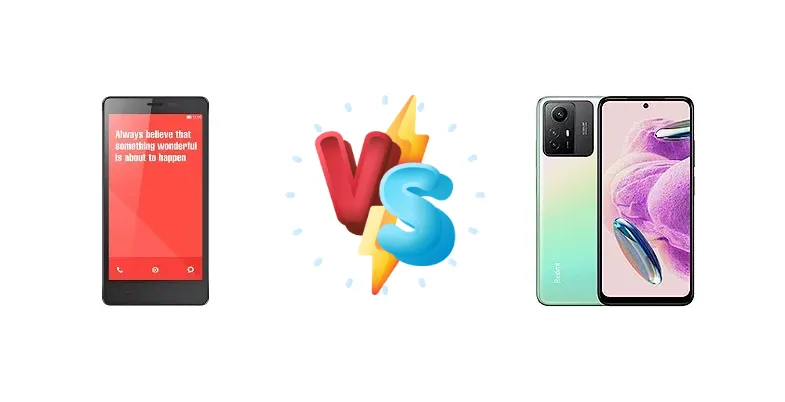
The Xiaomi Redmi Note series has long been a staple for budget-conscious smartphone users. We're pitting the original Redmi Note 4G, a device from a bygone era, against the more modern Redmi Note 12S to see just how far smartphone technology has advanced. This comparison will help you decide which phone best suits your needs.
🏆 Quick Verdict
The Redmi Note 12S is the clear winner. Its significantly faster processor, improved camera, and faster charging make it a vastly superior choice. While the Redmi Note 4G holds nostalgic value, the 12S offers a modern smartphone experience at a competitive price.
| Network |
|---|
| 2G bands | GSM 900 / 1800 - India | GSM 850 / 900 / 1800 / 1900 |
| 3G bands | HSDPA 900 / 2100 - India | HSDPA 850 / 900 / 2100 |
| 4G bands | 3, 40 - India | 1, 3, 5, 7, 8, 20, 28, 38, 40, 41 |
| Speed | HSPA, LTE Cat4 150/50 Mbps | HSPA, LTE |
| Technology | GSM / HSPA / LTE | GSM / HSPA / LTE |
| | 1, 2, 3, 4, 7 - Malaysia, Singapore | - |
| Launch |
|---|
| Announced | 2014, August. Released 2014, August | 2023, March 06 |
| Status | Discontinued | Available. Released 2023, April 26 |
| Body |
|---|
| Dimensions | 154 x 78.7 x 9.5 mm (6.06 x 3.10 x 0.37 in) | 159.9 x 73.9 x 8.1 mm (6.30 x 2.91 x 0.32 in) |
| SIM | Mini-SIM | Nano-SIM + Nano-SIM |
| Weight | 185 g (6.53 oz) | 176 g (6.21 oz) |
| Display |
|---|
| Resolution | 720 x 1280 pixels, 16:9 ratio (~267 ppi density) | 1080 x 2400 pixels, 20:9 ratio (~409 ppi density) |
| Size | 5.5 inches, 83.4 cm2 (~68.8% screen-to-body ratio) | 6.43 inches, 99.8 cm2 (~84.5% screen-to-body ratio) |
| Type | IPS LCD | AMOLED, 90Hz, 700 nits (HBM), 1000 nits (peak) |
| Platform |
|---|
| CPU | Quad-core 1.6 GHz Cortex-A7 | Octa-core (2x2.05 GHz Cortex-A76 & 6x2.0 GHz Cortex-A55) |
| Chipset | Qualcomm MSM8928 Snapdragon 400 (28 nm) | Mediatek MT6781 Helio G96 (12 nm) |
| GPU | Adreno 305 | Mali-G57 MC2 |
| OS | Android 4.2 (Jelly Bean), upgradable to 4.4.2 (KitKat), MIUI 5 | Android 13, MIUI 14 |
| Memory |
|---|
| Card slot | microSDXC (dedicated slot) | microSDXC (dedicated slot) |
| Internal | 8GB 2GB RAM | 64GB 6GB RAM, 128GB 6GB RAM, 256GB 8GB RAM |
| | eMMC 4.5 | - |
| Main Camera |
|---|
| Features | LED flash, HDR | LED flash, HDR, panorama |
| Single | 13 MP, f/2.2, 28mm (wide), AF | - |
| Triple | - | 108 MP, f/1.9, (wide), 1/1.52", 0.7µm, PDAF
8 MP, f/2.2, 118˚ (ultrawide), 1/4.0", 1.12µm
2 MP (macro) |
| Video | 1080p@30fps | 1080p@30fps |
| Selfie camera |
|---|
| Single | 5 MP | 16 MP, f/2.4, (wide) |
| Video | 720p | 1080p@30fps |
| Sound |
|---|
| 3.5mm jack | Yes | Yes |
| 35mm jack | Yes | Yes |
| Loudspeaker | Yes | Yes, with stereo speakers |
| Comms |
|---|
| Bluetooth | 4.0, A2DP, LE | 5.2, A2DP, LE |
| Infrared port | - | Yes |
| NFC | No | Yes (market/region dependent) |
| Positioning | GPS, GLONASS, BDS | GPS (L1), GLONASS (G1), GALILEO (E1), BDS (B1) |
| Radio | FM radio | Stereo FM radio, recording |
| USB | microUSB 2.0, OTG | USB Type-C 2.0 |
| WLAN | Wi-Fi 802.11 a/b/g/n/ac, dual-band, Wi-Fi Direct, hotspot | Wi-Fi 802.11 a/b/g/n/ac, dual-band |
| Features |
|---|
| Sensors | Accelerometer, gyro, proximity, compass | Fingerprint (side-mounted), accelerometer, gyro, proximity, compass |
| Battery |
|---|
| Charging | - | 33W wired |
| Music play | Up to 60 h | - |
| Stand-by | Up to 775 h (3G) | - |
| Talk time | Up to 38 h (3G) | - |
| Type | Li-Po 3100 mAh, removable | Li-Po 5000 mAh |
| Misc |
|---|
| Colors | Black/White | Onyx Black, Ice Blue, Pearl Green |
| Models | - | 2303CRA44A, 23030RAC7Y, 2303ERA42L |
| Price | About 160 EUR | € 122.47 / $ 149.99 / £ 229.89 |
Xiaomi Redmi Note 4G
- Ultra-budget friendly
- Compact size
- Decent call quality
- Outdated processor
- Low-resolution display
- Poor camera
- Slow charging
- Limited storage
Xiaomi Redmi Note 12S
- Fast processor
- Improved display
- Better camera
- Fast charging
- More storage options
- Modern features
- May be slightly more expensive than older budget options
- Plastic build (common in this price range)
Display Comparison
The Redmi Note 12S boasts a significantly improved display. It likely features a higher resolution (likely FHD+ vs the 4G's 720p), better color accuracy, and potentially a higher refresh rate (90Hz is common in this range). The 4G's display is adequate but noticeably less vibrant and sharp.
Camera Comparison
The Redmi Note 12S features a much more capable camera system. Expect higher resolution images, better low-light performance, and potentially features like optical image stabilization (OIS). The 4G's camera is functional but produces noticeably inferior results.
Performance
The performance difference is massive. The Redmi Note 12S's Octa-core Helio G96 chipset with Cortex-A76 cores provides a substantial performance boost over the 4G's Quad-core Snapdragon 400. Expect smoother multitasking, faster app loading, and better gaming performance on the 12S.
Battery Life
While both phones likely have similar battery capacities (around 4000mAh), the Redmi Note 12S's more efficient chipset and 33W fast charging give it a significant advantage in terms of battery life and charging speed.
Buying Guide
The Xiaomi Redmi Note 4G is suitable for users seeking a very basic, ultra-budget phone for calls, texts, and light browsing. The Redmi Note 12S is ideal for anyone wanting a smooth performance, decent camera, and longer battery life for everyday use and light gaming.
Frequently Asked Questions
❓ Is the Redmi Note 4G still usable in 2024?
Yes, it can still handle basic tasks, but its performance is severely limited compared to modern smartphones. Software updates are likely discontinued.
❓ What is the biggest difference between the two phones?
The biggest difference is the processor. The Redmi Note 12S has a much faster and more efficient chipset, resulting in a significantly better overall user experience.