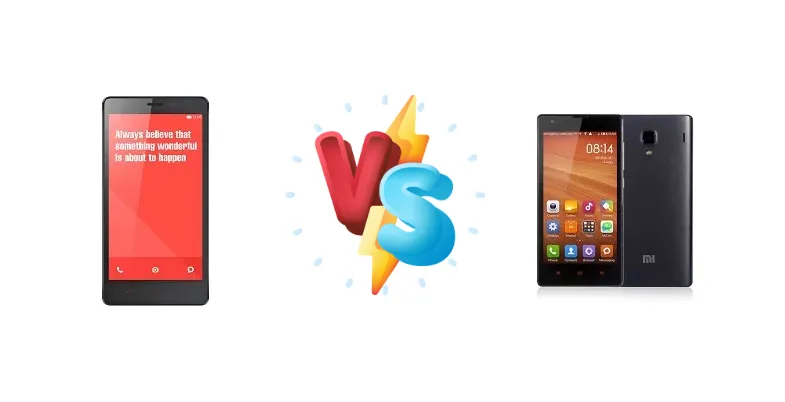
The Xiaomi Redmi series revolutionized the budget smartphone market, offering incredible value for money. Two popular contenders were the Redmi Note 4G and the Redmi 1S. But which one reigns supreme? This comprehensive comparison dives deep into their features to help you decide.
🏆 Quick Verdict
The Redmi Note 4G edges out the Redmi 1S thanks to its larger display, slightly better build quality, and often more available storage options. While both offer excellent value, the Note 4G provides a more modern and feature-rich experience for a small price premium.
| Network |
|---|
| 2G bands | GSM 900 / 1800 - India | GSM 900 / 1800 / 1900 |
| 3G bands | HSDPA 900 / 2100 - India | HSDPA 900 / 2100 |
| 4G bands | 3, 40 - India | - |
| Speed | HSPA, LTE Cat4 150/50 Mbps | HSPA |
| Technology | GSM / HSPA / LTE | GSM / HSPA |
| | 1, 2, 3, 4, 7 - Malaysia, Singapore | - |
| Launch |
|---|
| Announced | 2014, August. Released 2014, August | 2014, May. Released 2014, May |
| Status | Discontinued | Discontinued |
| Body |
|---|
| Build | - | Glass front (Asahi Dragontrail), plastic back, plastic frame |
| Dimensions | 154 x 78.7 x 9.5 mm (6.06 x 3.10 x 0.37 in) | 137 x 69 x 9.9 mm (5.39 x 2.72 x 0.39 in) |
| SIM | Mini-SIM | Dual SIM (Mini-SIM, dual stand-by) |
| Weight | 185 g (6.53 oz) | 158 g (5.57 oz) |
| Display |
|---|
| Protection | - | Asahi Dragontrail Glass |
| Resolution | 720 x 1280 pixels, 16:9 ratio (~267 ppi density) | 720 x 1280 pixels, 16:9 ratio (~312 ppi density) |
| Size | 5.5 inches, 83.4 cm2 (~68.8% screen-to-body ratio) | 4.7 inches, 60.9 cm2 (~64.4% screen-to-body ratio) |
| Type | IPS LCD | IPS LCD |
| Platform |
|---|
| CPU | Quad-core 1.6 GHz Cortex-A7 | Quad-core 1.6 GHz Cortex-A7 |
| Chipset | Qualcomm MSM8928 Snapdragon 400 (28 nm) | Qualcomm MSM8228 Snapdragon 400 (28 nm) |
| GPU | Adreno 305 | Adreno 305 |
| OS | Android 4.2 (Jelly Bean), upgradable to 4.4.2 (KitKat), MIUI 5 | Android 4.3 (Jelly Bean), upgradable to 4.4.4 (KitKat), MIUI 9.2 |
| Memory |
|---|
| Card slot | microSDXC (dedicated slot) | microSDXC (dedicated slot) |
| Internal | 8GB 2GB RAM | 8GB 1GB RAM |
| | eMMC 4.5 | eMMC 4.5 |
| Main Camera |
|---|
| Features | LED flash, HDR | LED flash, HDR |
| Single | 13 MP, f/2.2, 28mm (wide), AF | 8 MP, f/2.2, 1/3.2", 1.4µm, AF |
| Video | 1080p@30fps | 1080p@30fps |
| Selfie camera |
|---|
| Single | 5 MP | 1.6 MP |
| Video | 720p | 720p@30fps |
| Sound |
|---|
| 3.5mm jack | Yes | Yes |
| 35mm jack | Yes | Yes |
| Loudspeaker | Yes | Yes |
| Comms |
|---|
| Bluetooth | 4.0, A2DP, LE | 4.0, A2DP, LE |
| NFC | No | No |
| Positioning | GPS, GLONASS, BDS | GPS, GLONASS |
| Radio | FM radio | FM radio |
| USB | microUSB 2.0, OTG | microUSB 2.0, OTG |
| WLAN | Wi-Fi 802.11 a/b/g/n/ac, dual-band, Wi-Fi Direct, hotspot | Wi-Fi 802.11 b/g/n, Wi-Fi Direct, hotspot |
| Features |
|---|
| Sensors | Accelerometer, gyro, proximity, compass | Accelerometer, gyro, proximity, compass |
| Battery |
|---|
| Music play | Up to 60 h | - |
| Stand-by | Up to 775 h (3G) | - |
| Talk time | Up to 38 h (3G) | - |
| Type | Li-Po 3100 mAh, removable | Li-Ion 2000 mAh, removable |
| Misc |
|---|
| Colors | Black/White | Black, Chinese Red, Metallic Gray/ blue, green, yellow panels |
| Models | - | 2014011 |
| Price | About 160 EUR | About 90 EUR |
| Tests |
|---|
| Audio quality | - |
Noise -95.4dB / Crosstalk -82.3dB |
| Battery life | - | Endurance rating 51h |
| Camera | - |
Photo / Video |
| Display | - |
Contrast ratio: 1370 (nominal), 1.350 (sunlight) |
| Loudspeaker | - |
Voice 66dB / Noise 65dB / Ring 71dB |
| Performance | - |
Basemark OS II 2.0: 454 |
Xiaomi Redmi Note 4G
- Larger Display
- Potentially More RAM (2GB)
- Slightly Better Build Quality
- Often Available with More Storage
- Shorter Battery Life
- Can be slightly more expensive
Xiaomi Redmi 1S
- Exceptional Battery Life
- Lower Price Point
- Compact Size
- Smaller Display
- Limited RAM (1GB)
- Less Storage Options
Display Comparison
Both phones feature a 4.7-inch IPS display, offering decent viewing angles and color reproduction for their price range. However, the Redmi Note 4G often had options with slightly higher resolution, leading to a marginally sharper image. The contrast ratios are similar, providing adequate visibility in various lighting conditions.
Camera Comparison
Camera performance is comparable on both devices. Both feature basic 8MP rear cameras capable of capturing decent photos in good lighting conditions. Low-light performance is expectedly limited. Video recording capabilities are standard for the time, offering 720p recording. The Note 4G sometimes had slightly better image processing.
Performance
Both devices are powered by the Qualcomm Snapdragon 400 chipset with a 1.6 GHz quad-core Cortex-A7 CPU. Performance is generally adequate for everyday tasks like browsing, social media, and light gaming. Don't expect blazing-fast speeds, but they're capable for their intended budget segment. The Note 4G might have a slight edge due to potential RAM variations (often 2GB vs 1GB on the 1S).
Battery Life
The Redmi 1S boasts an impressive endurance rating of 51 hours, a significant advantage over the Redmi Note 4G. While the Note 4G's battery capacity is larger (typically 3200mAh vs 2000mAh), the 1S's optimized software and efficient hardware contribute to its superior battery life.
Buying Guide
The Xiaomi Redmi Note 4G is ideal for users who prioritize a larger screen for media consumption and a more premium feel. The Redmi 1S is a great choice for those seeking the absolute lowest price point and exceptional battery life, prioritizing affordability above all else.
Frequently Asked Questions
❓ Which phone is better for gaming?
While neither phone is a gaming powerhouse, the Redmi Note 4G's potential for 2GB of RAM gives it a slight edge for smoother performance in less demanding games.
❓ Is the Redmi Note 4G worth the extra cost?
If you value a larger screen and potentially more RAM, the Redmi Note 4G is worth the small price increase. However, if battery life is your top priority and you're on a tight budget, the Redmi 1S remains an excellent choice.