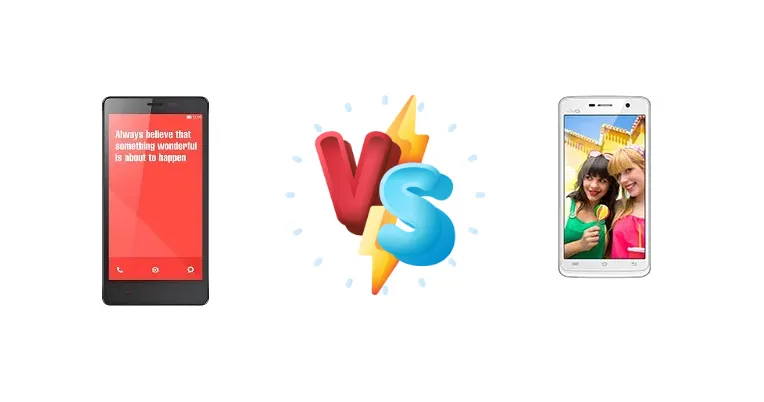
The Xiaomi Redmi Note 4G and vivo Y22 (2013) were popular budget smartphones offering a taste of Android at an affordable price. But which one holds up better today? We'll dive deep into their specs, performance, and features to help you decide which was the better buy back then, and which might still be interesting for a retro project.
🏆 Quick Verdict
The Xiaomi Redmi Note 4G edges out the vivo Y22 (2013) thanks to its slightly faster processor and generally better software support during its lifespan. While both are dated, the Redmi Note 4G offered a marginally smoother experience and a more robust community for custom ROMs.
| Network |
|---|
| 2G bands | GSM 900 / 1800 - India | GSM 850 / 900 / 1800 / 1900 - SIM 1 & SIM 2 |
| 3G bands | HSDPA 900 / 2100 - India | HSDPA 850 / 900 / 2100 |
| 4G bands | 3, 40 - India | - |
| Speed | HSPA, LTE Cat4 150/50 Mbps | HSPA 21.1/5.76 Mbps |
| Technology | GSM / HSPA / LTE | GSM / HSPA |
| | 1, 2, 3, 4, 7 - Malaysia, Singapore | - |
| Launch |
|---|
| Announced | 2014, August. Released 2014, August | 2013. Released 2013 |
| Status | Discontinued | Discontinued |
| Body |
|---|
| Dimensions | 154 x 78.7 x 9.5 mm (6.06 x 3.10 x 0.37 in) | 130.5 x 66.9 x 8.6 mm (5.14 x 2.63 x 0.34 in) |
| SIM | Mini-SIM | Dual SIM (Micro-SIM, dual stand-by) |
| Weight | 185 g (6.53 oz) | 126 g (4.44 oz) |
| Display |
|---|
| Resolution | 720 x 1280 pixels, 16:9 ratio (~267 ppi density) | 480 x 854 pixels, 16:9 ratio (~218 ppi density) |
| Size | 5.5 inches, 83.4 cm2 (~68.8% screen-to-body ratio) | 4.5 inches, 55.8 cm2 (~63.9% screen-to-body ratio) |
| Type | IPS LCD | IPS LCD |
| Platform |
|---|
| CPU | Quad-core 1.6 GHz Cortex-A7 | Quad-core 1.3 GHz Cortex-A7 |
| Chipset | Qualcomm MSM8928 Snapdragon 400 (28 nm) | Mediatek MT6582 (28 nm) |
| GPU | Adreno 305 | Mali-400MP2 |
| OS | Android 4.2 (Jelly Bean), upgradable to 4.4.2 (KitKat), MIUI 5 | Android 4.2.2 (Jelly Bean) |
| Memory |
|---|
| Card slot | microSDXC (dedicated slot) | microSDXC (dedicated slot) |
| Internal | 8GB 2GB RAM | 4GB 1GB RAM |
| | eMMC 4.5 | - |
| Main Camera |
|---|
| Features | LED flash, HDR | LED flash |
| Single | 13 MP, f/2.2, 28mm (wide), AF | 8 MP, AF |
| Video | 1080p@30fps | 1080p@30fps |
| Selfie camera |
|---|
| Single | 5 MP | Yes |
| Video | 720p | - |
| Sound |
|---|
| 3.5mm jack | Yes | Yes |
| 35mm jack | Yes | Yes |
| Loudspeaker | Yes | Yes |
| Comms |
|---|
| Bluetooth | 4.0, A2DP, LE | 4.0, A2DP, EDR |
| Infrared port | - | Yes |
| NFC | No | No |
| Positioning | GPS, GLONASS, BDS | GPS |
| Radio | FM radio | FM radio |
| USB | microUSB 2.0, OTG | microUSB 2.0 |
| WLAN | Wi-Fi 802.11 a/b/g/n/ac, dual-band, Wi-Fi Direct, hotspot | Wi-Fi 802.11 b/g/n, Wi-Fi Direct, hotspot |
| Features |
|---|
| Sensors | Accelerometer, gyro, proximity, compass | Accelerometer, proximity, compass |
| Battery |
|---|
| Music play | Up to 60 h | Up to 45 h |
| Stand-by | Up to 775 h (3G) | Up to 410 h (2G) / Up to 410 h (3G) |
| Talk time | Up to 38 h (3G) | Up to 12 h (2G) / Up to 10 h (3G) |
| Type | Li-Po 3100 mAh, removable | Li-Ion 1900 mAh, removable |
| Misc |
|---|
| Colors | Black/White | White, Black |
| Price | About 160 EUR | - |
| SAR | - | 0.36 W/kg (head) 0.90 W/kg (body) |
| SAR EU | - | 0.52 W/kg (head) 1.17 W/kg (body) |
Xiaomi Redmi Note 4G
- Slightly faster processor
- Larger battery capacity
- Potentially better software support (historically)
- More robust community for custom ROMs (historically)
- Outdated hardware
- Low-resolution display
- Mediocre camera
vivo Y22 (2013)
- Affordable (when new)
- Compact size
- Slower processor
- Smaller battery capacity
- Limited software support
- Outdated hardware
- Low-resolution display
- Mediocre camera
Display Comparison
Both phones featured relatively small, 5-inch IPS LCD displays with resolutions around 720p. Image quality was adequate for the time, but viewing angles and color accuracy are noticeably lacking by modern standards. The Redmi Note 4G's display might have had slightly better calibration, but the difference is minimal.
Camera Comparison
The Redmi Note 4G typically featured an 8MP or 13MP rear camera (depending on the variant) and a 5MP front camera. The vivo Y22 (2013) usually had an 8MP rear camera and a 5MP front camera. Image quality on both was mediocre, with limited dynamic range and noise in low light. The Redmi Note 4G's camera might have had slightly better processing, but don't expect miracles.
Performance
The Xiaomi Redmi Note 4G boasts a Qualcomm Snapdragon 400 chipset clocked at 1.6 GHz, compared to the vivo Y22's Mediatek MT6582 at 1.3 GHz. While both use Cortex-A7 cores, the Snapdragon 400 generally offered better performance and efficiency. Expect slightly smoother multitasking and app loading on the Redmi Note 4G.
Battery Life
The Redmi Note 4G generally had a larger battery capacity (around 3100mAh) compared to the vivo Y22 (2013) (around 2000mAh). This translates to noticeably longer battery life on the Redmi Note 4G, easily lasting a full day with moderate usage, while the vivo Y22 would require more frequent charging.
Buying Guide
The Xiaomi Redmi Note 4G is suitable for users looking for a nostalgic experience or a very basic phone for light tasks. The vivo Y22 (2013) is best left as a historical artifact, unless you're specifically seeking a device from that era for a collection or experimentation.
Frequently Asked Questions
❓ Are these phones still worth buying?
Generally no. Both are very outdated and lack modern features and security updates. They might be interesting for collectors or for experimenting with older Android versions.
❓ Can I update the software on either of these phones?
Official software updates are no longer available for either device. However, the Redmi Note 4G had a more active community, so custom ROMs might be available, but flashing them carries risks.