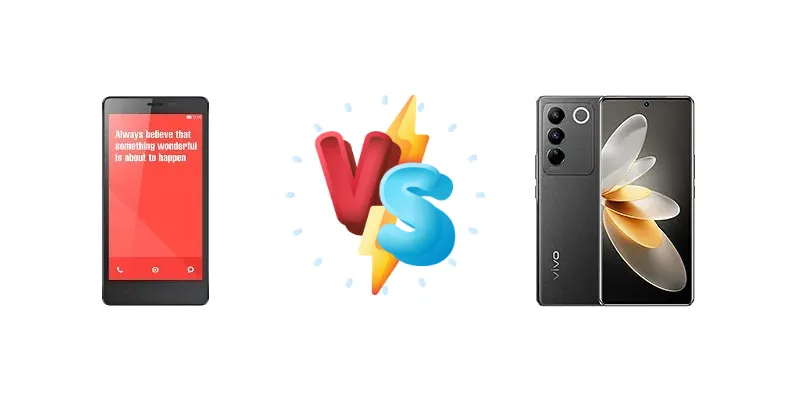
The Xiaomi Redmi Note 4G represents a bygone era of budget smartphones, while the vivo V27 Pro embodies modern flagship features. This comparison dives deep into their specs, performance, and overall value to help you decide which device best suits your needs. Prepare for a significant difference!
🏆 Quick Verdict
The vivo V27 Pro utterly dominates the Xiaomi Redmi Note 4G across nearly every metric. Its superior chipset, display, camera, and charging capabilities make it the clear winner, despite likely a higher price point. The Redmi Note 4G remains a basic option for extremely budget-conscious users.
| Network |
|---|
| 2G bands | GSM 900 / 1800 - India | GSM 850 / 900 / 1800 / 1900 |
| 3G bands | HSDPA 900 / 2100 - India | HSDPA 850 / 900 / 1700(AWS) / 2100 |
| 4G bands | 3, 40 - India | 1, 3, 4, 5, 8, 28, 38, 40, 41 |
| 5G bands | - | 1, 3, 5, 8, 28, 77, 78 SA/NSA |
| Speed | HSPA, LTE Cat4 150/50 Mbps | HSPA, LTE, 5G |
| Technology | GSM / HSPA / LTE | GSM / HSPA / LTE / 5G |
| | 1, 2, 3, 4, 7 - Malaysia, Singapore | - |
| Launch |
|---|
| Announced | 2014, August. Released 2014, August | 2023, March 01 |
| Status | Discontinued | Available. Released 2023, March 01 |
| Body |
|---|
| Build | - | Glass front, plastic frame, glass back |
| Dimensions | 154 x 78.7 x 9.5 mm (6.06 x 3.10 x 0.37 in) | 164.1 x 74.8 x 7.4 mm (6.46 x 2.94 x 0.29 in) |
| SIM | Mini-SIM | Nano-SIM + Nano-SIM |
| Weight | 185 g (6.53 oz) | 182 g (6.42 oz) |
| | - | Color changing back panel color |
| Display |
|---|
| Resolution | 720 x 1280 pixels, 16:9 ratio (~267 ppi density) | 1080 x 2400 pixels, 20:9 ratio (~388 ppi density) |
| Size | 5.5 inches, 83.4 cm2 (~68.8% screen-to-body ratio) | 6.78 inches, 111.0 cm2 (~90.4% screen-to-body ratio) |
| Type | IPS LCD | AMOLED, 1B colors, 120Hz, HDR10+ |
| Platform |
|---|
| CPU | Quad-core 1.6 GHz Cortex-A7 | Octa-core (1x3.1 GHz Cortex-A78 & 3x3.0 GHz Cortex-A78 & 4x2.0 GHz Cortex-A55) |
| Chipset | Qualcomm MSM8928 Snapdragon 400 (28 nm) | Mediatek Dimensity 8200 (4 nm) |
| GPU | Adreno 305 | Mali-G610 MC6 |
| OS | Android 4.2 (Jelly Bean), upgradable to 4.4.2 (KitKat), MIUI 5 | Android 13, Funtouch 13 |
| Memory |
|---|
| Card slot | microSDXC (dedicated slot) | No |
| Internal | 8GB 2GB RAM | 128GB 8GB RAM, 256GB 8GB RAM, 256GB 12GB RAM |
| | eMMC 4.5 | UFS 3.1 |
| Main Camera |
|---|
| Features | LED flash, HDR | Ring-LED flash, panorama, HDR |
| Single | 13 MP, f/2.2, 28mm (wide), AF | 50 MP, f/2.5, (wide), AF |
| Triple | - | 50 MP, f/1.9, (wide), 1/1.56", 1.0µm, PDAF, OIS
8 MP, f/2.2, 16mm, 120˚ (ultrawide), 1/4.0", 1.12µm
2 MP (macro) |
| Video | 1080p@30fps | 4K@30/60fps, 1080p@30fps, gyro-EIS |
| Selfie camera |
|---|
| Features | - | Dual-LED flash, HDR |
| Single | 5 MP | 50 MP, f/2.5, (wide), AF |
| Video | 720p | 4K@30/60fps, 1080p@30fps, gyro-EIS |
| Sound |
|---|
| 3.5mm jack | Yes | No |
| 35mm jack | Yes | No |
| Loudspeaker | Yes | Yes |
| | - | 24-bit/192kHz audio |
| Comms |
|---|
| Bluetooth | 4.0, A2DP, LE | 5.3, A2DP, LE |
| NFC | No | Yes |
| Positioning | GPS, GLONASS, BDS | GPS, GLONASS, GALILEO, BDS, NavIC |
| Radio | FM radio | No |
| USB | microUSB 2.0, OTG | USB Type-C 2.0, OTG |
| WLAN | Wi-Fi 802.11 a/b/g/n/ac, dual-band, Wi-Fi Direct, hotspot | Wi-Fi 802.11 a/b/g/n/ac/6, dual-band, Wi-Fi Direct |
| Features |
|---|
| Sensors | Accelerometer, gyro, proximity, compass | Fingerprint (under display, optical), accelerometer, gyro, proximity, compass |
| Battery |
|---|
| Charging | - | 66W wired, 50% in 19 min, 72% in 30 min |
| Music play | Up to 60 h | - |
| Stand-by | Up to 775 h (3G) | - |
| Talk time | Up to 38 h (3G) | - |
| Type | Li-Po 3100 mAh, removable | 4600 mAh |
| Misc |
|---|
| Colors | Black/White | Magic Blue, Noble Black |
| Models | - | V2230 |
| Price | About 160 EUR | About 440 EUR |
| SAR | - | 1.22 W/kg (head) 0.89 W/kg (body) |
| Tests |
|---|
| Battery life | - |
Endurance rating 121h
|
| Camera | - |
Photo / Video |
| Display | - |
Contrast ratio: Infinite (nominal) |
| Loudspeaker | - |
-29.1 LUFS (Average)
|
| Performance | - |
AnTuTu: 846767 (v9)
GeekBench: 3933 (v5.1), 3421 (v6)
GFXBench: 57fps (ES 3.1 onscreen) |
Xiaomi Redmi Note 4G
- Extremely affordable
- Decent battery life (potentially)
- Compact size (likely)
- Outdated chipset
- Low-resolution display
- Basic camera
- Slow charging
- Limited storage
vivo V27 Pro
- Powerful chipset
- Bright and vibrant display
- Excellent camera system
- Fast charging
- Modern design
- Potentially higher price
- May be larger and heavier
Display Comparison
The vivo V27 Pro boasts a significantly brighter display (978 nits vs. Redmi Note 4G's likely around 300-400 nits) with a superior contrast ratio (Infinite vs. Redmi Note 4G's likely standard). Colors will be more vibrant and viewing angles better on the V27 Pro. The Redmi Note 4G's display is adequate for basic use but lacks the visual appeal of the V27 Pro.
Camera Comparison
The vivo V27 Pro's camera system is a major upgrade. While specific specs are not provided, vivo is known for its strong camera performance. The Redmi Note 4G's camera is likely basic and produces lower-quality images, especially in low light. Expect better detail, dynamic range, and overall image quality from the V27 Pro.
Performance
The Dimensity 8200 chipset in the vivo V27 Pro is a powerhouse compared to the Snapdragon 400 in the Redmi Note 4G. Expect drastically faster app loading times, smoother multitasking, and the ability to handle demanding games with ease on the V27 Pro. The Redmi Note 4G will struggle with modern apps and multitasking.
Battery Life
Both phones claim impressive battery life (121h endurance rating). However, the vivo V27 Pro's 66W fast charging provides a significant advantage, allowing for rapid top-ups. The Redmi Note 4G likely has slower charging speeds.
Buying Guide
Who should buy the Xiaomi Redmi Note 4G? Primarily those seeking an incredibly affordable phone for basic tasks like calls, texts, and light browsing. Who should buy the vivo V27 Pro? Anyone wanting a premium experience with a great camera, fast charging, and smooth performance for demanding apps and games.
Frequently Asked Questions
❓ Is the Redmi Note 4G still worth buying in 2024?
Only if you're on an extremely tight budget and only need basic smartphone functionality. Otherwise, there are better options available.
❓ What is the biggest difference between these two phones?
The biggest difference is the chipset and overall performance. The vivo V27 Pro offers a significantly faster and more capable experience.
❓ Does the vivo V27 Pro support 5G?
Yes, the vivo V27 Pro supports 5G connectivity, while the Redmi Note 4G is limited to 4G.