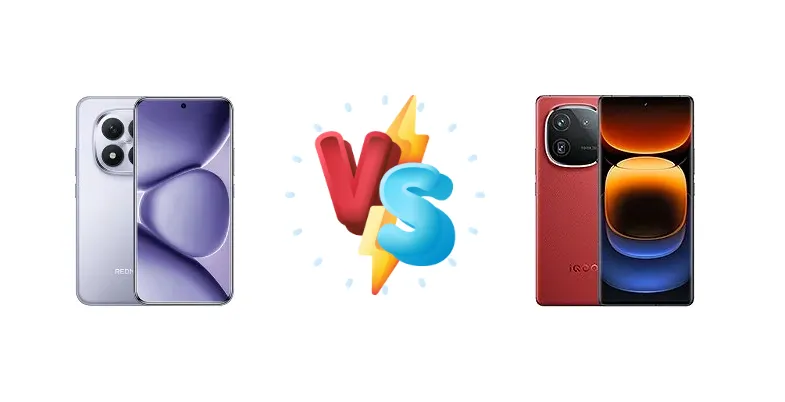
The Xiaomi Redmi Note 15 Pro+ aims to deliver a compelling experience at a more accessible price point, while the vivo iQOO 12 Pro represents a no-compromise flagship. This comparison dissects the core differences between these two devices, focusing on their chipsets, charging capabilities, and overall user experience to determine which phone offers the best value for your money.
🏆 Quick Verdict
For the average user prioritizing raw performance and future-proofing, the vivo iQOO 12 Pro is the clear winner. Its Snapdragon 8 Gen 3 chipset provides a substantial leap in processing power and graphics capabilities compared to the Redmi Note 15 Pro+'s Snapdragon 7s Gen 4. However, the Redmi Note 15 Pro+ remains a strong contender for budget-conscious users.
| Network |
|---|
| 2G bands | GSM 850 / 900 / 1800 / 1900 | GSM 850 / 900 / 1800 / 1900 |
| 3G bands | HSDPA 800 / 850 / 900 / 1700(AWS) / 1900 / 2100 | HSDPA 800 / 850 / 900 / 1700(AWS) / 1900 / 2100 |
| 4G bands | LTE | 1, 2, 3, 4, 5, 7, 8, 12, 17, 18, 19, 20, 25, 26, 28, 34, 38, 39, 40, 41, 42, 66 |
| 5G bands | SA/NSA | 1, 2, 3, 5, 7, 8, 12, 20, 25, 26, 28, 66, 38, 40, 41, 77, 78 SA/NSA |
| Speed | HSPA, LTE, 5G | HSPA, LTE, 5G |
| Technology | GSM / HSPA / LTE / 5G | GSM / CDMA / HSPA / CDMA2000 / LTE / 5G |
| Launch |
|---|
| Announced | Not announced yet | 2023, November 07 |
| Status | Rumored | Available. Released 2023, November 14 |
| Body |
|---|
| Build | Glass front (Gorilla Glass Victus 2), glass back (Gorrila Glass 7i) or silicone polymer back (eco leather), aluminum frame | - |
| Dimensions | 163.3 x 78.3 x 7.9 mm (6.43 x 3.08 x 0.31 in) | 164.6 x 75.4 x 8.6 mm or 8.8 mm |
| SIM | · Nano-SIM + eSIM· Nano-SIM + Nano-SIM | Nano-SIM + Nano-SIM |
| Weight | 207 g (7.30 oz) | 205 g or 210 g (7.23 oz) |
| Display |
|---|
| Protection | Corning Gorilla Glass Victus 2 | - |
| Resolution | 1280 x 2712 pixels, 19:9 ratio (~439 ppi density) | 1440 x 3200 pixels, 20:9 ratio (~518 ppi density) |
| Size | 6.83 inches, 116.2 cm2 (~90.9% screen-to-body ratio) | 6.78 inches, 111.0 cm2 (~89.4% screen-to-body ratio) |
| Type | AMOLED, 68B colors, 120Hz, 3840Hz PWM, HDR10+, Dolby Vision, 3200 nits (peak) | LTPO AMOLED, 1B colors, 144Hz, HDR10+, 1600 nits (HBM), 3000 nits (peak) |
| Platform |
|---|
| CPU | Octa-core (1x2.7 GHz Cortex-A720 & 3x2.4 GHz Cortex-A720 & 4x1.8 GHz Cortex-A520) | Octa-core (1x3.3 GHz Cortex-X4 & 3x3.2 GHz Cortex-A720 & 2x3.0 GHz Cortex-A720 & 2x2.3 GHz Cortex-A520) |
| Chipset | Qualcomm SM7635-AC Snapdragon 7s Gen 4 (4 nm) | Qualcomm SM8650-AB Snapdragon 8 Gen 3 (4 nm) |
| GPU | Adreno 810 | Adreno 750 |
| OS | Android 15, HyperOS 2 | Android 14, up to 2 major Android upgrades, Funtouch 14 (International), OriginOS 4 (China) |
| Memory |
|---|
| Card slot | No | No |
| Internal | 256GB 8GB RAM | 256GB 16GB RAM, 512GB 16GB RAM, 1TB 16GB RAM |
| Main Camera |
|---|
| Features | LED flash, HDR, panorama | Color spectrum sensor, Dual-LED flash, HDR, panorama |
| Triple | 200 MP, f/1.7, 23mm (wide), 1/1.4", 0.56µm, multi-directional PDAF, OIS
8 MP, f/2.2, 15mm, 120˚ (ultrawide), 1/4.0", 1.12µm
2 MP (macro) | 50 MP, f/1.7, 23mm (wide), 1/1.3", 1.2µm, ulti-directional PDAF, OIS
64 MP, f/2.6, 70mm (periscope telephoto), 1/2.0", PDAF, OIS, 3x optical zoom
50 MP, f/2.0, 15mm, 119˚ (ultrawide), AF |
| Video | 4K@24/30fps, 1080p@30/60/120fps, gyro-EIS, OIS | 8K@30fps, 4K@24/30/60fps, 1080p@30/60/120/240fps, gyro-EIS |
| Selfie camera |
|---|
| Features | HDR, panorama | HDR |
| Single | 32 MP, (wide) | 16 MP, f/2.5, (wide) |
| Video | 1080p@30/60fps | 1080p@30fps, gyro-EIS |
| Sound |
|---|
| 35mm jack | No | No |
| Loudspeaker | Yes, with stereo speakers (with Dolby Atmos) | Yes, with stereo speakers |
| Comms |
|---|
| Bluetooth | 5.4, A2DP, LE | 5.4, A2DP, LE, aptX HD, aptX Adaptive, aptX Lossless |
| Infrared port | Yes | Yes |
| NFC | Yes (market/region dependent) | Yes |
| Positioning | GPS (L1+L5), GALILEO, GLONASS, QZSS, BDS | GPS (L1+L5), GLONASS (G1), BDS (B1I+B1c+B2a), GALILEO (E1+E5a), QZSS (L1+L5) |
| Radio | Unspecified | No |
| USB | USB Type-C 2.0, OTG | USB Type-C 2.0, OTG |
| WLAN | Wi-Fi 802.11 a/b/g/n/ac/6/6e, dual-band, Wi-Fi Direct (/6e is market/region dependent) | Wi-Fi 802.11 a/b/g/n/ac/6/7, tri-band, Wi-Fi Direct |
| Features |
|---|
| Sensors | Fingerprint (under display, optical), accelerometer, gyro, compass, proximity | Fingerprint (under display, ultrasonic), accelerometer, gyro, proximity, compass |
| Battery |
|---|
| Charging | 100W wired | 120W wired
50W wireless
10W reverse wireless |
| Type | 6500 mAh | 5100 mAh |
| Misc |
|---|
| Colors | Glacier Blue, Mocha Brown, Black | Black, Red, White (BMW M branding) |
| Models | 2510ERA8BG | V2329A |
| Price | About 500 EUR | About 650 EUR |
Xiaomi Redmi Note 15 Pro+
- More affordable price point
- Fast 100W wired charging
- Good value for everyday use
- Less powerful Snapdragon 7s Gen 4 chipset
- Potentially inferior camera performance
- May lack flagship features like LTPO display
vivo iQOO 12 Pro
- Flagship Snapdragon 8 Gen 3 performance
- 120W wired, 50W wireless, and 10W reverse wireless charging
- Likely superior display and camera quality
- Higher price tag
- Potential for increased heat generation
- May be overkill for basic users
Display Comparison
While both devices utilize a 4nm process, the display details are missing. Assuming the Redmi Note 15 Pro+ follows recent trends, it likely features an AMOLED panel with a standard refresh rate. The iQOO 12 Pro, being a flagship, is expected to boast a superior LTPO AMOLED display with adaptive refresh rates (potentially up to 144Hz) for smoother scrolling and improved power efficiency. The iQOO 12 Pro will likely have higher peak brightness, enhancing visibility in direct sunlight. Bezels are also expected to be slimmer on the iQOO 12 Pro, contributing to a more immersive viewing experience.
Camera Comparison
Without specific camera specs, we can infer based on brand positioning. The iQOO 12 Pro is likely to feature a larger main sensor with optical image stabilization (OIS), enabling better low-light performance and sharper images. The Redmi Note 15 Pro+ will likely focus on a versatile camera setup, but may compromise on sensor size and image processing capabilities. The iQOO 12 Pro’s image processing pipeline, powered by the Snapdragon 8 Gen 3’s ISP, will likely offer more advanced features like improved dynamic range and noise reduction. The aperture of the main lens on the iQOO 12 Pro will likely be wider, allowing more light to reach the sensor.
Performance
The core difference lies in the chipsets. The iQOO 12 Pro’s Snapdragon 8 Gen 3 (4nm) is a significant upgrade over the Redmi Note 15 Pro+'s Snapdragon 7s Gen 4 (4nm). The 8 Gen 3 features a Cortex-X4 prime core clocked at 3.3 GHz, compared to the 7s Gen 4’s Cortex-A720 core at 2.7 GHz. This translates to a substantial performance advantage in CPU-intensive tasks. The GPU within the 8 Gen 3 is also far more powerful, delivering a smoother gaming experience and faster graphics rendering. The iQOO 12 Pro will also benefit from faster LPDDR5x RAM, further enhancing multitasking capabilities. Thermal management will be crucial; the 8 Gen 3 generates more heat, but the iQOO 12 Pro likely incorporates a more sophisticated cooling system to prevent throttling.
Battery Life
The iQOO 12 Pro boasts a significant advantage in charging speed with 120W wired charging, compared to the Redmi Note 15 Pro+'s 100W. This means the iQOO 12 Pro can charge from 0-100% much faster. The addition of 50W wireless charging and 10W reverse wireless charging on the iQOO 12 Pro provides added convenience. While battery capacity isn't specified, the faster charging of the iQOO 12 Pro mitigates the impact of a potentially smaller battery compared to the Redmi Note 15 Pro+. The efficiency of the Snapdragon 8 Gen 3 also contributes to better battery life during usage.
Buying Guide
Buy the Xiaomi Redmi Note 15 Pro+ if you need a reliable daily driver with fast charging and a decent camera, prioritizing affordability over absolute performance. You'll appreciate its value proposition if you primarily use your phone for social media, communication, and casual gaming. Buy the vivo iQOO 12 Pro if you demand the best possible performance for demanding tasks like gaming, video editing, and multitasking, and are willing to pay a premium for a flagship experience with faster charging and potentially more advanced features.
Frequently Asked Questions
❓ Will the Snapdragon 7s Gen 4 in the Redmi Note 15 Pro+ struggle with graphically demanding games like Genshin Impact?
The Snapdragon 7s Gen 4 is a capable mid-range chipset, but it will likely require reduced graphics settings and frame rates to achieve a smooth experience in demanding titles like Genshin Impact. Expect some frame drops during intense scenes. The iQOO 12 Pro’s Snapdragon 8 Gen 3 will handle these games at maximum settings with ease.
❓ How much faster is the 120W charging on the iQOO 12 Pro compared to the 100W charging on the Redmi Note 15 Pro+?
While both offer incredibly fast charging, the iQOO 12 Pro’s 120W charging will likely shave off around 15-20 minutes from a full 0-100% charge compared to the Redmi Note 15 Pro+. This difference is particularly noticeable when topping up the battery quickly during short breaks.
❓ Does the iQOO 12 Pro's Snapdragon 8 Gen 3 tend to overheat during prolonged gaming sessions?
The Snapdragon 8 Gen 3 is a powerful chip and generates more heat than the 7s Gen 4. However, the iQOO 12 Pro is expected to feature a sophisticated cooling system (likely including a vapor chamber) to mitigate thermal throttling. While the phone may get warm, it should maintain stable performance for extended gaming sessions.