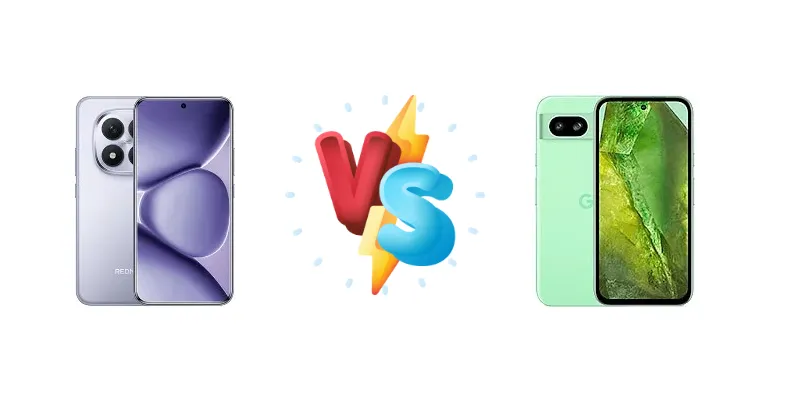
The Xiaomi Redmi Note 15 Pro+ and Google Pixel 8a represent distinct philosophies in the mid-range smartphone market. The Redmi Note 15 Pro+ aggressively targets charging speed and raw processing power with the Snapdragon 7s Gen 4, while the Pixel 8a emphasizes software experience, camera prowess, and long-term battery health powered by the Google Tensor G3.
🏆 Quick Verdict
For the average user prioritizing a smooth, long-lasting experience with exceptional camera capabilities, the Google Pixel 8a is the better choice. Its Tensor G3 chip, coupled with Google’s software optimization and impressive 40:06h endurance, outweighs the Redmi Note 15 Pro+'s faster charging.
| Network |
|---|
| 2G bands | GSM 850 / 900 / 1800 / 1900 | GSM 850 / 900 / 1800 / 1900 |
| 3G bands | HSDPA 800 / 850 / 900 / 1700(AWS) / 1900 / 2100 | HSDPA 800 / 850 / 900 / 1700(AWS) / 1900 / 2100 |
| 4G bands | LTE | 1, 2, 3, 4, 5, 7, 8, 12, 17, 18, 19, 20, 26, 28, 32, 38, 40, 41, 42, 66 - G6GPR (International) |
| 5G bands | SA/NSA | 1, 2, 3, 5, 7, 8, 12, 20, 26, 28, 38, 40, 41, 66, 75, 76, 77, 78 SA/NSA/Sub6 - G6GPR (International) |
| Speed | HSPA, LTE, 5G | HSPA, LTE, 5G |
| Technology | GSM / HSPA / LTE / 5G | GSM / HSPA / LTE / 5G |
| Launch |
|---|
| Announced | Not announced yet | 2024, May 07 |
| Status | Rumored | Available. Released 2024, May 14 |
| Body |
|---|
| Build | Glass front (Gorilla Glass Victus 2), glass back (Gorrila Glass 7i) or silicone polymer back (eco leather), aluminum frame | Glass front (Gorilla Glass 3), aluminum frame, plastic back |
| Dimensions | 163.3 x 78.3 x 7.9 mm (6.43 x 3.08 x 0.31 in) | 152.1 x 72.7 x 8.9 mm (5.99 x 2.86 x 0.35 in) |
| SIM | · Nano-SIM + eSIM· Nano-SIM + Nano-SIM | Nano-SIM + eSIM |
| Weight | 207 g (7.30 oz) | 188 g (6.63 oz) |
| Display |
|---|
| Protection | Corning Gorilla Glass Victus 2 | Corning Gorilla Glass 3, Mohs level 5 |
| Resolution | 1280 x 2712 pixels, 19:9 ratio (~439 ppi density) | 1080 x 2400 pixels, 20:9 ratio (~430 ppi density) |
| Size | 6.83 inches, 116.2 cm2 (~90.9% screen-to-body ratio) | 6.1 inches, 90.3 cm2 (~81.6% screen-to-body ratio) |
| Type | AMOLED, 68B colors, 120Hz, 3840Hz PWM, HDR10+, Dolby Vision, 3200 nits (peak) | OLED, HDR, 120Hz, 2000 nits (peak) |
| Platform |
|---|
| CPU | Octa-core (1x2.7 GHz Cortex-A720 & 3x2.4 GHz Cortex-A720 & 4x1.8 GHz Cortex-A520) | Nona-core (1x3.0 GHz Cortex-X3 & 4x2.45 GHz Cortex-A715 & 4x2.15 GHz Cortex-A510) |
| Chipset | Qualcomm SM7635-AC Snapdragon 7s Gen 4 (4 nm) | Google Tensor G3 (4 nm) |
| GPU | Adreno 810 | Immortalis-G715s MC10 |
| OS | Android 15, HyperOS 2 | Android 14, upgradable to Android 16, up to 7 major Android upgrades |
| Memory |
|---|
| Card slot | No | No |
| Internal | 256GB 8GB RAM | 128GB 8GB RAM, 256GB 8GB RAM |
| Main Camera |
|---|
| Dual | - | 64 MP (16 MP eff.), f/1.9, 26mm (wide), 1/1.73", 0.8µm, dual pixel PDAF, OIS
13 MP, f/2.2, 120˚ (ultrawide), 1.12µm |
| Features | LED flash, HDR, panorama | Dual-LED flash, Pixel Shift, Ultra HDR, panorama, Best Take |
| Triple | 200 MP, f/1.7, 23mm (wide), 1/1.4", 0.56µm, multi-directional PDAF, OIS
8 MP, f/2.2, 15mm, 120˚ (ultrawide), 1/4.0", 1.12µm
2 MP (macro) | - |
| Video | 4K@24/30fps, 1080p@30/60/120fps, gyro-EIS, OIS | 4K@30/60fps, 1080p@30/60/120/240fps, OIS |
| Selfie camera |
|---|
| Features | HDR, panorama | HDR, panorama |
| Single | 32 MP, (wide) | 13 MP, f/2.2, 20mm (ultrawide), 1.12µm |
| Video | 1080p@30/60fps | 4K@30fps, 1080p@30/60fps |
| Sound |
|---|
| 35mm jack | No | No |
| Loudspeaker | Yes, with stereo speakers (with Dolby Atmos) | Yes, with stereo speakers |
| Comms |
|---|
| Bluetooth | 5.4, A2DP, LE | 5.3, A2DP, LE |
| Infrared port | Yes | - |
| NFC | Yes (market/region dependent) | Yes |
| Positioning | GPS (L1+L5), GALILEO, GLONASS, QZSS, BDS | GPS, GLONASS, GALILEO, BDS, QZSS, NavIC |
| Radio | Unspecified | No |
| USB | USB Type-C 2.0, OTG | USB Type-C 3.2 |
| WLAN | Wi-Fi 802.11 a/b/g/n/ac/6/6e, dual-band, Wi-Fi Direct (/6e is market/region dependent) | Wi-Fi 802.11 a/b/g/n/ac/6e, dual/tri-band (market/region dependent) |
| Features |
|---|
| Sensors | Fingerprint (under display, optical), accelerometer, gyro, compass, proximity | Fingerprint (under display, optical), accelerometer, gyro, proximity, compass, barometer |
| Battery |
|---|
| Charging | 100W wired | 18W wired, PD3.0
7.5W wireless
Bypass charging |
| Type | 6500 mAh | Li-Po 4492 mAh |
| Misc |
|---|
| Colors | Glacier Blue, Mocha Brown, Black | Obsidian, Porcelain, Bay, Aloe |
| Models | 2510ERA8BG | GKV4X, G6GPR, G8HHN, G576D |
| Price | About 500 EUR | $ 229.98 / C$ 417.99 / £ 279.00 / € 299.99 / ₹ 33,300 |
| EU LABEL |
|---|
| Battery | - | 40:06h endurance, 1000 cycles |
| Energy | - | Class B |
| Free fall | - | Class A (270 falls) |
| Repairability | - | Class B |
Xiaomi Redmi Note 15 Pro+
- Ultra-fast 100W wired charging
- Potentially stronger sustained CPU performance
- Likely competitive price point
- Software experience may not match Pixel
- Camera performance likely lags behind Pixel 8a
- Battery life potentially shorter than Pixel 8a
Google Pixel 8a
- Exceptional battery life (40:06h endurance)
- Superior camera quality and image processing
- Smooth and refined software experience
- Slower 18W wired charging
- Less raw CPU power compared to Redmi Note 15 Pro+
- Higher price point
Display Comparison
The Pixel 8a boasts a significantly brighter display, reaching a measured 1508 nits, which will be crucial for outdoor visibility. While the Redmi Note 15 Pro+’s display specs are currently unknown, Xiaomi typically focuses on color accuracy and high refresh rates in this series. The Pixel 8a’s brightness advantage, combined with Google’s color calibration, provides a superior viewing experience, especially in challenging lighting conditions. The Pixel 8a also supports bypass charging, which reduces battery degradation during overnight charging.
Camera Comparison
Without detailed camera specs for the Redmi Note 15 Pro+, it’s difficult to make a direct comparison. However, Google’s Pixel phones are renowned for their computational photography. The Tensor G3’s image signal processor (ISP) excels at dynamic range, noise reduction, and detail preservation. The Pixel 8a’s software algorithms are likely to produce superior images, particularly in low-light conditions. While the Redmi Note 15 Pro+ may offer higher megapixel counts, the Pixel 8a’s image processing will likely deliver more consistently pleasing results. The Pixel 8a’s focus on software optimization will likely provide a more refined camera experience.
Performance
The core difference lies in the chipsets. The Redmi Note 15 Pro+ utilizes the Qualcomm SM7635-AC Snapdragon 7s Gen 4 (4nm), featuring an octa-core configuration with a prime Cortex-A720 core clocked at 2.7 GHz. The Pixel 8a, however, is powered by Google’s Tensor G3 (4nm), a nona-core processor with a Cortex-X3 prime core at 3.0 GHz. While the Snapdragon 7s Gen 4 offers strong multi-core performance, the Tensor G3’s Cortex-X3 core provides a performance edge in single-threaded tasks and AI-driven features. The Tensor G3’s integrated machine learning capabilities also enhance camera processing and on-device AI tasks. The Redmi Note 15 Pro+ will likely excel in sustained CPU workloads, while the Pixel 8a shines in AI and responsiveness.
Battery Life
The Pixel 8a’s battery endurance is a standout feature, achieving 40:06h of endurance and 11:25h of active use. This is significantly better than typical mid-range phones. While the Redmi Note 15 Pro+ boasts 100W wired charging, allowing for incredibly fast top-ups, the Pixel 8a’s longevity reduces the need for frequent charging. The Pixel 8a also supports 7.5W wireless charging and bypass charging, further extending battery lifespan. The Redmi Note 15 Pro+'s 100W charging is ideal for users who frequently run out of battery and need a quick boost, but the Pixel 8a’s overall battery life is more practical for everyday use.
Buying Guide
Buy the Xiaomi Redmi Note 15 Pro+ if you need blazing-fast 100W charging and prioritize peak CPU performance for demanding tasks or gaming. Buy the Google Pixel 8a if you prefer a refined software experience, exceptional camera quality, and a battery that’s built to last, even with moderate to heavy use. The Pixel 8a is ideal for users who value longevity and consistent performance over raw speed.
Frequently Asked Questions
❓ Does the Snapdragon 7s Gen 4 in the Redmi Note 15 Pro+ get hot during extended gaming sessions?
While the 4nm process helps with thermal efficiency, sustained gaming on the Redmi Note 15 Pro+ may lead to some throttling. The Tensor G3 in the Pixel 8a is also prone to some throttling, but Google’s software optimization aims to mitigate this. The Redmi Note 15 Pro+’s larger surface area may help dissipate heat slightly better.
❓ How does the Google Tensor G3's AI capabilities benefit everyday use on the Pixel 8a?
The Tensor G3’s AI engine powers features like Magic Eraser in Google Photos, improved voice recognition, and real-time translation. It also enhances the camera’s scene detection and image processing, resulting in better photos and videos. These AI-driven features contribute to a smoother and more intuitive user experience.
❓ Is 18W charging on the Pixel 8a slow compared to the Redmi Note 15 Pro+'s 100W?
Yes, 18W is significantly slower than 100W. However, the Pixel 8a’s exceptional battery life means you won’t need to charge it as often. The 100W charging on the Redmi Note 15 Pro+ is ideal for quick top-ups, but the Pixel 8a prioritizes long-term battery health and reduced charging frequency.
❓ Will the Pixel 8a receive longer software support than the Redmi Note 15 Pro+?
Google guarantees at least 7 years of software updates for the Pixel 8a, including security patches and OS upgrades. Xiaomi typically offers 2-3 years of major Android updates and 4 years of security patches for its Redmi Note series. Therefore, the Pixel 8a will receive significantly longer software support.