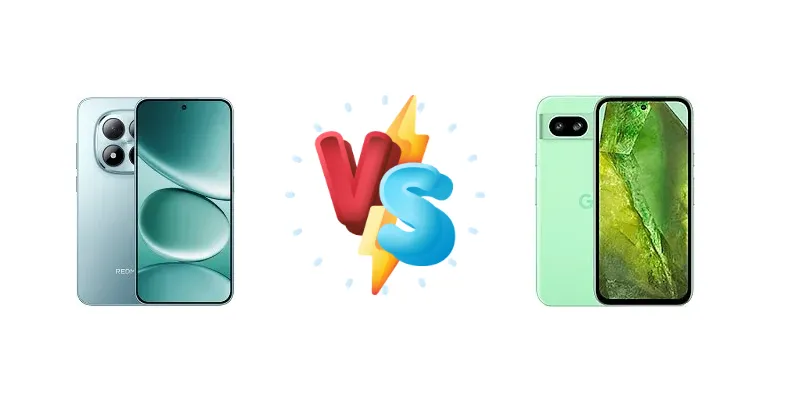
The Google Pixel 8a and Xiaomi Redmi Note 15 Pro represent two distinct philosophies in the mid-range smartphone market. The Pixel 8a brings Google’s renowned computational photography and AI features to a more accessible price point, while the Redmi Note 15 Pro aims to deliver maximum performance and features for the money. This comparison dissects their key differences to determine which device best suits your needs.
🏆 Quick Verdict
For the average user prioritizing camera quality, software experience, and long-term support, the Google Pixel 8a is the superior choice. However, the Xiaomi Redmi Note 15 Pro offers compelling value with its faster 45W charging and potentially more raw processing power for demanding tasks, making it ideal for power users on a budget.
| Network |
|---|
| 2G bands | GSM 850 / 900 / 1800 / 1900 | GSM 850 / 900 / 1800 / 1900 |
| 3G bands | HSDPA 800 / 850 / 900 / 1700(AWS) / 1900 / 2100 | HSDPA 800 / 850 / 900 / 1700(AWS) / 1900 / 2100 |
| 4G bands | LTE | 1, 2, 3, 4, 5, 7, 8, 12, 17, 18, 19, 20, 26, 28, 32, 38, 40, 41, 42, 66 - G6GPR (International) |
| 5G bands | SA/NSA | 1, 2, 3, 5, 7, 8, 12, 20, 26, 28, 38, 40, 41, 66, 75, 76, 77, 78 SA/NSA/Sub6 - G6GPR (International) |
| Speed | HSPA, LTE, 5G | HSPA, LTE, 5G |
| Technology | GSM / HSPA / LTE / 5G | GSM / HSPA / LTE / 5G |
| Launch |
|---|
| Announced | Not announced yet | 2024, May 07 |
| Status | Rumored | Available. Released 2024, May 14 |
| Body |
|---|
| Build | Glass front (Gorilla Glass Victus 2), plastic back or silicone polymer back (eco leather), plastic frame | Glass front (Gorilla Glass 3), aluminum frame, plastic back |
| Dimensions | 163.6 x 78.1 x 7.8 mm (6.44 x 3.07 x 0.31 in) | 152.1 x 72.7 x 8.9 mm (5.99 x 2.86 x 0.35 in) |
| SIM | · Nano-SIM + eSIM· Nano-SIM + Nano-SIM | Nano-SIM + eSIM |
| Weight | 210 g (7.41 oz) | 188 g (6.63 oz) |
| Display |
|---|
| Protection | Corning Gorilla Glass Victus 2 | Corning Gorilla Glass 3, Mohs level 5 |
| Resolution | 1280 x 2712 pixels, 19:9 ratio (~439 ppi density) | 1080 x 2400 pixels, 20:9 ratio (~430 ppi density) |
| Size | 6.83 inches, 116.2 cm2 (~90.9% screen-to-body ratio) | 6.1 inches, 90.3 cm2 (~81.6% screen-to-body ratio) |
| Type | AMOLED, 68B colors, 120Hz, 3840Hz PWM, HDR10+, Dolby Vision, 3200 nits (peak) | OLED, HDR, 120Hz, 2000 nits (peak) |
| Platform |
|---|
| CPU | Octa-core (4x2.6 GHz Cortex-A78 & 4x2.0 GHz Cortex-A55) | Nona-core (1x3.0 GHz Cortex-X3 & 4x2.45 GHz Cortex-A715 & 4x2.15 GHz Cortex-A510) |
| Chipset | Mediatek Dimensity 7400 Ultra (4 nm) | Google Tensor G3 (4 nm) |
| GPU | Mali-G615 MC2 | Immortalis-G715s MC10 |
| OS | Android 15, HyperOS 2 | Android 14, upgradable to Android 16, up to 7 major Android upgrades |
| Memory |
|---|
| Card slot | No | No |
| Internal | 256GB 8GB RAM | 128GB 8GB RAM, 256GB 8GB RAM |
| Main Camera |
|---|
| Dual | 50 MP, f/1.5, (wide), 1/1.95", 1.6µm, multi-directional PDAF, OIS
8 MP, 112˚ (ultrawide) | 64 MP (16 MP eff.), f/1.9, 26mm (wide), 1/1.73", 0.8µm, dual pixel PDAF, OIS
13 MP, f/2.2, 120˚ (ultrawide), 1.12µm |
| Features | LED flash, HDR, panorama | Dual-LED flash, Pixel Shift, Ultra HDR, panorama, Best Take |
| Triple | 200 MP, f/1.7, 23mm (wide), 1/1.4", 0.56µm, multi-directional PDAF, OIS
8 MP, f/2.2, 15mm, 120˚ (ultrawide), 1/4.0", 1.12µm
2 MP (macro) | - |
| Video | 4K@24/30fps, 1080p@30/60/120fps, gyro-EIS, OIS | 4K@30/60fps, 1080p@30/60/120/240fps, OIS |
| Selfie camera |
|---|
| Features | HDR, panorama | HDR, panorama |
| Single | 20 MP, f/2.2, 25mm (wide), 1/4.0", 0.7µm | 13 MP, f/2.2, 20mm (ultrawide), 1.12µm |
| Video | 1080p@30/60fps | 4K@30fps, 1080p@30/60fps |
| Sound |
|---|
| 35mm jack | No | No |
| Loudspeaker | Yes, with stereo speakers (with Dolby Atmos) | Yes, with stereo speakers |
| Comms |
|---|
| Bluetooth | 5.4, A2DP, LE | 5.3, A2DP, LE |
| Infrared port | Yes | - |
| NFC | Yes (market/region dependent) | Yes |
| Positioning | GPS, GALILEO, GLONASS, QZSS, BDS | GPS, GLONASS, GALILEO, BDS, QZSS, NavIC |
| Radio | Unspecified | No |
| USB | USB Type-C 2.0, OTG | USB Type-C 3.2 |
| WLAN | Wi-Fi 802.11 a/b/g/n/ac/6, dual-band, Wi-Fi Direct | Wi-Fi 802.11 a/b/g/n/ac/6e, dual/tri-band (market/region dependent) |
| Features |
|---|
| Sensors | Fingerprint (under display, optical), accelerometer, gyro, compass, proximity | Fingerprint (under display, optical), accelerometer, gyro, proximity, compass, barometer |
| Battery |
|---|
| Charging | 45W wired | 18W wired, PD3.0
7.5W wireless
Bypass charging |
| Type | 6580 mAh | Li-Po 4492 mAh |
| Misc |
|---|
| Colors | Glacier Blue, Gold, Black, Purple | Obsidian, Porcelain, Bay, Aloe |
| Models | 25060RABDG | GKV4X, G6GPR, G8HHN, G576D |
| Price | About 400 EUR | $ 229.98 / C$ 417.99 / £ 279.00 / € 299.99 / ₹ 33,300 |
| EU LABEL |
|---|
| Battery | - | 40:06h endurance, 1000 cycles |
| Energy | - | Class B |
| Free fall | - | Class A (270 falls) |
| Repairability | - | Class B |
Xiaomi Redmi Note 15 Pro
- Superior camera performance and image processing
- Clean Android experience with guaranteed updates
- Exceptional battery life and long-term battery health
- Slower charging speed (18W)
- Potentially lower raw processing power for gaming
Google Pixel 8a
- Faster 45W wired charging
- Potentially stronger gaming performance
- Competitive price point
- MIUI software may not appeal to all users
- Camera performance likely inferior to Pixel 8a
Display Comparison
The Pixel 8a boasts a measured peak brightness of 1508 nits, significantly outshining what we’d expect from the Redmi Note 15 Pro, ensuring excellent visibility even in direct sunlight. While the Redmi Note 15 Pro’s display specs are currently unknown, Xiaomi typically employs AMOLED panels in this series. The Pixel 8a’s display technology is likely to offer superior color accuracy and viewing angles, benefiting content creators and media consumers. The Pixel 8a’s display is also likely to have a higher refresh rate, contributing to smoother scrolling and animations.
Camera Comparison
The Pixel 8a’s camera prowess is a major selling point, leveraging Google’s computational photography expertise. While specific sensor details are missing for both phones, the Pixel 8a’s image processing pipeline is renowned for its dynamic range, accurate colors, and excellent low-light performance. The Redmi Note 15 Pro will likely feature a high-resolution main sensor, but without Google’s software magic, it may struggle to match the Pixel 8a’s image quality. The Pixel 8a’s video recording capabilities are also expected to be superior, with features like Cinematic Pan and improved stabilization. We can expect the Pixel 8a to focus on delivering consistently excellent photos in all conditions, while the Redmi Note 15 Pro may prioritize detail in good lighting.
Performance
The core difference lies in the chipsets: the Google Pixel 8a utilizes the Google Tensor G3 (4nm) with a nona-core configuration, including a high-performance Cortex-X3 core, optimized for AI and machine learning tasks. The Redmi Note 15 Pro features the Mediatek Dimensity 7400 Ultra (4nm) with an octa-core setup. While the Dimensity 7400 Ultra’s Cortex-A78 cores offer strong performance, the Tensor G3’s Cortex-X3 provides a performance edge in single-core tasks and AI-driven applications. The Pixel 8a’s Tensor G3 is designed to excel in tasks like image processing and voice recognition, while the Redmi Note 15 Pro will likely shine in graphics-intensive gaming. The Pixel 8a benefits from Google’s software optimization, potentially mitigating the raw clock speed difference.
Battery Life
The Google Pixel 8a demonstrates impressive battery endurance with a measured 40:06h endurance and 11:25h of active use, alongside a claimed 1000 charge cycles, indicating long-term battery health. The Redmi Note 15 Pro offers 45W wired charging, significantly faster than the Pixel 8a’s 18W charging with PD3.0 and 7.5W wireless charging. While the Pixel 8a’s battery life is exceptional, the Redmi Note 15 Pro’s faster charging will appeal to users who need to quickly top up their device. The Pixel 8a’s bypass charging feature allows for direct power delivery, minimizing heat generation during charging.
Buying Guide
Buy the Xiaomi Redmi Note 15 Pro if you need a phone primarily for gaming, heavy multitasking, or fast charging, and are comfortable with Xiaomi’s MIUI software. Buy the Google Pixel 8a if you prioritize a clean Android experience, exceptional camera performance, and guaranteed software updates, even if it means sacrificing some raw processing speed and charging speed.
Frequently Asked Questions
❓ Does the Mediatek Dimensity 7400 Ultra in the Redmi Note 15 Pro get hot during extended gaming sessions?
While the 4nm process helps with thermal efficiency, prolonged gaming on the Redmi Note 15 Pro may lead to some throttling. Xiaomi typically incorporates cooling solutions, but the Tensor G3 in the Pixel 8a is designed with thermal management in mind, potentially offering more consistent performance under sustained load.
❓ How does the Pixel 8a's software update commitment compare to the Redmi Note 15 Pro?
Google guarantees at least 7 years of software updates for the Pixel 8a, including security patches and OS upgrades. Xiaomi’s update policy for the Redmi Note series is typically shorter, usually offering 2-3 years of major Android updates and 4 years of security patches. This makes the Pixel 8a a more future-proof investment.
❓ Is the 7.5W wireless charging on the Pixel 8a practical for daily use?
7.5W wireless charging is relatively slow compared to wired charging. It's best suited for overnight charging or occasional top-ups. The Redmi Note 15 Pro’s 45W wired charging is significantly faster and more convenient for quickly replenishing the battery.
❓ What kind of video recording features can I expect from the Pixel 8a?
The Pixel 8a is expected to offer advanced video recording features like Cinematic Pan, improved stabilization, and high-quality 4K recording. Google’s video processing excels in dynamic range and color accuracy, resulting in professional-looking videos.