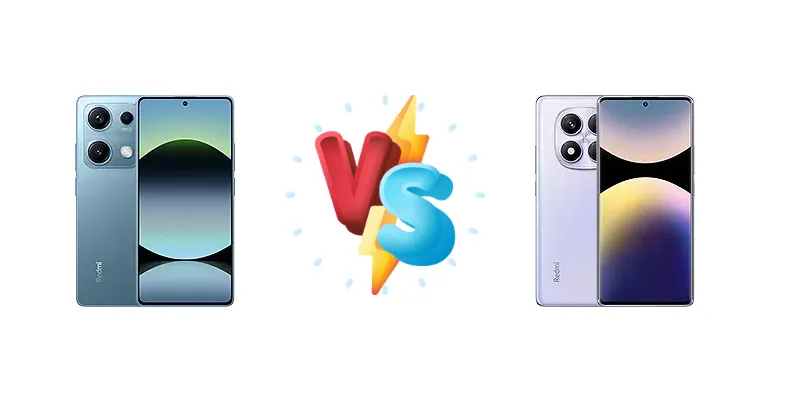
Xiaomi's Redmi Note series consistently delivers impressive value, but the latest iterations – the Redmi Note 14S and the Redmi Note 14 Pro 4G – present a compelling choice between prioritizing battery endurance and a brighter, more vibrant display. This comparison dives deep into the specifications and real-world implications of each device, helping you determine which best suits your needs.
🏆 Quick Verdict
For the average user, the Redmi Note 14 Pro 4G emerges as the slightly stronger choice, primarily due to its significantly superior display brightness and impressive 52-hour battery endurance. However, the Redmi Note 14S provides a compelling alternative for those prioritizing value and fast charging.
| Network |
|---|
| 2G bands | GSM 850 / 900 / 1800 / 1900 | GSM 850 / 900 / 1800 / 1900 |
| 3G bands | HSDPA 850 / 900 / 1700(AWS) / 1900 / 2100 | HSDPA 850 / 900 / 1700(AWS) / 1900 / 2100 |
| 4G bands | LTE | 1, 2, 3, 4, 5, 7, 8, 12, 13, 17, 20, 26, 28, 38, 40, 41, 66 |
| Speed | HSPA, LTE | HSPA, LTE |
| Technology | GSM / HSPA / LTE | GSM / HSPA / LTE |
| Launch |
|---|
| Announced | 2025, March 14 | 2025, January 10 |
| Status | Available. Released 2025, March 14 | Available. Released 2025, January 16 |
| Body |
|---|
| Build | Glass front (Gorilla Glass 5), plastic frame, plastic back | Glass front (Gorilla Glass Victus 2), plastic back, aluminum frame |
| Dimensions | 161.1 x 75 x 8 mm (6.34 x 2.95 x 0.31 in) | 162.2 x 74.9 x 8.2 mm (6.39 x 2.95 x 0.32 in) |
| SIM | Nano-SIM + Nano-SIM | Nano-SIM + Nano-SIM |
| Weight | 179 g (6.31 oz) | 180 g (6.35 oz) |
| Display |
|---|
| Protection | Corning Gorilla Glass 5 | Corning Gorilla Glass Victus 2, Mohs level 5 |
| Resolution | 1080 x 2400 pixels, 20:9 ratio (~395 ppi density) | 1080 x 2400 pixels, 20:9 ratio (~395 ppi density) |
| Size | 6.67 inches, 107.4 cm2 (~88.9% screen-to-body ratio) | 6.67 inches, 107.4 cm2 (~88.4% screen-to-body ratio) |
| Type | AMOLED, 1B colors, 120Hz, 500 nits (typ), 1000 nits (HBM), 1300 nits (peak) | AMOLED, 1B colors, 120Hz, 1920Hz PWM, 1200 nits (HBM), 1800 nits (peak) |
| Platform |
|---|
| CPU | Octa-core (2x2.2 GHz Cortex-A76 & 6x2.0 GHz Cortex-A55) | Octa-core (2x2.2 GHz Cortex-A76 & 6x2.0 GHz Cortex-A55) |
| Chipset | Mediatek Helio G99 Ultra | Mediatek Helio G100 Ultra (6 nm) |
| GPU | Mali-G57 MC2 | Mali-G57 MC2 |
| OS | Android 15, HyperOS | Android 14, HyperOS |
| Memory |
|---|
| Card slot | microSDXC (uses shared SIM slot) | microSDXC (uses shared SIM slot) |
| Internal | 128GB 8GB RAM, 256GB 8GB RAM, 512GB 12GB RAM | 128GB 8GB RAM, 256GB 8GB RAM, 256GB 12GB RAM, 512GB 12GB RAM |
| Main Camera |
|---|
| Features | LED flash, HDR, panorama | LED flash, HDR, panorama |
| Triple | 200 MP, f/1.7, 23mm (wide), 1/1.4", 0.56µm, multi-directional PDAF, OIS
8 MP, f/2.2, 15mm, 120˚ (ultrawide), 1/4.4", 1.0µm
2 MP (macro) | 200 MP, f/1.7, 23mm (wide), 1/1.4", 0.56µm, multi-directional PDAF, OIS
8 MP, f/2.2, 15mm, 120˚ (ultrawide), 1/4.4", 1.0µm
2 MP (macro) |
| Video | 1080p@30/60fps | 1080p@30/60fps, gyro-EIS |
| Selfie camera |
|---|
| Single | 16 MP, f/2.4, (wide), 1/3.0", 1.0µm | 32 MP, f/2.2, (wide) |
| Video | 1080p@30/60fps | 1080p@30fps |
| Sound |
|---|
| 35mm jack | Yes | Yes |
| Loudspeaker | Yes, with dual speakers | Yes, with stereo speakers (with Dolby Atmos) |
| Comms |
|---|
| Bluetooth | 5.2, A2DP, LE | 5.3, A2DP, LE |
| Infrared port | Yes | Yes |
| NFC | Yes (market/region dependent) | Yes (market/region dependent) |
| Positioning | GPS, GLONASS, GALILEO, BDS | GPS, GALILEO, GLONASS, QZSS, BDS |
| Radio | FM radio | FM radio |
| USB | USB Type-C 2.0, OTG | USB Type-C 2.0, OTG |
| WLAN | Wi-Fi 802.11 a/b/g/n/ac, dual-band | Wi-Fi 802.11 a/b/g/n/ac, dual-band |
| Features |
|---|
| Sensors | Fingerprint (under display, optical), accelerometer, gyro, compass | Fingerprint (under display, optical), accelerometer, proximity, gyro, compass |
| Battery |
|---|
| Charging | 67W wired, 50% in 16 min, 100% in 46 min | 45W wired |
| Type | 5000 mAh | 5500 mAh |
| Misc |
|---|
| Colors | Midnight Black, Aurora Purple, Ocean Blue | Midnight Black, Aurora Purple, Ocean Blue |
| Models | 2502FRA65G | 24116RACCG |
| Price | € 239.95 / $ 189.00 / £ 251.41 | € 179.90 / $ 245.00 / £ 172.99 |
| SAR EU | 0.99 W/kg (head) 0.99 W/kg (body) | 0.80 W/kg (head) 0.98 W/kg (body) |
| EU LABEL |
|---|
| Battery | - | 52:56h endurance, 1000 cycles |
| Energy | - | Class B |
| Free fall | - | Class B (180 falls) |
| Repairability | - | Class C |
Xiaomi Redmi Note 14S
- Faster 67W charging for quick top-ups
- Competitive performance for the price
- Likely more affordable than the Pro model
- Inferior display brightness compared to the Pro
- Lower battery endurance based on available data
Xiaomi Redmi Note 14 Pro 4G
- Exceptional battery life (52:56h endurance)
- Brighter 1500 nit display for outdoor visibility
- More efficient 6nm chipset
- Slower 45W charging
- Potentially higher price point
Display Comparison
The Redmi Note 14 Pro 4G boasts a significant advantage in display technology, achieving a measured peak brightness of 1500 nits. This is crucial for outdoor visibility, making it far more usable in direct sunlight compared to the Redmi Note 14S (brightness unspecified). While both likely utilize LCD panels given the price point, the Pro model’s higher brightness translates to a more vibrant and engaging viewing experience. The absence of refresh rate data for both devices suggests a standard 60Hz panel, focusing the differentiation solely on brightness and color accuracy, where the Pro model is expected to excel.
Camera Comparison
Without detailed camera specifications, a direct comparison is challenging. However, the market positioning suggests the Redmi Note 14 Pro 4G likely features a more sophisticated camera system. While both phones likely include a primary sensor, the Pro model may benefit from a larger sensor size and optical image stabilization (OIS), leading to better low-light performance and sharper images. The inclusion of a 2MP macro camera on either device is largely a marketing tactic, offering limited practical benefit due to its low resolution and fixed focus.
Performance
Both the Redmi Note 14S and the Redmi Note 14 Pro 4G are powered by Mediatek Helio G-series chipsets featuring the same CPU configuration: an octa-core setup with 2x2.2 GHz Cortex-A76 cores and 6x2.0 GHz Cortex-A55 cores. However, the Pro model utilizes the Helio G100 Ultra, fabricated on a more efficient 6nm process compared to the Helio G99 Ultra in the 14S. This smaller node should result in slightly improved thermal efficiency and potentially sustained performance during prolonged gaming sessions. While the CPU is identical, the GPU within the G100 Ultra may offer a marginal performance boost, though real-world differences are likely to be minimal for most users.
Battery Life
The Redmi Note 14 Pro 4G clearly dominates in battery endurance, offering a remarkable 52:56 hours of total usage and an active use score of 12:07 hours. This is a substantial improvement over the Redmi Note 14S, which lacks published endurance data. While the 14S compensates with faster 67W wired charging (50% in 16 minutes, 100% in 46 minutes) compared to the 45W charging on the Pro model, the Pro’s significantly larger battery capacity and superior efficiency provide a more substantial advantage for users who prioritize long-lasting power.
Buying Guide
Buy the Xiaomi Redmi Note 14S if you need a phone that charges incredibly quickly (67W) and offers solid performance for everyday tasks and casual gaming, all while remaining budget-friendly. Buy the Xiaomi Redmi Note 14 Pro 4G if you prefer a brighter, more visually immersive display experience, and value extended battery life for heavy usage, even if it means slightly slower charging.
Frequently Asked Questions
❓ Does the Helio G100 Ultra in the Redmi Note 14 Pro 4G noticeably outperform the Helio G99 Ultra in gaming?
While both chipsets share the same CPU configuration, the Helio G100 Ultra's 6nm process offers improved thermal efficiency. This means it's less likely to throttle performance during extended gaming sessions, potentially resulting in slightly smoother frame rates and more consistent performance over time. However, the difference is unlikely to be dramatic for most mobile games.
❓ How much faster is the 67W charging on the Redmi Note 14S compared to the 45W charging on the Redmi Note 14 Pro 4G in real-world use?
The Redmi Note 14S can reach 50% charge in just 16 minutes and 100% in 46 minutes. The Redmi Note 14 Pro 4G will take considerably longer to fully charge. While the Pro model's larger battery capacity means it will still provide all-day usage, the 14S is the clear winner for users who frequently need to quickly top up their battery.
❓ Is the difference in display brightness between the two phones noticeable in everyday use?
Yes, the 1500 nits peak brightness of the Redmi Note 14 Pro 4G is significantly brighter than what is expected on the Redmi Note 14S. This difference is most noticeable when using the phone outdoors in direct sunlight, where the Pro model will remain easily readable while the 14S may appear washed out.