
Xiaomi 14T Pro vs Redmi Note 14S: A Deep Dive into Xiaomi's Mid-Range Lineup
| Phones Images | |||||
|---|---|---|---|---|---|
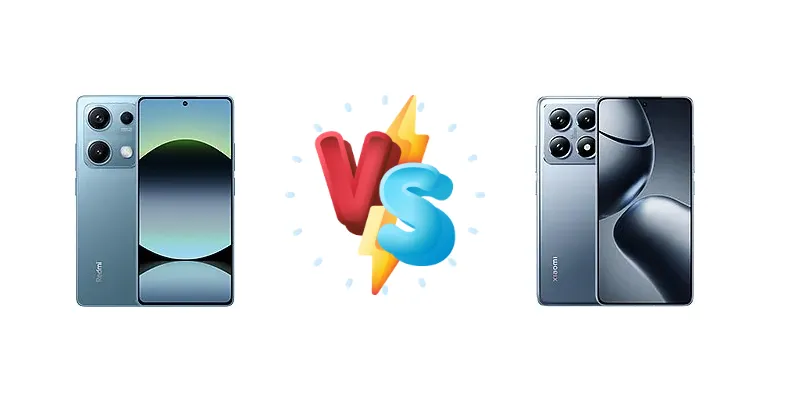
|
🏆 Quick Verdict
For most users, the Xiaomi 14T Pro is the superior choice. Its significantly more powerful Mediatek Dimensity 9300+ chipset, coupled with faster 120W charging and a brighter display, justifies the price premium. However, the Redmi Note 14S remains a compelling option for budget-conscious buyers prioritizing efficiency.
| PHONES | ||
|---|---|---|
| Phone Names | Xiaomi Redmi Note 14S | Xiaomi 14T Pro |
| Network | ||
|---|---|---|
| 2G bands | GSM 850 / 900 / 1800 / 1900 | GSM 850 / 900 / 1800 / 1900 |
| 3G bands | HSDPA 850 / 900 / 1700(AWS) / 1900 / 2100 | HSDPA 800 / 850 / 900 / 1700(AWS) / 1900 / 2100 |
| 4G bands | LTE | 1, 2, 3, 4, 5, 7, 8, 12, 13, 17, 18, 19, 20, 25, 26, 28, 32, 38, 39, 40, 41, 42, 48, 66 |
| 5G bands | - | 1, 2, 3, 5, 7, 8, 12, 20, 25, 26, 28, 38, 40, 41, 48, 66, 75, 77, 78 SA/NSA |
| Speed | HSPA, LTE | HSPA, LTE, 5G |
| Technology | GSM / HSPA / LTE | GSM / HSPA / LTE / 5G |
| Launch | ||
|---|---|---|
| Announced | 2025, March 14 | 2024, September 26 |
| Status | Available. Released 2025, March 14 | Available. Released 2024, September 26 |
| Body | ||
|---|---|---|
| Build | Glass front (Gorilla Glass 5), plastic frame, plastic back | Glass front (Gorilla Glass 5), aluminum frame, glass back (Panda X) |
| Dimensions | 161.1 x 75 x 8 mm (6.34 x 2.95 x 0.31 in) | 160.4 x 75.1 x 8.4 mm (6.31 x 2.96 x 0.33 in) |
| SIM | Nano-SIM + Nano-SIM | · Nano-SIM + eSIM· eSIM + eSIM· Nano-SIM + Nano-SIM |
| Weight | 179 g (6.31 oz) | 209 g (7.37 oz) |
| Display | ||
|---|---|---|
| Protection | Corning Gorilla Glass 5 | Corning Gorilla Glass 5 |
| Resolution | 1080 x 2400 pixels, 20:9 ratio (~395 ppi density) | 1220 x 2712 pixels, 20:9 ratio (~446 ppi density) |
| Size | 6.67 inches, 107.4 cm2 (~88.9% screen-to-body ratio) | 6.67 inches, 107.4 cm2 (~89.1% screen-to-body ratio) |
| Type | AMOLED, 1B colors, 120Hz, 500 nits (typ), 1000 nits (HBM), 1300 nits (peak) | AMOLED, 68B colors, 144Hz, 3840Hz PWM, Dolby Vision, HDR10+, 1600 nits (HBM), 4000 nits (peak) |
| Platform | ||
|---|---|---|
| CPU | Octa-core (2x2.2 GHz Cortex-A76 & 6x2.0 GHz Cortex-A55) | Octa-core (1x3.4 GHz Cortex-X4 & 3x2.85 GHz Cortex-X4 & 4x2.0 GHz Cortex-A720) |
| Chipset | Mediatek Helio G99 Ultra | Mediatek Dimensity 9300+ (4 nm) |
| GPU | Mali-G57 MC2 | Immortalis-G720 MC12 |
| OS | Android 15, HyperOS | Android 14, HyperOS |
| Memory | ||
|---|---|---|
| Card slot | microSDXC (uses shared SIM slot) | No |
| Internal | 128GB 8GB RAM, 256GB 8GB RAM, 512GB 12GB RAM | 256GB 12GB RAM, 512GB 12GB RAM, 512GB 16GB RAM, 1TB 12GB RAM |
| Main Camera | ||
|---|---|---|
| Features | LED flash, HDR, panorama | Leica lens, Ultra HDR, LED flash, HDR, panorama |
| Triple | 200 MP, f/1.7, 23mm (wide), 1/1.4", 0.56µm, multi-directional PDAF, OIS 8 MP, f/2.2, 15mm, 120˚ (ultrawide), 1/4.4", 1.0µm 2 MP (macro) | 50 MP, f/1.6, 23mm (wide), 1/1.31", 1.2µm, PDAF, OIS 50 MP, f/2.0, 60mm (telephoto), 1/2.88", 0.61µm, PDAF, 2.6x optical zoom 12 MP, f/2.2, 15mm (ultrawide), 1/3.06", 1.12µm |
| Video | 1080p@30/60fps | 8K@24/30fps, 4K@24/30/60fps, 1080p@30/60/120/240/960fps, gyro-EIS, 10-bit Rec. 2020, HDR10+ |
| Selfie camera | ||
|---|---|---|
| Features | - | HDR |
| Single | 16 MP, f/2.4, (wide), 1/3.0", 1.0µm | 32 MP, f/2.0, 25mm (wide), 1/3.44", 0.64µm |
| Video | 1080p@30/60fps | 4K@30fps, 1080p@30/60fps, HDR10+ |
| Sound | ||
|---|---|---|
| 35mm jack | Yes | No |
| Loudspeaker | Yes, with dual speakers | Yes, with stereo speakers |
| Comms | ||
|---|---|---|
| Bluetooth | 5.2, A2DP, LE | 5.4, A2DP, LE, LHDC |
| Infrared port | Yes | Yes |
| NFC | Yes (market/region dependent) | Yes (market/region dependent) |
| Positioning | GPS, GLONASS, GALILEO, BDS | GPS (L1+L5), BDS (B1I+B1C+B2a+B2b), GALILEO (E1+E5a+E5b), QZSS (L1+L5), NavIC (L5), GLONASS |
| Radio | FM radio | No |
| USB | USB Type-C 2.0, OTG | USB Type-C 2.0, OTG |
| WLAN | Wi-Fi 802.11 a/b/g/n/ac, dual-band | Wi-Fi 802.11 a/b/g/n/ac/6e/7, dual-band, Wi-Fi Direct |
| Features | ||
|---|---|---|
| Sensors | Fingerprint (under display, optical), accelerometer, gyro, compass | Fingerprint (under display, optical), accelerometer, gyro, proximity, compass |
| Battery | ||
|---|---|---|
| Charging | 67W wired, 50% in 16 min, 100% in 46 min | 120W wired, PD3.0, QC4, 100% in 19 min 50W wireless, 100% in 45 min |
| Type | 5000 mAh | Li-Po 5000 mAh |
| Misc | ||
|---|---|---|
| Colors | Midnight Black, Aurora Purple, Ocean Blue | Titan Gray, Titan Blue, Titan Black |
| Models | 2502FRA65G | 2407FPN8EG |
| Price | € 239.95 / $ 189.00 / £ 251.41 | $ 550.00 / £ 498.00 / € 539.99 |
| SAR EU | 0.99 W/kg (head) 0.99 W/kg (body) | 0.99 W/kg (head) 1.00 W/kg (body) |
Xiaomi Redmi Note 14S
- More affordable price point
- Efficient processor for basic tasks
- Respectable 67W fast charging
- Significantly weaker performance compared to the 14T Pro
- Likely lower display brightness and quality
- Potentially limited camera capabilities
Xiaomi 14T Pro
- Exceptional performance with the Dimensity 9300+
- Ultra-fast 120W wired and 50W wireless charging
- Bright and vibrant display with 1228 nits peak brightness
- Higher price tag
- Potentially more heat generation under heavy load
- May be overkill for basic smartphone users
Display Comparison
The Xiaomi 14T Pro boasts a significantly brighter display, reaching a measured peak of 1228 nits, compared to the Redmi Note 14S (brightness data unavailable, but expected to be lower based on segment). This higher brightness translates to improved visibility in direct sunlight. While both likely utilize LCD panels given the price points, the 14T Pro’s superior brightness and potential for higher color accuracy make it the better choice for media consumption. The absence of LTPO technology on either device suggests standard refresh rate management, impacting power consumption during dynamic content.
Camera Comparison
Without detailed camera specifications for the Redmi Note 14S, a direct comparison is limited. However, the 14T Pro is expected to feature a more advanced camera system, likely with a larger main sensor and more sophisticated image processing algorithms. The 14T Pro’s image signal processor (ISP), integrated within the Dimensity 9300+, will offer superior noise reduction and dynamic range compared to the Helio G99 Ultra’s ISP. While both phones may include multiple lenses, the quality of the primary sensor and the software processing will be the defining factors in image quality.
Performance
The performance gap between these devices is substantial. The Xiaomi 14T Pro’s Mediatek Dimensity 9300+ (4nm) chipset, featuring a 1x3.4 GHz Cortex-X4 prime core, dwarfs the Redmi Note 14S’s Mediatek Helio G99 Ultra. The Dimensity 9300+’s architecture – including 3x Cortex-X4 performance cores and 4x Cortex-A720 efficiency cores – provides a massive leap in CPU and GPU capabilities. This translates to smoother multitasking, faster app loading times, and significantly improved gaming performance. The 4nm process node of the Dimensity 9300+ also contributes to better thermal efficiency, reducing the likelihood of throttling under sustained load. The Helio G99 Ultra, while capable for everyday tasks, will struggle with graphically intensive games and demanding applications.
Battery Life
The Xiaomi 14T Pro delivers a compelling battery and charging experience. Its 12:32h active use score demonstrates strong endurance, and the 120W wired charging – capable of a full charge in just 19 minutes – is a significant advantage. The Redmi Note 14S offers 67W wired charging, reaching 100% in 46 minutes, which is respectable but considerably slower. While the Redmi Note 14S’s battery capacity is unknown, the 14T Pro’s combination of efficient chipset and rapid charging provides a more convenient and less disruptive user experience.
Buying Guide
Buy the Xiaomi Redmi Note 14S if you need a reliable daily driver with a focus on battery life and affordability, and aren't demanding of intensive gaming or high-end camera features. Buy the Xiaomi 14T Pro if you prioritize performance for gaming and demanding applications, require faster charging speeds, and appreciate a brighter, more vibrant display experience, even if it means a higher upfront cost.