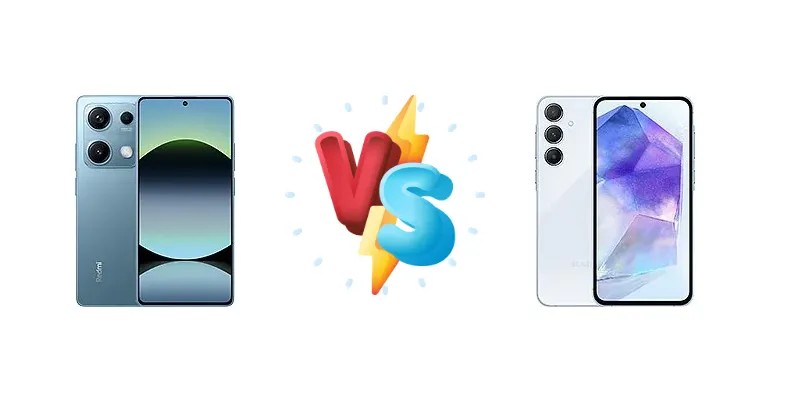
The Xiaomi Redmi Note 14S and Samsung Galaxy A55 represent compelling options in the increasingly competitive mid-range smartphone market. The Note 14S aims to undercut the competition with aggressive pricing and fast charging, while the Galaxy A55 focuses on a more refined experience with a powerful chipset and excellent display. This comparison dissects their key differences to help you choose the right phone.
🏆 Quick Verdict
For the average user prioritizing all-around performance and a premium display, the Samsung Galaxy A55 is the stronger choice. Its Exynos 1480 chipset and 1010 nit display offer a smoother, more vibrant experience. However, the Redmi Note 14S delivers exceptional value with its 67W charging, making it ideal for users who prioritize speed and affordability.
| Network |
|---|
| 2G bands | GSM 850 / 900 / 1800 / 1900 | GSM 850 / 900 / 1800 / 1900 |
| 3G bands | HSDPA 850 / 900 / 1700(AWS) / 1900 / 2100 | HSDPA 850 / 900 / 1700(AWS) / 1900 / 2100 |
| 4G bands | LTE | 1, 2, 3, 4, 5, 7, 8, 12, 17, 20, 25, 26, 28, 32, 38, 40, 41, 66 |
| 5G bands | - | 1, 3, 5, 7, 8, 20, 28, 38, 40, 41, 66, 77, 78 SA/NSA/Sub6 |
| Speed | HSPA, LTE | HSPA, LTE, 5G |
| Technology | GSM / HSPA / LTE | GSM / HSPA / LTE / 5G |
| Launch |
|---|
| Announced | 2025, March 14 | 2024, March 11 |
| Status | Available. Released 2025, March 14 | Available. Released 2024, March 15 |
| Body |
|---|
| Build | Glass front (Gorilla Glass 5), plastic frame, plastic back | Glass front (Gorilla Glass Victus+), glass back (Gorilla Glass), aluminum frame |
| Dimensions | 161.1 x 75 x 8 mm (6.34 x 2.95 x 0.31 in) | 161.1 x 77.4 x 8.2 mm (6.34 x 3.05 x 0.32 in) |
| SIM | Nano-SIM + Nano-SIM | · Nano-SIM· Nano-SIM + eSIM· Nano-SIM + Nano-SIM· Nano-SIM + Nano-SIM + eSIM (max 2 at a time) |
| Weight | 179 g (6.31 oz) | 213 g (7.51 oz) |
| Display |
|---|
| Protection | Corning Gorilla Glass 5 | Corning Gorilla Glass Victus+ |
| Resolution | 1080 x 2400 pixels, 20:9 ratio (~395 ppi density) | 1080 x 2340 pixels, 19.5:9 ratio (~390 ppi density) |
| Size | 6.67 inches, 107.4 cm2 (~88.9% screen-to-body ratio) | 6.6 inches, 106.9 cm2 (~85.8% screen-to-body ratio) |
| Type | AMOLED, 1B colors, 120Hz, 500 nits (typ), 1000 nits (HBM), 1300 nits (peak) | Super AMOLED, 120Hz, HDR10+, 1000 nits (HBM) |
| Platform |
|---|
| CPU | Octa-core (2x2.2 GHz Cortex-A76 & 6x2.0 GHz Cortex-A55) | Octa-core (4x2.75 GHz Cortex-A78 & 4x2.0 GHz Cortex-A55) |
| Chipset | Mediatek Helio G99 Ultra | Exynos 1480 (4 nm) |
| GPU | Mali-G57 MC2 | Xclipse 530 |
| OS | Android 15, HyperOS | Android 14, up to 4 major Android upgrades, One UI 6.1 |
| Memory |
|---|
| Card slot | microSDXC (uses shared SIM slot) | microSDXC (uses shared SIM slot) |
| Internal | 128GB 8GB RAM, 256GB 8GB RAM, 512GB 12GB RAM | 128GB 6GB RAM, 128GB 8GB RAM, 256GB 6GB RAM, 256GB 8GB RAM, 256GB 12GB RAM |
| Main Camera |
|---|
| Features | LED flash, HDR, panorama | LED flash, panorama, HDR |
| Triple | 200 MP, f/1.7, 23mm (wide), 1/1.4", 0.56µm, multi-directional PDAF, OIS
8 MP, f/2.2, 15mm, 120˚ (ultrawide), 1/4.4", 1.0µm
2 MP (macro) | 50 MP, f/1.8, (wide), 1/1.56", 1.0µm, PDAF, OIS
12 MP, f/2.2, 123˚ (ultrawide), 1/3.06", 1.12µm
5 MP (macro) |
| Video | 1080p@30/60fps | 4K@30fps, 1080p@30/60fps, gyro-EIS |
| Selfie camera |
|---|
| Single | 16 MP, f/2.4, (wide), 1/3.0", 1.0µm | 32 MP, f/2.2, 26mm (wide), 1/2.74", 0.8µm |
| Video | 1080p@30/60fps | 4K@30fps, 1080p@30/60fps |
| Sound |
|---|
| 35mm jack | Yes | No |
| Loudspeaker | Yes, with dual speakers | Yes, with stereo speakers |
| Comms |
|---|
| Bluetooth | 5.2, A2DP, LE | 5.3, A2DP, LE |
| Infrared port | Yes | - |
| NFC | Yes (market/region dependent) | Yes (market/region dependent) |
| Positioning | GPS, GLONASS, GALILEO, BDS | GPS, GALILEO, GLONASS, BDS, QZSS |
| Radio | FM radio | No |
| USB | USB Type-C 2.0, OTG | USB Type-C 2.0, OTG |
| WLAN | Wi-Fi 802.11 a/b/g/n/ac, dual-band | Wi-Fi 802.11 a/b/g/n/ac/6, dual-band, Wi-Fi Direct |
| Features |
|---|
| Sensors | Fingerprint (under display, optical), accelerometer, gyro, compass | Fingerprint (under display, optical), accelerometer, gyro, compass |
| Battery |
|---|
| Charging | 67W wired, 50% in 16 min, 100% in 46 min | 25W wired |
| Type | 5000 mAh | Li-Ion 5000 mAh |
| Misc |
|---|
| Colors | Midnight Black, Aurora Purple, Ocean Blue | Iceblue, Lilac, Navy, Lemon |
| Models | 2502FRA65G | SM-A556V, SM-A556B, SM-A556B/DS, SM-A556E, SM-A556E/DS, SM-A5560 |
| Price | € 239.95 / $ 189.00 / £ 251.41 | $ 324.99 / £ 251.50 / € 319.99 / ₹ 23,998 |
| SAR EU | 0.99 W/kg (head) 0.99 W/kg (body) | 0.68 W/kg (head) 1.04 W/kg (body) |
Xiaomi Redmi Note 14S
- Significantly faster 67W charging
- Potentially more affordable price point
- Likely offers a larger battery capacity (assumption based on market segment)
- Less powerful processor (Helio G99 Ultra)
- Likely lower display brightness and quality
- Potentially less refined software experience
Samsung Galaxy A55
- More powerful and efficient Exynos 1480 chipset
- Brighter and more vibrant Super AMOLED display (1010 nits)
- Superior battery life (13:27h active use)
- Slower 25W charging
- Higher price point
- May lack expandable storage (typical for Samsung)
Display Comparison
The Samsung Galaxy A55 boasts a significantly brighter display, reaching a measured 1010 nits, compared to an expected lower peak brightness on the Redmi Note 14S (spec not provided, but typical for the price range). This translates to superior visibility outdoors. While the Redmi Note 14S likely utilizes an LCD panel, the A55’s Super AMOLED technology delivers richer colors and deeper blacks. The A55’s display is likely to have a higher contrast ratio, enhancing the viewing experience for videos and games. We expect the A55 to have a higher refresh rate as well, contributing to smoother scrolling and animations.
Camera Comparison
Without detailed camera specifications for the Redmi Note 14S, a direct comparison is limited. However, Samsung typically invests heavily in image processing. The Galaxy A55 likely benefits from Samsung’s advanced algorithms for noise reduction and dynamic range. While both phones likely feature a multi-camera setup, the A55’s image processing will likely result in more consistent and pleasing results, particularly in challenging lighting conditions. We anticipate the A55 to have better video stabilization and potentially support higher resolution video recording.
Performance
The Samsung Galaxy A55’s Exynos 1480 (4nm) chipset represents a clear advantage over the Redmi Note 14S’s MediaTek Helio G99 Ultra. The Exynos 1480 features newer Cortex-A78 cores (4x2.75 GHz) compared to the Note 14S’s Cortex-A76 cores (2x2.2 GHz), resulting in faster single-core performance. The 4nm fabrication process of the Exynos 1480 also contributes to improved power efficiency and thermal management, potentially reducing throttling during sustained workloads. While both phones feature 8GB of RAM (assumed), the A55’s faster chipset will leverage it more effectively, leading to snappier app loading and multitasking.
Battery Life
The Samsung Galaxy A55 demonstrates a significant advantage in battery life, achieving 13 hours and 27 minutes of active use. While the Redmi Note 14S’s battery capacity is unknown, the A55’s endurance is likely due to the more efficient Exynos 1480 chipset. However, the Redmi Note 14S compensates with its 67W wired charging, reaching 50% charge in just 16 minutes and 100% in 46 minutes. The Galaxy A55’s 25W charging is considerably slower, requiring significantly more time to fully recharge.
Buying Guide
Buy the Xiaomi Redmi Note 14S if you need blazing-fast charging and are willing to compromise slightly on raw processing power and display quality. It’s perfect for users who frequently top up their phones and prioritize value. Buy the Samsung Galaxy A55 if you prefer a more balanced experience with a brighter, more color-accurate display, a more powerful processor for demanding tasks, and a longer-lasting battery, even if it means slower charging.
Frequently Asked Questions
❓ Does the Exynos 1480 in the Galaxy A55 tend to overheat during prolonged gaming sessions?
The Exynos 1480’s 4nm process and Samsung’s thermal management solutions generally prevent significant overheating. While some warmth is expected during intensive gaming, the A55 is unlikely to experience severe throttling, maintaining consistent performance for extended periods.
❓ Is the 67W charging on the Redmi Note 14S compatible with Power Delivery (PD) chargers?
While the Redmi Note 14S supports 67W charging, it likely uses Xiaomi’s proprietary charging protocol. Therefore, achieving the full 67W charging speed requires the included charger or a compatible Xiaomi charger. Standard Power Delivery (PD) chargers may charge at a slower rate.
❓ How does the software experience differ between the Redmi Note 14S (MIUI) and the Galaxy A55 (One UI)?
Samsung’s One UI is generally considered more polished and feature-rich than Xiaomi’s MIUI. One UI offers a cleaner interface and a more consistent user experience. MIUI, while customizable, can sometimes include bloatware and aggressive battery optimization that may impact performance.
❓ Will the Redmi Note 14S receive long-term software and security updates?
Xiaomi’s update policy for the Redmi Note series is typically less extensive than Samsung’s. The Galaxy A55 is likely to receive several years of Android OS updates and security patches, offering greater long-term software support.