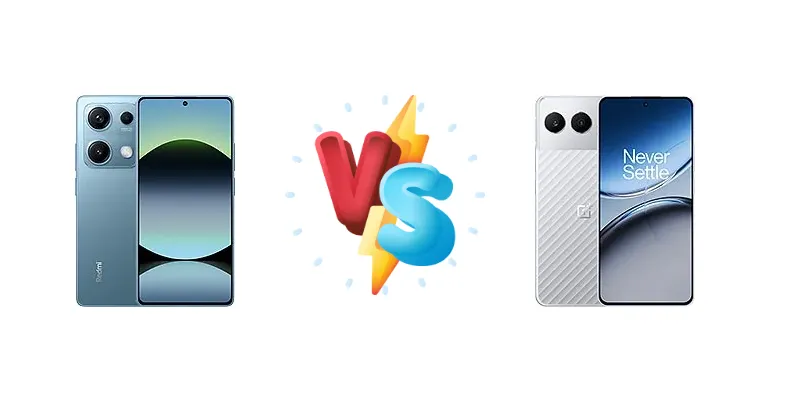
The mid-range smartphone market is fiercely competitive, and the Xiaomi Redmi Note 14S and OnePlus Nord 4 represent compelling options for users seeking a balance of features and affordability. The Note 14S focuses on efficient performance with the Helio G99 Ultra, while the Nord 4 aims for a more premium experience powered by the Snapdragon 7+ Gen 3. This comparison dissects their key differences to help you choose the right device.
🏆 Quick Verdict
For the average user prioritizing raw performance and faster charging, the OnePlus Nord 4 is the clear winner. Its Snapdragon 7+ Gen 3 chipset and 100W charging significantly outperform the Redmi Note 14S's Helio G99 Ultra and 67W charging, justifying the potential price difference.
| Network |
|---|
| 2G bands | GSM 850 / 900 / 1800 / 1900 | GSM 850 / 900 / 1800 / 1900 |
| 3G bands | HSDPA 850 / 900 / 1700(AWS) / 1900 / 2100 | HSDPA 800 / 850 / 900 / 1700(AWS) / 1800 / 1900 / 2100 - International |
| 4G bands | LTE | 1, 2, 3, 4, 5, 7, 8, 12, 17, 18, 19, 20, 26, 28, 38, 39, 40, 41, 66 - International |
| 5G bands | - | 1, 2, 3, 5, 7, 8, 12, 20, 28, 38, 40, 41, 66, 77, 78 SA/NSA - International |
| Speed | HSPA, LTE | HSPA, LTE, 5G |
| Technology | GSM / HSPA / LTE | GSM / HSPA / LTE / 5G |
| Launch |
|---|
| Announced | 2025, March 14 | 2024, July 16 |
| Status | Available. Released 2025, March 14 | Available. Released 2024, August 08 |
| Body |
|---|
| Build | Glass front (Gorilla Glass 5), plastic frame, plastic back | Glass front, aluminum back, aluminum frame |
| Dimensions | 161.1 x 75 x 8 mm (6.34 x 2.95 x 0.31 in) | 162.6 x 75 x 8 mm (6.40 x 2.95 x 0.31 in) |
| SIM | Nano-SIM + Nano-SIM | Nano-SIM + Nano-SIM |
| Weight | 179 g (6.31 oz) | 199.5 g (7.05 oz) |
| Display |
|---|
| Protection | Corning Gorilla Glass 5 | - |
| Resolution | 1080 x 2400 pixels, 20:9 ratio (~395 ppi density) | 1240 x 2772 pixels, 20:9 ratio (~450 ppi density) |
| Size | 6.67 inches, 107.4 cm2 (~88.9% screen-to-body ratio) | 6.74 inches, 109.7 cm2 (~90.0% screen-to-body ratio) |
| Type | AMOLED, 1B colors, 120Hz, 500 nits (typ), 1000 nits (HBM), 1300 nits (peak) | Fluid AMOLED, 1B colors, 120Hz, HDR10+, 2150 nits (peak) |
| Platform |
|---|
| CPU | Octa-core (2x2.2 GHz Cortex-A76 & 6x2.0 GHz Cortex-A55) | Octa-core (1x2.8 GHz Cortex-X4 & 4x2.6 GHz Cortex-A720 & 3x1.9 GHz Cortex-A520) |
| Chipset | Mediatek Helio G99 Ultra | Qualcomm SM7675 Snapdragon 7+ Gen 3 (4 nm) |
| GPU | Mali-G57 MC2 | Adreno 732 |
| OS | Android 15, HyperOS | Android 14, up to 4 major Android upgrades, OxygenOS 15 |
| Memory |
|---|
| Card slot | microSDXC (uses shared SIM slot) | No |
| Internal | 128GB 8GB RAM, 256GB 8GB RAM, 512GB 12GB RAM | 128GB 8GB RAM, 256GB 8GB RAM, 256GB 12GB RAM, 512GB 16GB RAM |
| Main Camera |
|---|
| Dual | - | 50 MP, f/1.8, 25mm (wide), 1/1.95", 0.8µm, PDAF, OIS
8 MP, f/2.2, 112˚ (ultrawide), 1/4.0", 1.12µm |
| Features | LED flash, HDR, panorama | Dual-LED flash, HDR, panorama |
| Triple | 200 MP, f/1.7, 23mm (wide), 1/1.4", 0.56µm, multi-directional PDAF, OIS
8 MP, f/2.2, 15mm, 120˚ (ultrawide), 1/4.4", 1.0µm
2 MP (macro) | - |
| Video | 1080p@30/60fps | 4K@30/60fps, 1080p@30/60/120fps, gyro-EIS |
| Selfie camera |
|---|
| Features | - | Panorama |
| Single | 16 MP, f/2.4, (wide), 1/3.0", 1.0µm | 16 MP, f/2.4, 24mm (wide), 1.0µm |
| Video | 1080p@30/60fps | 1080p@30fps |
| Sound |
|---|
| 35mm jack | Yes | No |
| Loudspeaker | Yes, with dual speakers | Yes, with stereo speakers |
| Comms |
|---|
| Bluetooth | 5.2, A2DP, LE | 5.4, A2DP, LE, aptX HD, LHDC |
| Infrared port | Yes | Yes |
| NFC | Yes (market/region dependent) | Yes |
| Positioning | GPS, GLONASS, GALILEO, BDS | GPS, GALILEO, GLONASS, BDS, QZSS |
| Radio | FM radio | No |
| USB | USB Type-C 2.0, OTG | USB Type-C 2.0 |
| WLAN | Wi-Fi 802.11 a/b/g/n/ac, dual-band | Wi-Fi 802.11 a/b/g/n/ac/6, dual-band, Wi-Fi Direct |
| Features |
|---|
| Sensors | Fingerprint (under display, optical), accelerometer, gyro, compass | Fingerprint (under display, optical), accelerometer, gyro, proximity, compass |
| Battery |
|---|
| Charging | 67W wired, 50% in 16 min, 100% in 46 min | 100W wired, PPS, 100% in 28 min |
| Type | 5000 mAh | 5500 mAh |
| Misc |
|---|
| Colors | Midnight Black, Aurora Purple, Ocean Blue | Obsidian Midnight, Mercurial Silver, Oasis Green |
| Models | 2502FRA65G | CPH2663, CPH2661 |
| Price | € 239.95 / $ 189.00 / £ 251.41 | € 410.27 / £ 423.17 |
| SAR | - | 1.18 W/kg (head) 1.06 W/kg (body) |
| SAR EU | 0.99 W/kg (head) 0.99 W/kg (body) | - |
Xiaomi Redmi Note 14S
- Potentially lower price point
- Good efficiency from Helio G99 Ultra
- Reliable daily driver performance
- Slower charging speed (67W)
- Less powerful chipset compared to Snapdragon 7+ Gen 3
- Display likely less bright and color accurate
OnePlus Nord 4
- Significantly faster charging (100W)
- Powerful Snapdragon 7+ Gen 3 chipset
- Brighter and likely more accurate display
- Potentially higher price
- May run slightly warmer under heavy load
- Software experience may vary based on OxygenOS updates
Display Comparison
The OnePlus Nord 4 boasts a significantly brighter display, reaching a measured peak of 1163 nits, making it far more usable outdoors in direct sunlight compared to the Redmi Note 14S (brightness data unavailable). While the Note 14S’s panel specifics are unknown, the Nord 4’s brightness advantage is substantial. The Nord 4’s display technology is likely to offer superior color accuracy and viewing angles, though this requires further testing. Bezels are expected to be similar on both devices, typical for this price segment.
Camera Comparison
Without detailed camera specs for the Redmi Note 14S, a direct comparison is limited. However, the OnePlus Nord 4 is expected to have a more sophisticated camera system, leveraging Qualcomm’s image signal processor (ISP) for improved image processing. The Nord 4 likely features a larger main sensor and potentially optical image stabilization (OIS), resulting in better low-light performance and sharper images. The Redmi Note 14S may rely on software enhancements to compensate for a potentially less capable sensor. We anticipate the Nord 4 to offer more consistent and higher-quality photos and videos.
Performance
The core difference lies in the chipsets. The OnePlus Nord 4’s Qualcomm SM7675 Snapdragon 7+ Gen 3 (4nm) is a substantial upgrade over the Redmi Note 14S’s Mediatek Helio G99 Ultra. The Snapdragon 7+ Gen 3 features a Cortex-X4 prime core clocked at 2.8 GHz, alongside Cortex-A720 performance cores, offering a significant leap in CPU and GPU performance. The 4nm process node of the Snapdragon also translates to better thermal efficiency, reducing throttling during sustained workloads. The Redmi Note 14S’s Helio G99 Ultra, while capable, relies on older Cortex-A76 and A55 cores and a less efficient manufacturing process. This will result in lower frame rates in demanding games and potentially more noticeable thermal throttling.
Battery Life
The OnePlus Nord 4 shines in battery charging, supporting 100W wired charging with PPS, achieving a full charge in just 28 minutes. The Redmi Note 14S, with its 67W charging, takes considerably longer at 46 minutes to reach 100%. While the Redmi Note 14S’s battery capacity is unknown, the Nord 4’s active use score of 14:41h demonstrates excellent battery life, likely due to the efficient Snapdragon 7+ Gen 3 chipset. The faster charging of the Nord 4 is a significant convenience factor for users who frequently need to top up their battery.
Buying Guide
Buy the Xiaomi Redmi Note 14S if you need a reliable daily driver with good battery life and prioritize value for money. It's ideal for users who primarily browse, use social media, and occasionally game. Buy the OnePlus Nord 4 if you prefer a smoother, more responsive experience, especially for demanding tasks like gaming and video editing, and value significantly faster charging speeds. It's geared towards power users who want a near-flagship experience without the flagship price.
Frequently Asked Questions
❓ Will the Helio G99 Ultra in the Redmi Note 14S struggle with graphically intensive games like Genshin Impact?
The Helio G99 Ultra is capable of running Genshin Impact, but you'll likely need to lower the graphics settings to medium or low to maintain a stable frame rate. The Snapdragon 7+ Gen 3 in the Nord 4 will provide a significantly smoother experience at higher settings.
❓ How does the 100W charging on the OnePlus Nord 4 compare to other fast charging standards?
The Nord 4’s 100W charging is among the fastest available on smartphones. It’s considerably quicker than the Redmi Note 14S’s 67W charging and surpasses many other phones that utilize 65W or 80W charging. The inclusion of PPS (Power Delivery Protocol) ensures optimized charging efficiency and safety.
❓ Is the difference in chipset performance between the Snapdragon 7+ Gen 3 and Helio G99 Ultra noticeable in everyday tasks?
For basic tasks like browsing, social media, and messaging, the difference may not be immediately apparent. However, when multitasking, editing photos/videos, or launching demanding apps, the Snapdragon 7+ Gen 3 will provide a noticeably snappier and more responsive experience.
❓ Does the OnePlus Nord 4 support software updates for an extended period?
OnePlus typically provides 3 years of Android OS updates and 4 years of security patches for its Nord series devices. This is a competitive level of software support, ensuring your device remains secure and up-to-date for a considerable time.