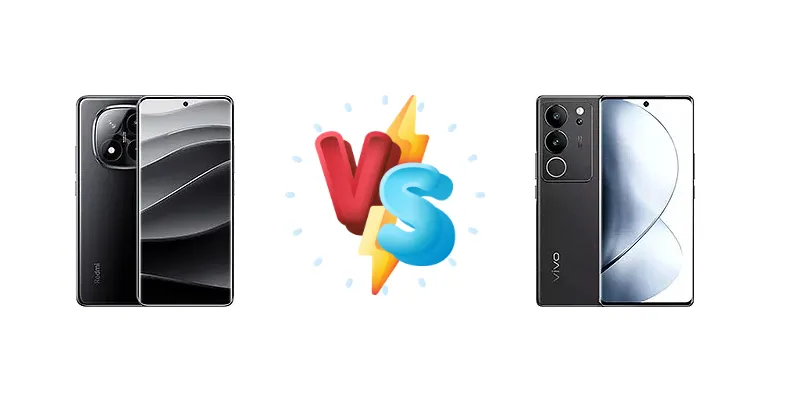
The Xiaomi Redmi Note 14 Pro+ 5G (India) and the vivo V29 Pro represent compelling options in the competitive mid-range smartphone market. The Redmi Note 14 Pro+ focuses on delivering strong performance with the latest Snapdragon 7s Gen 3, while the V29 Pro aims for a balanced experience with the Dimensity 8200 and a focus on camera capabilities and battery endurance. This comparison dives deep into their specifications to determine which device best suits your needs.
🏆 Quick Verdict
For the average user prioritizing raw performance and fast charging, the Xiaomi Redmi Note 14 Pro+ 5G emerges as the winner. Its Snapdragon 7s Gen 3 offers a modern architecture and efficient 4nm process, coupled with 90W charging. While the V29 Pro boasts excellent battery life, the Redmi Note 14 Pro+ provides a more responsive experience.
| Network |
|---|
| 2G bands | GSM 850 / 900 / 1800 / 1900 | GSM 850 / 900 / 1800 / 1900 |
| 3G bands | HSDPA 850 / 900 / 2100 - India | HSDPA 850 / 900 / 1700(AWS) / 1900 / 2100 |
| 4G bands | 1, 3, 5, 8, 28, 38, 40, 41 - India | 1, 3, 4, 5, 8, 19, 28, 34, 38, 39, 40, 41 |
| 5G bands | 1, 3, 5, 8, 28, 38, 40, 41, 77, 78 SA/NSA - India | 1, 3, 5, 8, 28, 40, 77, 78 SA/NSA |
| Speed | HSPA, LTE, 5G | HSPA, LTE, 5G |
| Technology | GSM / HSPA / LTE / 5G | GSM / HSPA / LTE / 5G |
| Launch |
|---|
| Announced | 2024, September 26 | 2023, October 04 |
| Status | Available. Released 2024, September 26 | Available. Released 2023, October 10 |
| Body |
|---|
| Build | Glass front (Gorilla Glass Victus 2), glass back (Gorrila Glass 7i) or silicone polymer back (eco leather) | Glass front, glass back, plastic frame |
| Dimensions | 162.5 x 74.7 x 8.8 mm (6.40 x 2.94 x 0.35 in) | 164.2 x 74.4 x 7.5 mm (6.46 x 2.93 x 0.30 in) |
| SIM | · Nano-SIM + eSIM· Nano-SIM + Nano-SIM | Nano-SIM + Nano-SIM |
| Weight | 205 g or 210 g (7.23 oz) | 188 g (6.63 oz) |
| Display |
|---|
| Protection | Corning Gorilla Glass Victus 2 | - |
| Resolution | 1220 x 2712 pixels, 20:9 ratio (~446 ppi density) | 1260 x 2800 pixels, 20:9 ratio (~453 ppi density) |
| Size | 6.67 inches, 107.4 cm2 (~88.5% screen-to-body ratio) | 6.78 inches, 111.0 cm2 (~90.8% screen-to-body ratio) |
| Type | AMOLED, 68B colors, 120Hz, HDR10+, Dolby Vision, 3000 nits (peak) | AMOLED, 120Hz |
| Platform |
|---|
| CPU | Octa-core (1x2.5 GHz Cortex-A720 & 3x2.4 GHz Cortex-A720 & 4x1.8 GHz Cortex-A520) | Octa-core (1x3.1 GHz Cortex-A78 & 3x3.0 GHz Cortex-A78 & 4x2.0 GHz Cortex-A55) |
| Chipset | Qualcomm SM7635 Snapdragon 7s Gen 3 (4 nm) | Mediatek Dimensity 8200 (4 nm) |
| GPU | Adreno 810 | Mali-G610 MC6 |
| OS | Android 14, up to 3 major Android upgrades, HyperOS | Android 13, up to 3 major Android upgrades, Funtouch 13 |
| Memory |
|---|
| Card slot | No | No |
| Internal | 128GB 8GB RAM, 256GB 8GB RAM, 256GB 12GB RAM, 512GB 12GB RAM, 512GB 16GB RAM | 256GB 8GB RAM, 256GB 12GB RAM |
| Main Camera |
|---|
| Dual | - | 50 MP, f/1.9, (wide), 1/1.56", 1.0µm, PDAF, OIS
12 MP, f/2.0, (telephoto), 1/2.93", 1.22µm, PDAF, 2x optical zoom
8 MP, f/2.2, (ultrawide), 1/4.0", 1.12µm |
| Features | LED flash, HDR, panorama | Ring-LED flash, panorama, HDR |
| Triple | 50 MP, f/1.6, 24mm (wide), 1/1.55", 1.0µm, PDAF, OIS
50 MP, f/2.0, 60mm (telephoto), 1/2.76", PDAF (50cm - ∞), 2.5x optical zoom
8 MP, f/2.2, 15mm, 120˚ (ultrawide), 1/4.0", 1.12µm | - |
| Video | 4K@24/30fps, 1080p@30/60/120fps, gyro-EIS, OIS | 4K@30fps, 1080p@30fps |
| Selfie camera |
|---|
| Features | HDR, panorama | - |
| Single | 20 MP, f/2.2, 21mm (wide), 1/4.0", 0.7µm | 50 MP, f/2.0, 22mm (wide), 1/2.76", 0.64µm, AF |
| Video | 1080p@30/60fps | 1080p@30fps |
| Sound |
|---|
| 35mm jack | No | No |
| Loudspeaker | Yes, with stereo speakers | Yes |
| Comms |
|---|
| Bluetooth | 5.4, A2DP, LE, LHDC | 5.3, A2DP, LE |
| Infrared port | Yes | - |
| NFC | Yes (market/region dependent) | No |
| Positioning | GPS, GALILEO, GLONASS, QZSS, BDS (B1I+B1c) | GPS (L1), GLONASS (G1), BDS (B1I), GALILEO (E1), QZSS (L1), NavIC |
| Radio | Unspecified | No |
| USB | USB Type-C 2.0, OTG | USB Type-C 2.0, OTG |
| WLAN | Wi-Fi 802.11 a/b/g/n/ac/6, dual-band, Wi-Fi Direct | Wi-Fi 802.11 a/b/g/n/ac, dual-band |
| Features |
|---|
| Sensors | Fingerprint (under display, optical), accelerometer, gyro, compass, proximity (ultrasonic) | Fingerprint (under display, optical), accelerometer, gyro, proximity, compass |
| Battery |
|---|
| Charging | 90W wired, PD | 80W wired, 50% in 18 min |
| Type | Si/C Li-Ion 6200 mAh | 4600 mAh |
| Misc |
|---|
| Colors | Titan Black, Phantom Purple, Spectre Blue, White, Green | Himalayan Blue, Space Black, Pink |
| Models | 24115RA8EC, 24115RA8EI | V2251 |
| Price | ₹ 28,998 | About 460 EUR |
| SAR | 0.79 W/kg (head) 0.54 W/kg (body) | 1.17 W/kg (head) 0.77 W/kg (body) |
Xiaomi Redmi Note 14 Pro+ 5G (India)
- Faster 90W charging for quick power-ups
- More modern Snapdragon 7s Gen 3 architecture
- Potentially better thermal management due to 4nm process
- Camera specifications currently unknown
- Display brightness not specified, potentially lower than V29 Pro
vivo V29 Pro
- Excellent battery life with 12:07h active use
- Brighter display (1029 nits) for outdoor visibility
- Refined camera system with established image processing
- Slower 80W charging compared to Redmi Note 14 Pro+
- Older Dimensity 8200 chipset architecture
Display Comparison
The vivo V29 Pro boasts a significantly brighter display, reaching a measured 1029 nits. While the Redmi Note 14 Pro+’s display specifications are currently unavailable, the V29 Pro’s high peak brightness ensures excellent visibility in direct sunlight. The V29 Pro’s panel likely benefits from its focus on multimedia consumption, offering a more vibrant viewing experience. Without knowing the Redmi Note 14 Pro+'s panel technology (LTPO, AMOLED), it's difficult to assess its power efficiency compared to the V29 Pro.
Camera Comparison
The context data for the Redmi Note 14 Pro+ 5G lacks camera details, making a direct comparison challenging. The vivo V29 Pro is described as having a capable Photo/Video camera system. Assuming the V29 Pro follows vivo’s typical strategy, it likely prioritizes image processing for vibrant, social media-ready photos. Without sensor size or aperture information for either device, it’s difficult to assess low-light performance. The V29 Pro’s camera system is likely more mature and refined, given vivo’s established camera reputation.
Performance
The core difference lies in the chipsets. The vivo V29 Pro’s MediaTek Dimensity 8200, with its 3.1 GHz Cortex-A78 prime core and 3x 3.0 GHz Cortex-A78 performance cores, offers strong multi-core performance. However, the Xiaomi Redmi Note 14 Pro+ 5G utilizes the Qualcomm SM7635 Snapdragon 7s Gen 3, built on a more efficient 4nm process. While clock speeds are lower (2.5 GHz Cortex-A720), the newer architecture and process node suggest better sustained performance and thermal management. The Snapdragon 7s Gen 3’s Cortex-A720 cores are a generation ahead of the Dimensity 8200’s A78 cores, offering improved IPC (Instructions Per Clock).
Battery Life
The vivo V29 Pro demonstrates impressive battery endurance, achieving an active use score of 12:07h and an endurance rating of 113h. This suggests a well-optimized system and efficient components. The Redmi Note 14 Pro+ 5G, with its 90W wired charging (PD support), offers significantly faster charging speeds – a key advantage for users who prioritize quick top-ups. The V29 Pro’s 80W charging, reaching 50% in 18 minutes, is respectable but slower. The Redmi Note 14 Pro+'s faster charging could offset a potentially smaller battery capacity (spec not provided).
Buying Guide
Buy the Xiaomi Redmi Note 14 Pro+ 5G (India) if you need a phone optimized for gaming and demanding applications, and value the fastest possible charging speeds. Buy the vivo V29 Pro if you prioritize all-day battery life, a brighter display for outdoor visibility, and a more refined camera experience focused on still photography and video.
Frequently Asked Questions
❓ Will the Dimensity 8200 in the vivo V29 Pro throttle under sustained gaming loads?
The Dimensity 8200 is a capable chipset, but its 5nm process and older core design may lead to more noticeable thermal throttling during extended gaming sessions compared to the Redmi Note 14 Pro+'s 4nm Snapdragon 7s Gen 3. Expect some performance dips after prolonged use, but it should still provide a playable experience.
❓ How does the 90W charging on the Redmi Note 14 Pro+ compare to the 80W charging on the vivo V29 Pro in real-world use?
While both offer fast charging, the Redmi Note 14 Pro+'s 90W charging will significantly reduce charging times. Expect a faster 0-100% charge, potentially shaving off 15-20 minutes compared to the V29 Pro. This is a major benefit for users who frequently need to quickly top up their battery.
❓ Is the camera on the vivo V29 Pro better for video recording or still photography?
Vivo typically optimizes its cameras for still photography, focusing on vibrant colors and pleasing aesthetics for social media. While the V29 Pro likely offers decent video recording capabilities, its strengths lie in capturing high-quality photos, particularly in well-lit conditions.