
Xiaomi Redmi Note 14 Pro+ 5G vs vivo iQOO Neo 7 Pro: A Detailed Comparison
| Phones Images | |||||
|---|---|---|---|---|---|
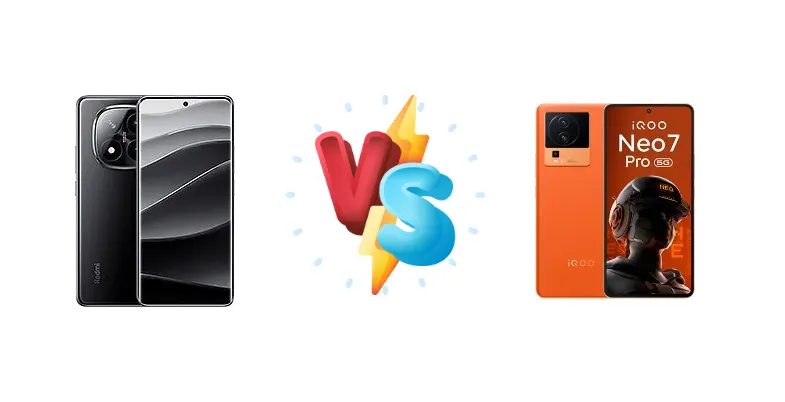
|
🏆 Quick Verdict
For the average user prioritizing raw performance and faster charging, the vivo iQOO Neo 7 Pro is the clear winner. Its Snapdragon 8+ Gen 1 chipset provides a significant performance uplift over the Redmi Note 14 Pro+'s Snapdragon 7s Gen 3. However, the Redmi Note 14 Pro+ offers excellent value and a modern feature set for those on a tighter budget.
| PHONES | ||
|---|---|---|
| Phone Names | Xiaomi Redmi Note 14 Pro+ 5G (India) | vivo iQOO Neo 7 Pro |
| Network | ||
|---|---|---|
| 2G bands | GSM 850 / 900 / 1800 / 1900 | GSM 850 / 900 / 1800 / 1900 |
| 3G bands | HSDPA 850 / 900 / 2100 - India | HSDPA 800 / 850 / 900 / 1700(AWS) / 1900 / 2100 |
| 4G bands | 1, 3, 5, 8, 28, 38, 40, 41 - India | 1, 2, 3, 4, 5, 8, 28, 34, 38, 39, 40, 41 |
| 5G bands | 1, 3, 5, 8, 28, 38, 40, 41, 77, 78 SA/NSA - India | 1, 3, 5, 8, 28, 40, 77, 78 SA/NSA |
| Speed | HSPA, LTE, 5G | HSPA, LTE, 5G |
| Technology | GSM / HSPA / LTE / 5G | GSM / HSPA / LTE / 5G |
| Launch | ||
|---|---|---|
| Announced | 2024, September 26 | 2023, July 04 |
| Status | Available. Released 2024, September 26 | Available. Released 2023, July 15 |
| Body | ||
|---|---|---|
| Build | Glass front (Gorilla Glass Victus 2), glass back (Gorrila Glass 7i) or silicone polymer back (eco leather) | Glass front, plastic frame, glass or leather back |
| Dimensions | 162.5 x 74.7 x 8.8 mm (6.40 x 2.94 x 0.35 in) | 164.8 x 76.9 x 8.5 mm or 8.9 mm |
| SIM | · Nano-SIM + eSIM· Nano-SIM + Nano-SIM | Nano-SIM + Nano-SIM |
| Weight | 205 g or 210 g (7.23 oz) | 197 g or 202 g (6.95 oz) |
| Display | ||
|---|---|---|
| Protection | Corning Gorilla Glass Victus 2 | - |
| Resolution | 1220 x 2712 pixels, 20:9 ratio (~446 ppi density) | 1080 x 2400 pixels, 20:9 ratio (~388 ppi density) |
| Size | 6.67 inches, 107.4 cm2 (~88.5% screen-to-body ratio) | 6.78 inches, 111.0 cm2 (~87.6% screen-to-body ratio) |
| Type | AMOLED, 68B colors, 120Hz, HDR10+, Dolby Vision, 3000 nits (peak) | AMOLED, 1B colors, 120Hz, HDR10+, 1300 nits (peak) |
| Platform | ||
|---|---|---|
| CPU | Octa-core (1x2.5 GHz Cortex-A720 & 3x2.4 GHz Cortex-A720 & 4x1.8 GHz Cortex-A520) | Octa-core (1x3.19 GHz Cortex-X2 & 3x2.75 GHz Cortex-A710 & 4x2.0 GHz Cortex-A510) |
| Chipset | Qualcomm SM7635 Snapdragon 7s Gen 3 (4 nm) | Qualcomm SM8475 Snapdragon 8+ Gen 1 (4 nm) |
| GPU | Adreno 810 | Adreno 730 |
| OS | Android 14, up to 3 major Android upgrades, HyperOS | Android 13, Funtouch 13 |
| Memory | ||
|---|---|---|
| Card slot | No | No |
| Internal | 128GB 8GB RAM, 256GB 8GB RAM, 256GB 12GB RAM, 512GB 12GB RAM, 512GB 16GB RAM | 128GB 8GB RAM, 256GB 12GB RAM |
| Main Camera | ||
|---|---|---|
| Features | LED flash, HDR, panorama | LED flash, HDR, panorama |
| Triple | 50 MP, f/1.6, 24mm (wide), 1/1.55", 1.0µm, PDAF, OIS 50 MP, f/2.0, 60mm (telephoto), 1/2.76", PDAF (50cm - ∞), 2.5x optical zoom 8 MP, f/2.2, 15mm, 120˚ (ultrawide), 1/4.0", 1.12µm | 50 MP, f/1.9, 24mm (wide), 1/1.57", 1.0µm, PDAF, OIS 8 MP, f/2.2, 16mm (ultrawide), 1/4.0", 1.12µm 2 MP (macro) |
| Video | 4K@24/30fps, 1080p@30/60/120fps, gyro-EIS, OIS | 4K@30fps, 1080p@30fps |
| Selfie camera | ||
|---|---|---|
| Features | HDR, panorama | HDR |
| Single | 20 MP, f/2.2, 21mm (wide), 1/4.0", 0.7µm | 16 MP, f/2.5, (wide), 1/3.1", 1.0µm |
| Video | 1080p@30/60fps | 1080p@30fps |
| Sound | ||
|---|---|---|
| 35mm jack | No | No |
| Loudspeaker | Yes, with stereo speakers | Yes, with stereo speakers |
| Comms | ||
|---|---|---|
| Bluetooth | 5.4, A2DP, LE, LHDC | 5.3, A2DP, LE, aptX HD, aptX Adaptive |
| Infrared port | Yes | Yes |
| NFC | Yes (market/region dependent) | No |
| Positioning | GPS, GALILEO, GLONASS, QZSS, BDS (B1I+B1c) | GPS, GLONASS, GALILEO, BDS, QZSS, NavIC |
| Radio | Unspecified | No |
| USB | USB Type-C 2.0, OTG | USB Type-C 2.0, OTG |
| WLAN | Wi-Fi 802.11 a/b/g/n/ac/6, dual-band, Wi-Fi Direct | Wi-Fi 802.11 a/b/g/n/ac/6, dual-band, Wi-Fi Direct |
| Features | ||
|---|---|---|
| Sensors | Fingerprint (under display, optical), accelerometer, gyro, compass, proximity (ultrasonic) | Fingerprint (under display, optical), accelerometer, gyro, proximity, compass |
| Battery | ||
|---|---|---|
| Charging | 90W wired, PD | 120W wired, 50% in 8 min |
| Type | Si/C Li-Ion 6200 mAh | 5000 mAh |
| Misc | ||
|---|---|---|
| Colors | Titan Black, Phantom Purple, Spectre Blue, White, Green | Fearless Flame, Dark Storm |
| Models | 24115RA8EC, 24115RA8EI | I2217 |
| Price | ₹ 28,998 | About 380 EUR |
| SAR | 0.79 W/kg (head) 0.54 W/kg (body) | - |
Xiaomi Redmi Note 14 Pro+ 5G (India)
- Excellent value for money
- Efficient Snapdragon 7s Gen 3 chipset
- Fast 90W wired charging
- Less powerful CPU compared to the iQOO Neo 7 Pro
- Potentially limited gaming performance
vivo iQOO Neo 7 Pro
- Flagship-level Snapdragon 8+ Gen 1 performance
- Ultra-fast 120W wired charging (50% in 8 min)
- Superior ISP for better image quality
- Potentially higher price
- Snapdragon 8+ Gen 1 can generate more heat under sustained load
Display Comparison
While both devices likely feature AMOLED panels (based on brand trends), specific details like peak brightness and refresh rates are missing. However, the core difference lies in the processing power driving the display. The Snapdragon 8+ Gen 1 in the iQOO Neo 7 Pro has a more powerful ISP, potentially leading to better image processing for display output. The Redmi Note 14 Pro+ will likely focus on efficiency, potentially offering slightly better battery life during display-intensive tasks.
Camera Comparison
Without specific camera sensor details, it's difficult to make a definitive judgment. However, the iQOO Neo 7 Pro benefits from the Snapdragon 8+ Gen 1’s superior image signal processor (ISP). This ISP enables faster image processing, better dynamic range, and improved low-light performance. The Redmi Note 14 Pro+ will likely rely on software algorithms to compensate for its less powerful ISP. The iQOO Neo 7 Pro is more likely to capture sharper, more detailed images and videos, especially in challenging lighting conditions. The 8+ Gen 1 also supports more advanced camera features, such as 8K video recording (likely).
Performance
The iQOO Neo 7 Pro’s Snapdragon 8+ Gen 1 (4nm) is a substantial upgrade over the Redmi Note 14 Pro+'s Snapdragon 7s Gen 3 (4nm). The 8+ Gen 1 boasts a prime Cortex-X2 core clocked at 3.19 GHz, compared to the 7s Gen 3’s Cortex-A720 core at 2.5 GHz. This translates to significantly faster CPU performance in benchmarks and real-world applications. The 7s Gen 3’s architecture, while efficient, is geared towards mid-range performance, while the 8+ Gen 1 delivers near-flagship speeds. The iQOO Neo 7 Pro will excel in demanding games and multitasking scenarios, while the Redmi Note 14 Pro+ will handle everyday tasks smoothly but may show limitations under heavy load. The 7s Gen 3's efficiency might lead to slightly better sustained performance due to lower heat generation, but the 8+ Gen 1's raw power is undeniable.
Battery Life
The iQOO Neo 7 Pro’s 120W wired charging is a significant advantage, capable of charging 50% in just 8 minutes. The Redmi Note 14 Pro+’s 90W charging is still fast, but noticeably slower. While battery capacity isn’t specified, the faster charging of the iQOO Neo 7 Pro mitigates any potential disadvantage from a slightly smaller battery. The iQOO Neo 7 Pro allows for quicker top-ups, minimizing downtime, which is crucial for power users. The Redmi Note 14 Pro+ will offer respectable battery life, but the iQOO Neo 7 Pro’s charging speed provides a more convenient user experience.
Buying Guide
Buy the Xiaomi Redmi Note 14 Pro+ 5G (India) if you need a well-rounded smartphone with a modern feature set and prioritize value for money. It's ideal for everyday users, social media enthusiasts, and those who enjoy mobile photography without demanding the absolute highest performance. Buy the vivo iQOO Neo 7 Pro if you prefer a smoother, more responsive experience for gaming, demanding applications, and multitasking. It’s the better choice for power users and those who value faster charging speeds.