
Xiaomi Redmi Note 14 Pro 5G vs Xiaomi 13 Lite: A Detailed Comparison
| Phones Images | |||||
|---|---|---|---|---|---|
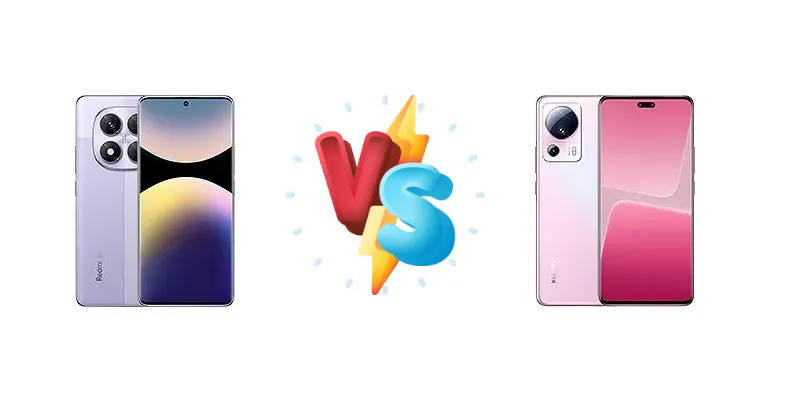
|
🏆 Quick Verdict
For the average user prioritizing long-term battery life and sustained performance, the Xiaomi Redmi Note 14 Pro 5G emerges as the stronger choice. Its significantly improved battery endurance (40:51h vs 93h) and newer Dimensity 7300 Ultra chipset offer a more future-proof experience, despite the 13 Lite's faster 67W charging.
| PHONES | ||
|---|---|---|
| Phone Names | Xiaomi Redmi Note 14 Pro 5G | Xiaomi 13 Lite |
| Network | ||
|---|---|---|
| 2G bands | GSM 850 / 900 / 1800 / 1900 | GSM 850 / 900 / 1800 / 1900 |
| 3G bands | HSDPA 800 / 850 / 900 / 1700(AWS) / 1900 / 2100 | HSDPA 800 / 850 / 900 / 1700(AWS) / 1900 / 2100 |
| 4G bands | 1, 2, 3, 4, 5, 7, 8, 12, 13, 17, 18, 19, 20, 26, 28, 32, 38, 40, 41, 42, 48, 66 | 1, 2, 3, 4, 5, 7, 8, 12, 13, 17, 18, 19, 20, 26, 28, 32, 38, 40, 41, 42, 66 |
| 5G bands | 1, 2, 3, 5, 7, 8, 20, 28, 38, 40, 41, 48, 66, 77, 78 SA/NSA | 1, 3, 5, 7, 8, 20, 28, 38, 40, 41, 66, 77, 78 SA/NSA |
| Speed | HSPA, LTE, 5G | HSPA, LTE, 5G |
| Technology | GSM / HSPA / LTE / 5G | GSM / HSPA / LTE / 5G |
| Launch | ||
|---|---|---|
| Announced | 2025, January 10 | 2023, February 26 |
| Status | Available. Released 2025, January 15 | Available. Released 2023, March 08 |
| Body | ||
|---|---|---|
| Build | Glass front (Gorilla Glass Victus 2), plastic back or silicone polymer back (eco leather) | Glass front (Gorilla Glass 5), glass back, plastic frame |
| Dimensions | 162.3 x 74.4 x 8.4 mm (6.39 x 2.93 x 0.33 in) | 159.2 x 72.7 x 7.2 mm (6.27 x 2.86 x 0.28 in) |
| SIM | · Nano-SIM + eSIM· Nano-SIM + Nano-SIM | · Nano-SIM + eSIM· Nano-SIM + Nano-SIM |
| Weight | 190 g (6.70 oz) | 171 g (6.03 oz) |
| - | IP53, dust and splash resistant | |
| Display | ||
|---|---|---|
| Protection | Corning Gorilla Glass Victus 2, Mohs level 5 | Corning Gorilla Glass 5 |
| Resolution | 1220 x 2712 pixels, 20:9 ratio (~446 ppi density) | 1080 x 2400 pixels, 20:9 ratio (~402 ppi density) |
| Size | 6.67 inches, 107.4 cm2 (~88.9% screen-to-body ratio) | 6.55 inches, 103.6 cm2 (~89.5% screen-to-body ratio) |
| Type | AMOLED, 68B colors, 120Hz, 1920Hz PWM, HDR10+, Dolby Vision, 3000 nits (peak) | AMOLED, 68B colors, Dolby Vision, HDR10+, 120Hz, 500 nits (typ), 1000 nits (peak) |
| Platform | ||
|---|---|---|
| CPU | Octa-core (4x2.5 GHz Cortex-A78 & 4x2.0 GHz Cortex-A55) | Octa-core (1x2.4 GHz Cortex-A710 & 3x2.36 GHz Cortex-A710 & 4x1.8 GHz Cortex-A510) |
| Chipset | Mediatek Dimensity 7300 Ultra (4 nm) | Qualcomm SM7450-AB Snapdragon 7 Gen 1 (4 nm) |
| GPU | Mali-G615 MC2 | Adreno 644 |
| OS | Android 14, up to 3 major Android upgrades, HyperOS | Android 12, MIUI 14 |
| Memory | ||
|---|---|---|
| Card slot | No | No |
| Internal | 256GB 8GB RAM, 256GB 12GB RAM, 512GB 12GB RAM | 64GB 8GB RAM, 128GB 8GB RAM, 256GB 8GB RAM |
| - | UFS 2.2 | |
| Main Camera | ||
|---|---|---|
| Features | LED flash, HDR, panorama | Dual-LED dual-tone flash, HDR, panorama |
| Triple | 200 MP, f/1.7, 23mm (wide), 1/1.4", 0.56µm, multi-directional PDAF, OIS 8 MP, f/2.2, 15mm, 120˚ (ultrawide), 1/4.0", 1.12µm 2 MP (macro) | 50 MP, f/1.8, 23mm (wide), 1/1.56", 1.0µm, PDAF 8 MP, f/2.2, 119˚ (ultrawide), 1/4.0", 1.12µm 2 MP (macro) |
| Video | 4K@24/30fps, 1080p@30/60/120fps, gyro-EIS, OIS | 4K@30fps, 1080p@30/60/120fps, 720p@960fps |
| Selfie camera | ||
|---|---|---|
| Dual | - | 32 MP, f/2.4, 100˚ (ultrawide), 1/2.74", 0.8µm 8 MP, f/2.3, (depth) |
| Features | HDR, panorama | Dual-LED flash, HDR |
| Single | 20 MP, f/2.2, 25mm (wide), 1/4.0", 0.7µm | - |
| Video | 1080p@30/60fps | 1080p@30/60fps |
| Sound | ||
|---|---|---|
| 3.5mm jack | - | No |
| 35mm jack | No | No |
| Loudspeaker | Yes, with stereo speakers (with Dolby Atmos) | Yes |
| - | 24-bit/192kHz audio | |
| Comms | ||
|---|---|---|
| Bluetooth | 5.4, A2DP, LE | 5.2, A2DP, LE |
| Infrared port | Yes | Yes |
| NFC | Yes (market/region dependent) | Yes (market/region dependent) |
| Positioning | GPS, GALILEO, GLONASS, QZSS, BDS | GPS (L1), GLONASS (G1), BDS (B1I+B1c), GALILEO (E1), QZSS (L1) |
| Radio | Unspecified | No |
| USB | USB Type-C 2.0, OTG | USB Type-C 2.0, OTG |
| WLAN | Wi-Fi 802.11 a/b/g/n/ac/6, dual-band, Wi-Fi Direct | Wi-Fi 802.11 a/b/g/n/ac/6, dual-band |
| Features | ||
|---|---|---|
| Sensors | Fingerprint (under display, optical), accelerometer, gyro, compass, proximity | Fingerprint (under display, optical), accelerometer, gyro, proximity, compass |
| Battery | ||
|---|---|---|
| Charging | 45W wired, PD | 67W wired, 100% in 40 min |
| Type | 5110 mAh | Li-Po 4500 mAh |
| Misc | ||
|---|---|---|
| Colors | Lavender Purple, Coral Green, Midnight Black | Black, Lite Blue, Lite Pink |
| Models | 24090RA29G | - |
| Price | $ 299.50 / C$ 710.13 / £ 196.90 / € 224.00 | About 180 EUR |
| SAR | 1.09 W/kg (head) 1.06 W/kg (body) | - |
| SAR EU | 0.99 W/kg (head) 0.99 W/kg (body) | - |
| Tests | ||
|---|---|---|
| Battery life | - | Endurance rating 93h |
| Camera | - | Photo / Video |
| Display | - | Contrast ratio: Infinite (nominal) |
| Loudspeaker | - | -28.5 LUFS (Average) |
| Performance | - | AnTuTu: 534143 (v9) GeekBench: 2936 (v5.1), 2434 (v6) GFXBench: 33fps (ES 3.1 onscreen) |
| EU LABEL | ||
|---|---|---|
| Battery | 40:51h endurance, 1000 cycles | - |
| Energy | Class C | - |
| Free fall | Class B (180 falls) | - |
| Repairability | Class C | - |
Xiaomi Redmi Note 14 Pro 5G
- Significantly longer battery life (40:51h endurance)
- More powerful and efficient Dimensity 7300 Ultra chipset
- Higher peak display brightness (1138 nits)
- Slower charging speed (45W vs 67W)
- Camera specs are currently unknown
Xiaomi 13 Lite
- Faster charging speed (67W, 100% in 40 minutes)
- Potentially lower price point (due to being an older model)
- Good display quality (938 nits)
- Shorter battery life (93h endurance)
- Less powerful Snapdragon 7 Gen 1 chipset
Display Comparison
Both phones feature displays capable of reaching high brightness levels, with the Redmi Note 14 Pro 5G edging out the 13 Lite at 1138 nits versus 938 nits. This translates to better visibility in direct sunlight for the newer model. While both boast an 'Infinite' contrast ratio (nominal), the Note 14 Pro 5G’s display technology isn’t specified, leaving questions about potential advancements like LTPO for variable refresh rates. The 13 Lite’s display, while excellent, is likely a standard AMOLED panel. The difference in peak brightness is noticeable, making the Note 14 Pro 5G the better choice for outdoor use.
Camera Comparison
Both devices are listed as having 'Photo / Video' capabilities, but detailed camera specifications are absent. Given the Redmi Note 14 Pro 5G’s positioning as a newer 'Pro' model, it’s reasonable to expect a more advanced camera system, potentially with a larger main sensor and improved image processing algorithms. The 13 Lite likely relies on software enhancements to compensate for potentially smaller sensors. Without specific sensor size or aperture data, it’s difficult to make a definitive judgment, but the Note 14 Pro 5G likely offers a more versatile and capable camera experience.
Performance
The Redmi Note 14 Pro 5G’s Mediatek Dimensity 7300 Ultra (4nm) represents a significant architectural leap over the Xiaomi 13 Lite’s Qualcomm Snapdragon 7 Gen 1 (4nm). While both are built on a 4nm process, the Dimensity 7300 Ultra utilizes newer Cortex-A78 cores clocked at 2.5 GHz, compared to the 13 Lite’s Cortex-A710 cores at 2.4 GHz. This, coupled with a more efficient core configuration (4x A78 vs 1x A710 + 3x A710), suggests superior multi-core performance and improved power efficiency in the Note 14 Pro 5G. The 13 Lite’s CPU configuration, with a mix of A710 and A510 cores, is less optimized for sustained workloads.
Battery Life
The Redmi Note 14 Pro 5G boasts an impressive 40:51h endurance rating, a substantial improvement over the Xiaomi 13 Lite’s 93h. This difference is likely due to the more efficient Dimensity 7300 Ultra chipset and potentially optimized power management. While the 13 Lite offers faster 67W charging (100% in 40 minutes), the Note 14 Pro 5G’s 45W charging is offset by its significantly longer battery life. The Note 14 Pro 5G also claims 1000 charge cycles, suggesting a longer lifespan for the battery itself.
Buying Guide
Buy the Xiaomi Redmi Note 14 Pro 5G if you need exceptional battery life, a more modern chipset for demanding apps and games, and are willing to trade slightly slower charging for significantly longer usage between charges. Buy the Xiaomi 13 Lite if you prioritize faster charging speeds, potentially a lower price point, and are a lighter user who doesn't heavily tax the processor or battery.