
Redmi Note 14 Pro 5G vs Nothing Phone (2): A Detailed Comparison
| Phones Images | |||||
|---|---|---|---|---|---|
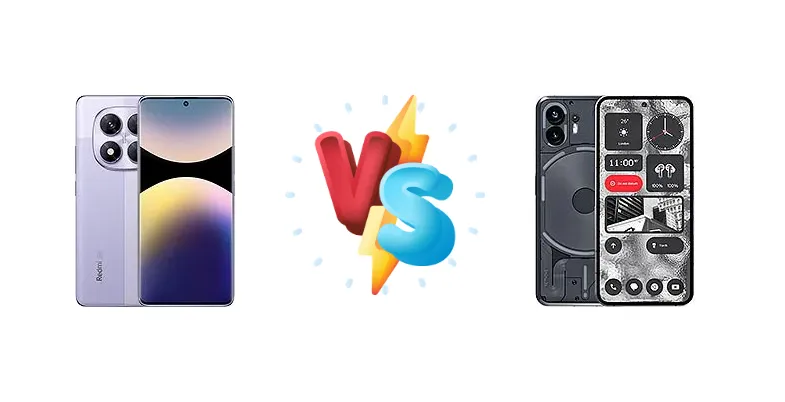
|
🏆 Quick Verdict
For the average user prioritizing raw performance and a more refined software experience, the Nothing Phone (2) is the better choice. Its Snapdragon 8+ Gen 1 chipset provides a significant performance advantage. However, the Redmi Note 14 Pro 5G offers excellent battery endurance and a bright display at a potentially lower price point.
| PHONES | ||
|---|---|---|
| Phone Names | Xiaomi Redmi Note 14 Pro 5G | Nothing Phone (2) |
| Network | ||
|---|---|---|
| 2G bands | GSM 850 / 900 / 1800 / 1900 | GSM 850 / 900 / 1800 / 1900 |
| 3G bands | HSDPA 800 / 850 / 900 / 1700(AWS) / 1900 / 2100 | HSDPA 800 / 850 / 900 / 1700(AWS) / 1900 / 2100 |
| 4G bands | 1, 2, 3, 4, 5, 7, 8, 12, 13, 17, 18, 19, 20, 26, 28, 32, 38, 40, 41, 42, 48, 66 | 1, 2, 3, 4, 5, 7, 8, 12, 17, 18, 19, 20, 25, 26, 28, 30, 32, 34, 38, 39, 40, 41, 42, 48, 66, 71 |
| 5G bands | 1, 2, 3, 5, 7, 8, 20, 28, 38, 40, 41, 48, 66, 77, 78 SA/NSA | 1, 2, 3, 5, 7, 8, 12, 20, 25, 28, 30, 38, 40, 41, 66, 71, 75, 77, 78 SA/NSA |
| Speed | HSPA, LTE, 5G | HSPA, LTE, 5G |
| Technology | GSM / HSPA / LTE / 5G | GSM / HSPA / LTE / 5G |
| Launch | ||
|---|---|---|
| Announced | 2025, January 10 | 2023, July 11 |
| Status | Available. Released 2025, January 15 | Available. Released 2023, July 17 |
| Body | ||
|---|---|---|
| Build | Glass front (Gorilla Glass Victus 2), plastic back or silicone polymer back (eco leather) | Glass front (Gorilla Glass 5), glass back (Gorilla Glass 5), aluminum frame |
| Dimensions | 162.3 x 74.4 x 8.4 mm (6.39 x 2.93 x 0.33 in) | 162.1 x 76.4 x 8.6 mm (6.38 x 3.01 x 0.34 in) |
| SIM | · Nano-SIM + eSIM· Nano-SIM + Nano-SIM | Nano-SIM + Nano-SIM |
| Weight | 190 g (6.70 oz) | 201.2 g (7.09 oz) |
| Display | ||
|---|---|---|
| Protection | Corning Gorilla Glass Victus 2, Mohs level 5 | Corning Gorilla Glass 5 |
| Resolution | 1220 x 2712 pixels, 20:9 ratio (~446 ppi density) | 1080 x 2412 pixels, 20:9 ratio (~394 ppi density) |
| Size | 6.67 inches, 107.4 cm2 (~88.9% screen-to-body ratio) | 6.7 inches, 108.0 cm2 (~87.2% screen-to-body ratio) |
| Type | AMOLED, 68B colors, 120Hz, 1920Hz PWM, HDR10+, Dolby Vision, 3000 nits (peak) | LTPO OLED, 1B colors, 120Hz, 1920Hz PWM, HDR10+, 1600 nits (HBM), 1600 nits (peak) |
| Platform | ||
|---|---|---|
| CPU | Octa-core (4x2.5 GHz Cortex-A78 & 4x2.0 GHz Cortex-A55) | Octa-core (1x3.0 GHz Cortex-X2 & 3x2.5 GHz Cortex-A710 & 4x1.80 GHz Cortex-A510) |
| Chipset | Mediatek Dimensity 7300 Ultra (4 nm) | Qualcomm SM8475 Snapdragon 8+ Gen 1 (4 nm) |
| GPU | Mali-G615 MC2 | Adreno 730 |
| OS | Android 14, up to 3 major Android upgrades, HyperOS | Android 13, upgradable to Android 15, up to 3 major Android upgrades, Nothing OS 3.0 |
| Memory | ||
|---|---|---|
| Card slot | No | No |
| Internal | 256GB 8GB RAM, 256GB 12GB RAM, 512GB 12GB RAM | 128GB 8GB RAM, 256GB 12GB RAM, 512GB 12GB RAM |
| Main Camera | ||
|---|---|---|
| Dual | - | 50 MP, f/1.9, 24mm (wide), 1/1.56", 1.0µm, PDAF, OIS 50 MP, f/2.2, 114˚ (ultrawide), 1/2.76", 0.64µm, AF |
| Features | LED flash, HDR, panorama | LED flash, panorama, HDR |
| Triple | 200 MP, f/1.7, 23mm (wide), 1/1.4", 0.56µm, multi-directional PDAF, OIS 8 MP, f/2.2, 15mm, 120˚ (ultrawide), 1/4.0", 1.12µm 2 MP (macro) | - |
| Video | 4K@24/30fps, 1080p@30/60/120fps, gyro-EIS, OIS | 4K@30/60fps, 1080p@30/60fps, gyro-EIS, live HDR, OIS |
| Selfie camera | ||
|---|---|---|
| Features | HDR, panorama | HDR |
| Single | 20 MP, f/2.2, 25mm (wide), 1/4.0", 0.7µm | 32 MP, f/2.5, (wide), 1/2.74", 0.8µm |
| Video | 1080p@30/60fps | 1080p@30fps |
| Sound | ||
|---|---|---|
| 35mm jack | No | No |
| Loudspeaker | Yes, with stereo speakers (with Dolby Atmos) | Yes, with stereo speakers |
| Comms | ||
|---|---|---|
| Bluetooth | 5.4, A2DP, LE | 5.3, A2DP, LE, aptX HD, aptX Adaptive |
| Infrared port | Yes | - |
| NFC | Yes (market/region dependent) | Yes |
| Positioning | GPS, GALILEO, GLONASS, QZSS, BDS | GPS (L1+L5), GLONASS (L1), BDS (B1I+B1c), GALILEO (E1), QZSS (L1), NavIC |
| Radio | Unspecified | No |
| USB | USB Type-C 2.0, OTG | USB Type-C 2.0, OTG |
| WLAN | Wi-Fi 802.11 a/b/g/n/ac/6, dual-band, Wi-Fi Direct | Wi-Fi 802.11 a/b/g/n/ac/6, dual-band, Wi-Fi Direct |
| Features | ||
|---|---|---|
| Sensors | Fingerprint (under display, optical), accelerometer, gyro, compass, proximity | Fingerprint (under display, optical), accelerometer, proximity, gyro, compass |
| Battery | ||
|---|---|---|
| Charging | 45W wired, PD | 45W wired, PD3.0, PPS, QC4, 100% in 55 min 15W wireless, 100% in 130 min 5W reverse wireless |
| Type | 5110 mAh | Li-Ion 4700 mAh |
| Misc | ||
|---|---|---|
| Colors | Lavender Purple, Coral Green, Midnight Black | White, Dark Gray |
| Models | 24090RA29G | A065 |
| Price | $ 299.50 / C$ 710.13 / £ 196.90 / € 224.00 | $ 379.99 / £ 370.00 |
| SAR | 1.09 W/kg (head) 1.06 W/kg (body) | - |
| SAR EU | 0.99 W/kg (head) 0.99 W/kg (body) | - |
| EU LABEL | ||
|---|---|---|
| Battery | 40:51h endurance, 1000 cycles | - |
| Energy | Class C | - |
| Free fall | Class B (180 falls) | - |
| Repairability | Class C | - |
Xiaomi Redmi Note 14 Pro 5G
- Exceptional battery life (40:51h endurance)
- Bright display (1138 nits)
- Potentially lower price point
- Less powerful chipset compared to Snapdragon 8+ Gen 1
- Limited charging options (no wireless)
Nothing Phone (2)
- Superior performance with Snapdragon 8+ Gen 1
- Faster charging (45W wired + 15W wireless)
- Unique Glyph Interface and software experience
- Slightly lower peak brightness than Redmi Note 14 Pro 5G
- Potentially higher price
Display Comparison
Both phones feature displays capable of reaching nearly 1000 nits of peak brightness, with the Redmi Note 14 Pro 5G slightly edging out the Nothing Phone (2) at 1138 nits. While both are excellent for outdoor visibility, the lack of information regarding panel technology (LTPO, refresh rate) for the Redmi Note 14 Pro 5G leaves the Nothing Phone (2) potentially offering a more adaptive and power-efficient viewing experience. Bezels appear comparable based on available imagery, and color accuracy is not specified for either device, requiring further testing.
Camera Comparison
The provided data lacks detailed camera specifications for both devices. The Nothing Phone (2) is advertised as having strong photo and video capabilities, suggesting a focus on image processing and sensor quality. Without knowing sensor sizes, apertures, or OIS implementation, it’s difficult to make a definitive comparison. The Redmi Note 14 Pro 5G’s camera performance remains largely unknown, and any claims regarding its capabilities would be speculative without further information. We can safely assume both will include standard features like HDR and night mode.
Performance
The core difference lies in the chipsets. The Nothing Phone (2) boasts the Qualcomm Snapdragon 8+ Gen 1, built on a 4nm process, featuring a Cortex-X2 prime core clocked at 3.0 GHz. This contrasts with the Redmi Note 14 Pro 5G’s MediaTek Dimensity 7300 Ultra, also 4nm, but utilizing a Cortex-A78 based core configuration. The Snapdragon 8+ Gen 1’s architecture provides a substantial advantage in sustained performance and GPU capabilities, making the Nothing Phone (2) the clear winner for demanding tasks like gaming and video editing. The Dimensity 7300 Ultra is still a capable chip, but it’s positioned a tier below in terms of raw power.
Battery Life
The Nothing Phone (2) achieves an impressive 14:21h active use score, despite a potentially smaller battery capacity (not specified). This is likely due to the Snapdragon 8+ Gen 1’s efficiency and optimized software. The Redmi Note 14 Pro 5G delivers exceptional endurance with a 40:51h rating, suggesting a larger battery and efficient power management. Both support 45W wired charging with PD, but the Nothing Phone (2) adds PD3.0, PPS, and QC4 for faster charging (100% in 55 minutes) and includes 15W wireless and 5W reverse wireless charging, features absent on the Redmi Note 14 Pro 5G.
Buying Guide
Buy the Xiaomi Redmi Note 14 Pro 5G if you need exceptional battery life – its 40:51h endurance is a standout feature – and prioritize a bright, vibrant display for media consumption. Buy the Nothing Phone (2) if you prefer a smoother, more responsive user experience, demand better gaming performance, and appreciate the unique Glyph Interface and faster charging capabilities.