
Xiaomi Redmi Note 14 Pro 5G vs Google Pixel 7a: A Battle of Endurance and Intelligence
| Phones Images | |||||
|---|---|---|---|---|---|
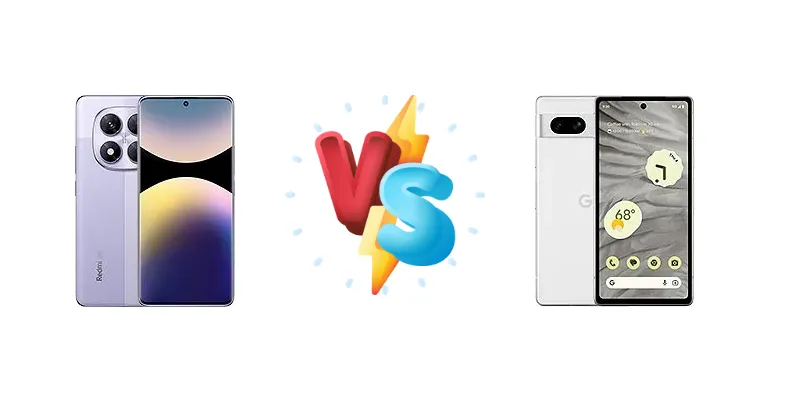
|
🏆 Quick Verdict
For the average user prioritizing battery life and display brightness, the Xiaomi Redmi Note 14 Pro 5G emerges as the winner. Its significantly longer endurance rating and brighter screen outweigh the Pixel 7a’s advantages in camera processing and raw processing power, especially considering the price difference.
| PHONES | ||
|---|---|---|
| Phone Names | Xiaomi Redmi Note 14 Pro 5G | Google Pixel 7a |
| Network | ||
|---|---|---|
| 2G bands | GSM 850 / 900 / 1800 / 1900 | GSM 850 / 900 / 1800 / 1900 |
| 3G bands | HSDPA 800 / 850 / 900 / 1700(AWS) / 1900 / 2100 | HSDPA 800 / 850 / 900 / 1700(AWS) / 1900 / 2100 |
| 4G bands | 1, 2, 3, 4, 5, 7, 8, 12, 13, 17, 18, 19, 20, 26, 28, 32, 38, 40, 41, 42, 48, 66 | 1, 2, 3, 4, 5, 7, 8, 12, 13, 14, 17, 20, 25, 26, 28, 29, 30, 38, 40, 41, 48, 66, 71 - GWKK3, G0DZQ |
| 5G bands | 1, 2, 3, 5, 7, 8, 20, 28, 38, 40, 41, 48, 66, 77, 78 SA/NSA | 1, 2, 3, 5, 7, 8, 12, 14, 20, 25, 28, 30, 38, 41, 48, 66, 71, 77, 78 SA/NSA/Sub6 - GWKK3 |
| Speed | HSPA, LTE, 5G | HSPA, LTE, 5G |
| Technology | GSM / HSPA / LTE / 5G | GSM / HSPA / LTE / 5G |
| - | 1, 2, 3, 5, 7, 8, 12, 20, 25, 28, 38, 40, 41, 66, 75, 76, 77, 78, 79 SA/NSA/Sub6 - GHL1X, G82U8 | |
| Launch | ||
|---|---|---|
| Announced | 2025, January 10 | 2023, May 10 |
| Status | Available. Released 2025, January 15 | Available. Released 2023, May 10 |
| Body | ||
|---|---|---|
| Build | Glass front (Gorilla Glass Victus 2), plastic back or silicone polymer back (eco leather) | Glass front (Gorilla Glass 3), aluminum frame, plastic back |
| Dimensions | 162.3 x 74.4 x 8.4 mm (6.39 x 2.93 x 0.33 in) | 152 x 72.9 x 9 mm (5.98 x 2.87 x 0.35 in) |
| SIM | · Nano-SIM + eSIM· Nano-SIM + Nano-SIM | Nano-SIM + eSIM |
| Weight | 190 g (6.70 oz) | 193.5 g (6.84 oz) |
| - | IP67 dust/water resistant (up to 1m for 30 min) | |
| Display | ||
|---|---|---|
| Protection | Corning Gorilla Glass Victus 2, Mohs level 5 | Corning Gorilla Glass 3 |
| Resolution | 1220 x 2712 pixels, 20:9 ratio (~446 ppi density) | 1080 x 2400 pixels, 20:9 ratio (~429 ppi density) |
| Size | 6.67 inches, 107.4 cm2 (~88.9% screen-to-body ratio) | 6.1 inches, 90.7 cm2 (~81.8% screen-to-body ratio) |
| Type | AMOLED, 68B colors, 120Hz, 1920Hz PWM, HDR10+, Dolby Vision, 3000 nits (peak) | OLED, HDR, 90Hz |
| - | Always-on display | |
| Platform | ||
|---|---|---|
| CPU | Octa-core (4x2.5 GHz Cortex-A78 & 4x2.0 GHz Cortex-A55) | Octa-core (2x2.85 GHz Cortex-X1 & 2x2.35 GHz Cortex-A78 & 4x1.80 GHz Cortex-A55) |
| Chipset | Mediatek Dimensity 7300 Ultra (4 nm) | Google Tensor G2 (5 nm) |
| GPU | Mali-G615 MC2 | Mali-G710 MP7 |
| OS | Android 14, up to 3 major Android upgrades, HyperOS | Android 13, upgradable to Android 15, up to 5 major Android upgrades |
| Memory | ||
|---|---|---|
| Card slot | No | No |
| Internal | 256GB 8GB RAM, 256GB 12GB RAM, 512GB 12GB RAM | 128GB 8GB RAM |
| - | UFS 3.1 | |
| Main Camera | ||
|---|---|---|
| Dual | - | 64 MP, f/1.9, 26mm (wide), 1/1.73", 0.8µm, dual pixel PDAF, OIS 13 MP, f/2.2, 120˚ (ultrawide), 1.12µm |
| Features | LED flash, HDR, panorama | Dual-LED flash, Pixel Shift, Auto-HDR, panorama |
| Triple | 200 MP, f/1.7, 23mm (wide), 1/1.4", 0.56µm, multi-directional PDAF, OIS 8 MP, f/2.2, 15mm, 120˚ (ultrawide), 1/4.0", 1.12µm 2 MP (macro) | - |
| Video | 4K@24/30fps, 1080p@30/60/120fps, gyro-EIS, OIS | 4K@30/60fps, 1080p@30/60/120/240fps, OIS |
| Selfie camera | ||
|---|---|---|
| Features | HDR, panorama | HDR, panorama |
| Single | 20 MP, f/2.2, 25mm (wide), 1/4.0", 0.7µm | 13 MP, f/2.2, 20mm (ultrawide), 1.12µm |
| Video | 1080p@30/60fps | 4K@30fps, 1080p@30fps |
| Sound | ||
|---|---|---|
| 3.5mm jack | - | No |
| 35mm jack | No | No |
| Loudspeaker | Yes, with stereo speakers (with Dolby Atmos) | Yes, with stereo speakers |
| Comms | ||
|---|---|---|
| Bluetooth | 5.4, A2DP, LE | 5.3, A2DP, LE |
| Infrared port | Yes | - |
| NFC | Yes (market/region dependent) | Yes |
| Positioning | GPS, GALILEO, GLONASS, QZSS, BDS | GPS, GLONASS, GALILEO, BDS, QZSS, NavIC |
| Radio | Unspecified | No |
| USB | USB Type-C 2.0, OTG | USB Type-C 3.2 |
| WLAN | Wi-Fi 802.11 a/b/g/n/ac/6, dual-band, Wi-Fi Direct | Wi-Fi 802.11 a/b/g/n/ac/6e, tri-band |
| Features | ||
|---|---|---|
| Sensors | Fingerprint (under display, optical), accelerometer, gyro, compass, proximity | Fingerprint (under display, optical), accelerometer, gyro, proximity, compass, barometer |
| Battery | ||
|---|---|---|
| Charging | 45W wired, PD | 18W wired, PD3.0 7.5W wireless |
| Type | 5110 mAh | Li-Po 4385 mAh |
| Misc | ||
|---|---|---|
| Colors | Lavender Purple, Coral Green, Midnight Black | Charcoal, Snow, Sea, Coral |
| Models | 24090RA29G | GWKK3, GHL1X, G0DZQ, G82U8 |
| Price | $ 299.50 / C$ 710.13 / £ 196.90 / € 224.00 | € 179.90 / $ 150.00 / £ 170.00 / ₹ 25,980 |
| SAR | 1.09 W/kg (head) 1.06 W/kg (body) | - |
| SAR EU | 0.99 W/kg (head) 0.99 W/kg (body) | - |
| EU LABEL | ||
|---|---|---|
| Battery | 40:51h endurance, 1000 cycles | - |
| Energy | Class C | - |
| Free fall | Class B (180 falls) | - |
| Repairability | Class C | - |
Xiaomi Redmi Note 14 Pro 5G
- Exceptional battery life (40:51h endurance)
- Brighter display (1138 nits)
- Faster charging (45W)
- Camera performance is unknown without sensor details
- Software experience may not be as refined as Pixel
Google Pixel 7a
- Excellent camera image processing
- Smooth and refined software experience
- Wireless charging support
- Significantly shorter battery life
- Slower charging speed (18W)
Display Comparison
Both phones feature displays capable of reaching over 1000 nits of peak brightness, with the Redmi Note 14 Pro 5G slightly edging out the Pixel 7a at 1138 nits versus 1070 nits. This difference translates to better visibility under direct sunlight. While neither specification details refresh rate, the Redmi Note 14 Pro's brightness advantage is immediately noticeable. The Pixel 7a’s display is known for its color accuracy, but the Redmi Note 14 Pro’s higher peak brightness offers a more practical benefit for everyday use.
Camera Comparison
The Pixel 7a is widely celebrated for its camera capabilities, leveraging Google’s computational photography expertise. While specific sensor details are missing for the Redmi Note 14 Pro 5G, the Pixel 7a’s strength lies in its image processing pipeline, delivering consistently excellent photos and videos. The Pixel 7a excels in dynamic range and low-light performance. The Redmi Note 14 Pro 5G will likely rely more on hardware specifications, and without knowing those details, it’s difficult to directly compare. The Pixel 7a’s video capabilities are also a strong point, offering excellent stabilization and detail.
Performance
The chipset choice is where these phones diverge significantly. The Pixel 7a utilizes Google’s Tensor G2 (5nm), prioritizing AI and machine learning tasks, resulting in excellent image processing. However, the Redmi Note 14 Pro 5G employs the Mediatek Dimensity 7300 Ultra (4nm). The 4nm process node of the Dimensity chip generally offers better power efficiency than the 5nm Tensor G2, contributing to the Redmi’s superior battery life. The Tensor G2’s CPU configuration (2x2.85 GHz Cortex-X1 & 2x2.35 GHz Cortex-A78 & 4x1.80 GHz Cortex-A55) offers peak performance, but the Dimensity 7300 Ultra’s (4x2.5 GHz Cortex-A78 & 4x2.0 GHz Cortex-A55) sustained performance may be more consistent due to better thermal management. The Pixel 7a’s strength lies in its AI capabilities, while the Redmi Note 14 Pro 5G focuses on efficient, all-around performance.
Battery Life
The Redmi Note 14 Pro 5G truly shines in battery endurance, achieving a remarkable 40:51h rating and 11:39h of active use. This is a substantial improvement over the Pixel 7a’s older 76h endurance rating. The Redmi also supports 45W wired charging with PD, significantly faster than the Pixel 7a’s 18W charging. This translates to a much quicker 0-100% charge time for the Redmi Note 14 Pro 5G. The Pixel 7a does offer 7.5W wireless charging, a feature absent on the Redmi, but the charging speed is considerably slower.
Buying Guide
Buy the Xiaomi Redmi Note 14 Pro 5G if you need all-day battery life, a bright and easily visible screen for outdoor use, and prioritize value for money. Buy the Google Pixel 7a if you prefer a more refined software experience, exceptional camera image processing, and a compact form factor, and are willing to compromise on battery endurance and charging speed.