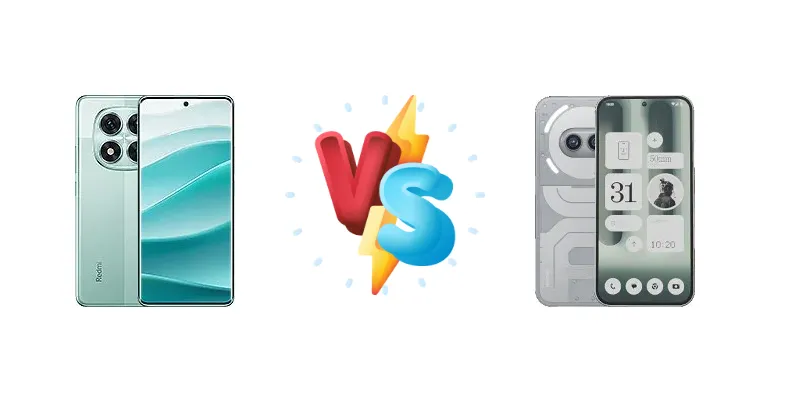
The mid-range smartphone market is fiercely competitive, and the Xiaomi Redmi Note 14 Pro 5G (India) and Nothing Phone (2a) Plus represent compelling options. The Redmi Note 14 Pro 5G aims to deliver flagship features at a more accessible price point, while the Nothing Phone (2a) Plus focuses on a refined user experience and distinctive design. This comparison dissects their key specifications to determine which device offers the best overall package.
🏆 Quick Verdict
For the average user prioritizing sustained performance and a potentially smoother gaming experience, the Nothing Phone (2a) Plus emerges as the winner. Its Dimensity 7350 Pro chipset and impressive 16:34h active use battery life provide a noticeable edge, despite the Redmi Note 14 Pro 5G's competitive pricing.
| Network |
|---|
| 2G bands | GSM 850 / 900 / 1800 / 1900 | GSM 850 / 900 / 1800 / 1900 |
| 3G bands | HSDPA 850 / 900 / 2100 - India | HSDPA 800 / 850 / 900 / 1700(AWS) / 1900 / 2100 |
| 4G bands | 1, 3, 5, 8, 28, 38, 40, 41 - India | 1, 3, 4, 5, 7, 8, 18, 19, 20, 26, 28, 38, 39, 40, 41, 42, 66 |
| 5G bands | 1, 3, 5, 8, 28, 38, 40, 41, 77, 78 SA/NSA - India | 1, 3, 5, 7, 8, 20, 28, 38, 40, 41, 66, 77, 78 SA/NSA |
| Speed | HSPA, LTE, 5G | HSPA, LTE, 5G |
| Technology | GSM / CDMA / HSPA / LTE / 5G | GSM / HSPA / LTE / 5G |
| Launch |
|---|
| Announced | 2024, September 26 | 2024, July 31 |
| Status | Available. Released 2024, September 26 | Available. Released 2024, August 03 |
| Body |
|---|
| Build | Glass front (Gorilla Glass Victus 2), plastic back or silicone polymer back (eco leather) | Glass front (Gorilla Glass 5), plastic frame, plastic back |
| Dimensions | 162.3 x 74.4 x 8.2 mm or 8.5 mm | 161.7 x 76.3 x 8.5 mm (6.37 x 3.00 x 0.33 in) |
| SIM | · Nano-SIM + eSIM· Nano-SIM + Nano-SIM | Nano-SIM + Nano-SIM |
| Weight | 190 g (6.70 oz) | 190 g (6.70 oz) |
| Display |
|---|
| Protection | Corning Gorilla Glass Victus 2 | Corning Gorilla Glass 5 |
| Resolution | 1220 x 2712 pixels, 20:9 ratio (~446 ppi density) | 1080 x 2412 pixels, 20:9 ratio (~395 ppi density) |
| Size | 6.67 inches, 107.4 cm2 (~88.9% screen-to-body ratio) | 6.7 inches, 107.5 cm2 (~87.1% screen-to-body ratio) |
| Type | AMOLED, 68B colors, 120Hz, HDR10+, Dolby Vision, 3000 nits (peak) | AMOLED, 1B colors, 120Hz, 2160Hz PWM, HDR10+, 700 nits (typ), 1100 nits (HBM), 1300 nits (peak) |
| Platform |
|---|
| CPU | Octa-core (4x2.5 GHz Cortex-A78 & 4x2.0 GHz Cortex-A55) | Octa-core (2x3.0 GHz Cortex-A715 & 6x 2.0 GHz Cortex-A510) |
| Chipset | Mediatek Dimensity 7300 Ultra (4 nm) | Mediatek Dimensity 7350 Pro (4 nm) |
| GPU | Mali-G615 MC2 | Mali-G610 MC4 |
| OS | Android 14, up to 3 major Android upgrades, HyperOS | Android 14, up to 3 major Android upgrades, Nothing OS 3.0 |
| Memory |
|---|
| Card slot | No | No |
| Internal | 128GB 8GB RAM, 256GB 8GB RAM, 256GB 12GB RAM, 512GB 12GB RAM | 256GB 8GB RAM, 256GB 12GB RAM |
| Main Camera |
|---|
| Dual | - | 50 MP, f/1.9, 24mm (wide), 1/1.57", 1.0µm, PDAF, OIS
50 MP, f/2.2, 114˚ (ultrawide), 1/2.76", 0.64µm |
| Features | LED flash, HDR, panorama | LED flash, panorama, HDR |
| Triple | 50 MP, f/1.5, 26mm (wide), 1/1.96", 0.8µm, PDAF, OIS
8 MP, f/2.2, 15mm, 120˚ (ultrawide), 1/4.0", 1.12µm
2 MP (macro) | - |
| Video | 4K@24/30fps, 1080p@30/60/120fps, gyro-EIS, OIS | 4K@30fps, 1080p@60/120fps, gyro-EIS |
| Selfie camera |
|---|
| Features | HDR, panorama | HDR |
| Single | 20 MP, f/2.2, 25mm (wide), 1/4.0", 0.7µm | 50 MP, f/2.2, (wide), 1/2.76" |
| Video | 1080p@30/60fps | 4K@30fps |
| Sound |
|---|
| 35mm jack | No | No |
| Loudspeaker | Yes, with stereo speakers | Yes, with stereo speakers |
| Comms |
|---|
| Bluetooth | 5.4, A2DP, LE, LHDC | 5.3, A2DP, LE |
| Infrared port | Yes | - |
| NFC | Yes (market/region dependent) | Yes, 360˚ |
| Positioning | GPS, GLONASS, BDS, GALILEO, QZSS | GPS, GALILEO, GLONASS, BDS, QZSS |
| Radio | Unspecified | No |
| USB | USB Type-C 2.0, OTG | USB Type-C 2.0, OTG |
| WLAN | Wi-Fi 802.11 a/b/g/n/ac/6, dual-band, Wi-Fi Direct | Wi-Fi 802.11 a/b/g/n/ac/6, dual-band, Wi-Fi Direct |
| Features |
|---|
| Sensors | Fingerprint (under display, optical), accelerometer, gyro, compass, proximity (ultrasonic) | Fingerprint (under display, optical), accelerometer, gyro, proximity, compass |
| Battery |
|---|
| Charging | 45W wired, PD3.0 | 50W wired, 50% in 21 min, 100% in 56 min |
| Type | Si/C Li-Ion 5500 mAh | 5000 mAh |
| Misc |
|---|
| Colors | Titan Black, Phantom Purple, Spectre Blue, White | Black, Grey |
| Models | 24090RA29C, 24090RA29I | A142P |
| Price | ₹ 19,990 | € 269.90 / ₹ 22,599 |
| SAR EU | 0.93 W/kg (head) 0.83 W/kg (body) | - |
Xiaomi Redmi Note 14 Pro 5G (India)
- Potentially lower price point
- 45W fast charging (PD3.0 support)
- Likely feature-rich camera system
- Older CPU architecture (Cortex-A78)
- Limited charging speed compared to the competition
- Display brightness data unavailable
Nothing Phone (2a) Plus
- Superior battery life (16:34h active use)
- Faster Dimensity 7350 Pro chipset
- Brighter display (1097 nits)
- Potentially higher price
- Charging speed, while fast, isn't the fastest available
- Software experience may not appeal to all users
Display Comparison
The Nothing Phone (2a) Plus boasts a significantly brighter display, reaching a measured peak of 1097 nits. This translates to superior visibility under direct sunlight compared to the Redmi Note 14 Pro 5G, for which display brightness data is unavailable. While both utilize 4nm chipsets, the display's brightness impacts usability in outdoor scenarios. The Nothing Phone (2a) Plus's brightness is a clear advantage for users who frequently consume content outdoors or in brightly lit environments. We expect the Redmi Note 14 Pro 5G to have a standard AMOLED panel, while Nothing's panel is likely to have better color accuracy.
Camera Comparison
Without detailed camera specifications for the Redmi Note 14 Pro 5G, a direct comparison is limited. However, given the Redmi Note series' history, it likely features a high-resolution main sensor. The Nothing Phone (2a) Plus's image processing style is known for its natural color reproduction, while Xiaomi typically leans towards more saturated images. Users who prefer a more realistic look will likely favor the Nothing Phone (2a) Plus. The absence of OIS information for the Redmi Note 14 Pro 5G is a concern, potentially leading to less stable videos and blurry low-light photos compared to a phone with OIS.
Performance
Both phones are powered by Mediatek Dimensity chips fabricated on a 4nm process, but the Nothing Phone (2a) Plus utilizes the Dimensity 7350 Pro, a step up from the Redmi Note 14 Pro 5G’s Dimensity 7300 Ultra. The 7350 Pro features a faster CPU configuration – 2x3.0 GHz Cortex-A715 cores versus the Redmi’s 4x2.5 GHz Cortex-A78 cores – suggesting better single-core performance. While both have octa-core CPUs, the architectural differences favor the Nothing Phone (2a) Plus in CPU-intensive tasks. The Redmi Note 14 Pro 5G's Cortex-A78 cores are older generation, potentially impacting sustained performance under heavy load. The Nothing Phone (2a) Plus is likely to offer a smoother experience for demanding applications and gaming.
Battery Life
The Nothing Phone (2a) Plus demonstrates a clear advantage in battery life, achieving an impressive 16:34h of active use. While the Redmi Note 14 Pro 5G’s battery capacity is unknown, the Nothing Phone (2a) Plus’s longevity is a significant benefit for power users. Furthermore, the Nothing Phone (2a) Plus supports 50W fast charging, reaching 50% in 21 minutes and 100% in 56 minutes, while the Redmi Note 14 Pro 5G is limited to 45W. This faster charging speed minimizes downtime and provides greater convenience.
Buying Guide
Buy the Xiaomi Redmi Note 14 Pro 5G (India) if you need a feature-rich phone with fast charging at the lowest possible price and are willing to potentially compromise on peak performance. Buy the Nothing Phone (2a) Plus if you prefer a more refined software experience, longer battery life, and a slightly more powerful processor for demanding tasks and gaming.
Frequently Asked Questions
❓ Does the Dimensity 7300 Ultra in the Redmi Note 14 Pro 5G struggle with graphically intensive games like Genshin Impact?
While the Dimensity 7300 Ultra is a capable chip, the older Cortex-A78 cores and potentially less aggressive thermal management compared to the Nothing Phone (2a) Plus's 7350 Pro could lead to frame drops and throttling during extended gaming sessions in demanding titles like Genshin Impact. Expect to adjust graphics settings for a smoother experience.
❓ How does the 50W charging on the Nothing Phone (2a) Plus compare to other phones with 65W or 80W charging?
While 50W isn't the fastest charging available, the Nothing Phone (2a) Plus's 56-minute full charge time is still competitive. The difference between 50W and 65W/80W is often marginal in real-world usage, and the Nothing Phone (2a) Plus's efficient power management and battery optimization contribute to its excellent overall battery life.
❓ Is the Nothing Phone (2a) Plus's Glyph Interface useful beyond aesthetics?
The Glyph Interface offers customizable light patterns for notifications, calls, and system alerts. While primarily aesthetic, it can be useful for quickly identifying notifications without looking at the screen, and some users find it a convenient way to monitor charging progress or timer durations.