
Xiaomi Redmi Note 14 Pro 5G vs Motorola Edge 50 Pro: A Detailed Comparison
| Phones Images | |||||
|---|---|---|---|---|---|
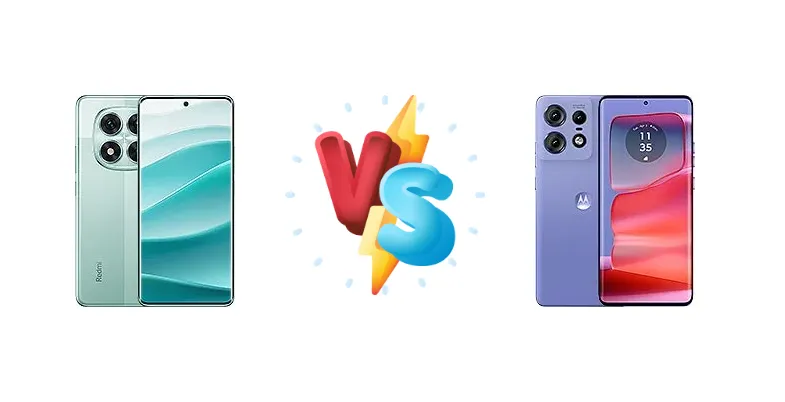
|
🏆 Quick Verdict
For the average user prioritizing rapid charging and a brighter display, the Motorola Edge 50 Pro is the better choice. Its 125W charging and 1295 nits peak brightness are significant advantages. However, the Redmi Note 14 Pro 5G offers a strong performance profile with the Dimensity 7300 Ultra, making it a viable alternative for budget-conscious gamers.
| PHONES | ||
|---|---|---|
| Phone Names | Xiaomi Redmi Note 14 Pro 5G (India) | Motorola Edge 50 Pro |
| Network | ||
|---|---|---|
| 2G bands | GSM 850 / 900 / 1800 / 1900 | GSM 850 / 900 / 1800 / 1900 |
| 3G bands | HSDPA 850 / 900 / 2100 - India | HSDPA 850 / 900 / 1700(AWS) / 1900 / 2100 |
| 4G bands | 1, 3, 5, 8, 28, 38, 40, 41 - India | 1, 2, 3, 4, 5, 7, 8, 12, 13, 17, 18, 19, 20, 26, 28, 32, 38, 39, 40, 41, 43, 48, 66 |
| 5G bands | 1, 3, 5, 8, 28, 38, 40, 41, 77, 78 SA/NSA - India | 1, 2, 3, 5, 7, 8, 20, 26, 28, 38, 40, 41, 66, 77, 78 SA/NSA/Sub6 |
| Speed | HSPA, LTE, 5G | HSPA, LTE, 5G |
| Technology | GSM / CDMA / HSPA / LTE / 5G | GSM / HSPA / LTE / 5G |
| Launch | ||
|---|---|---|
| Announced | 2024, September 26 | 2024, April 03 |
| Status | Available. Released 2024, September 26 | Available. Released 2024, April 08 |
| Body | ||
|---|---|---|
| Build | Glass front (Gorilla Glass Victus 2), plastic back or silicone polymer back (eco leather) | Glass front, plastic back or silicone polymer back (eco leather), aluminum frame |
| Dimensions | 162.3 x 74.4 x 8.2 mm or 8.5 mm | 161.2 x 72.4 x 8.2 mm (6.35 x 2.85 x 0.32 in) |
| SIM | · Nano-SIM + eSIM· Nano-SIM + Nano-SIM | · Nano-SIM + eSIM· Nano-SIM + Nano-SIM |
| Weight | 190 g (6.70 oz) | 186 g (6.56 oz) |
| Display | ||
|---|---|---|
| Protection | Corning Gorilla Glass Victus 2 | Corning Gorilla Glass (unspecified version) |
| Resolution | 1220 x 2712 pixels, 20:9 ratio (~446 ppi density) | 1220 x 2712 pixels, 20:9 ratio (~446 ppi density) |
| Size | 6.67 inches, 107.4 cm2 (~88.9% screen-to-body ratio) | 6.7 inches, 107.4 cm2 (~92.0% screen-to-body ratio) |
| Type | AMOLED, 68B colors, 120Hz, HDR10+, Dolby Vision, 3000 nits (peak) | P-OLED, 1B colors, 144Hz, HDR10+, 2000 nits (peak) |
| Platform | ||
|---|---|---|
| CPU | Octa-core (4x2.5 GHz Cortex-A78 & 4x2.0 GHz Cortex-A55) | Octa-core (1x2.63 GHz Cortex-A715 & 4x2.4 GHz Cortex-A715 & 3x1.8 GHz Cortex-A510) |
| Chipset | Mediatek Dimensity 7300 Ultra (4 nm) | Qualcomm SM7550-AB Snapdragon 7 Gen 3 (4 nm) |
| GPU | Mali-G615 MC2 | Adreno 720 |
| OS | Android 14, up to 3 major Android upgrades, HyperOS | Android 14, up to 3 major Android upgrades |
| Memory | ||
|---|---|---|
| Card slot | No | No |
| Internal | 128GB 8GB RAM, 256GB 8GB RAM, 256GB 12GB RAM, 512GB 12GB RAM | 128GB 8GB RAM, 256GB 8GB RAM, 256GB 12GB RAM, 512GB 12GB RAM |
| Main Camera | ||
|---|---|---|
| Features | LED flash, HDR, panorama | Laser AF, LED flash, panorama, HDR |
| Triple | 50 MP, f/1.5, 26mm (wide), 1/1.96", 0.8µm, PDAF, OIS 8 MP, f/2.2, 15mm, 120˚ (ultrawide), 1/4.0", 1.12µm 2 MP (macro) | 50 MP, f/1.4, 25mm (wide), 1/1.55", 1.0µm, multi-directional PDAF, OIS 10 MP, f/2.0, 67mm (telephoto), 1/3.94", 1.0µm, PDAF, OIS, 3x optical zoom 13 MP, f/2.2, 16mm, 120˚ (ultrawide), 1/3.0", 1.12µm, PDAF |
| Video | 4K@24/30fps, 1080p@30/60/120fps, gyro-EIS, OIS | 4K@30fps, 1080p@30/60/120/240fps, 10-bit HDR10+, gyro-EIS |
| Selfie camera | ||
|---|---|---|
| Features | HDR, panorama | HDR |
| Single | 20 MP, f/2.2, 25mm (wide), 1/4.0", 0.7µm | 50 MP, f/1.9, 21mm (wide), 0.64µm, AF |
| Video | 1080p@30/60fps | 4K@30fps, 1080p@30/60fps |
| Sound | ||
|---|---|---|
| 35mm jack | No | No |
| Loudspeaker | Yes, with stereo speakers | Yes, with stereo speakers |
| Comms | ||
|---|---|---|
| Bluetooth | 5.4, A2DP, LE, LHDC | 5.4, A2DP, LE |
| Infrared port | Yes | - |
| NFC | Yes (market/region dependent) | Yes |
| Positioning | GPS, GLONASS, BDS, GALILEO, QZSS | GPS, GLONASS, GALILEO, BDS, QZSS, NavIC |
| Radio | Unspecified | No |
| USB | USB Type-C 2.0, OTG | USB Type-C 3.1, OTG, DisplayPort 1.4 |
| WLAN | Wi-Fi 802.11 a/b/g/n/ac/6, dual-band, Wi-Fi Direct | Wi-Fi 802.11 a/b/g/n/ac/6e, tri-band, Wi-Fi Direct |
| Features | ||
|---|---|---|
| Sensors | Fingerprint (under display, optical), accelerometer, gyro, compass, proximity (ultrasonic) | Fingerprint (under display, optical), accelerometer, gyro, proximity, compass |
| Battery | ||
|---|---|---|
| Charging | 45W wired, PD3.0 | 125W wired, 100% in 18 min 50W wireless 10W reverse wireless |
| Type | Si/C Li-Ion 5500 mAh | Li-Po 4500 mAh |
| Misc | ||
|---|---|---|
| Colors | Titan Black, Phantom Purple, Spectre Blue, White | Luxe Lavender, Black Beauty, Moonlight Pearl, Vanilla Cream |
| Models | 24090RA29C, 24090RA29I | XT2403-2 |
| Price | ₹ 19,990 | € 410.57 / $ 399.00 / £ 369.99 / ₹ 22,995 |
| SAR | - | 1.08 W/kg (head) 1.08 W/kg (body) |
| SAR EU | 0.93 W/kg (head) 0.83 W/kg (body) | - |
Xiaomi Redmi Note 14 Pro 5G (India)
- Competitive chipset (Dimensity 7300 Ultra)
- Potentially better value for money
- 45W fast charging with PD3.0
- Slower charging compared to Edge 50 Pro
- Display brightness data unavailable
Motorola Edge 50 Pro
- 125W wired charging (18 min full charge)
- 50W wireless charging
- 1295 nits peak display brightness
- Potentially higher price
- Snapdragon 7 Gen 3 may not offer a massive performance leap over Dimensity 7300 Ultra
Display Comparison
The Motorola Edge 50 Pro boasts a significantly brighter display, reaching a measured peak brightness of 1295 nits. This is a substantial advantage in outdoor visibility compared to the Redmi Note 14 Pro, for which display brightness data is unavailable. While the Redmi Note 14 Pro’s panel specifics are unknown, the Edge 50 Pro’s high brightness, combined with likely excellent color accuracy, makes it ideal for media consumption in all lighting conditions. The absence of LTPO technology in either device suggests both will rely on adaptive refresh rates to balance smoothness and power efficiency.
Camera Comparison
Detailed camera specifications for the Redmi Note 14 Pro are currently unavailable. The Motorola Edge 50 Pro’s camera system is expected to be a strong point, though specific sensor details are missing. The focus should be on the main sensor’s size and aperture, as these directly impact low-light performance. Without knowing the Redmi Note 14 Pro’s sensor details, it’s difficult to make a direct comparison, but Motorola’s history suggests a focus on computational photography and image stabilization.
Performance
The Motorola Edge 50 Pro utilizes the Qualcomm Snapdragon 7 Gen 3 (4nm), featuring a 1x2.63 GHz Cortex-A715 prime core and 4x2.4 GHz Cortex-A715 performance cores, alongside 3x1.8 GHz Cortex-A510 efficiency cores. The Redmi Note 14 Pro 5G, on the other hand, is powered by the MediaTek Dimensity 7300 Ultra (4nm) with a 4x2.5 GHz Cortex-A78 and 4x2.0 GHz Cortex-A55 configuration. While clock speeds aren't everything, the Snapdragon 7 Gen 3’s newer architecture (Cortex-A715 vs A78) generally translates to improved single-core performance and efficiency. Both devices utilize a 4nm process, suggesting comparable thermal performance, but the Snapdragon’s ISP is likely more advanced for image processing.
Battery Life
The Motorola Edge 50 Pro excels in charging speed, offering 125W wired charging, capable of a full charge in just 18 minutes. It also includes 50W wireless charging and 10W reverse wireless charging. The Redmi Note 14 Pro 5G is limited to 45W wired charging with PD3.0 support. While the Edge 50 Pro’s battery capacity isn’t specified, its active use score of 11:59h indicates excellent battery life. The faster charging of the Edge 50 Pro significantly reduces downtime, making it ideal for users who frequently need to top up their battery.
Buying Guide
Buy the Xiaomi Redmi Note 14 Pro 5G (India) if you need a balanced smartphone with a capable processor for gaming and everyday tasks, and prioritize value for money. Buy the Motorola Edge 50 Pro if you prefer a brighter display, incredibly fast charging speeds (including wireless), and a more premium overall experience, even if it comes at a higher price.