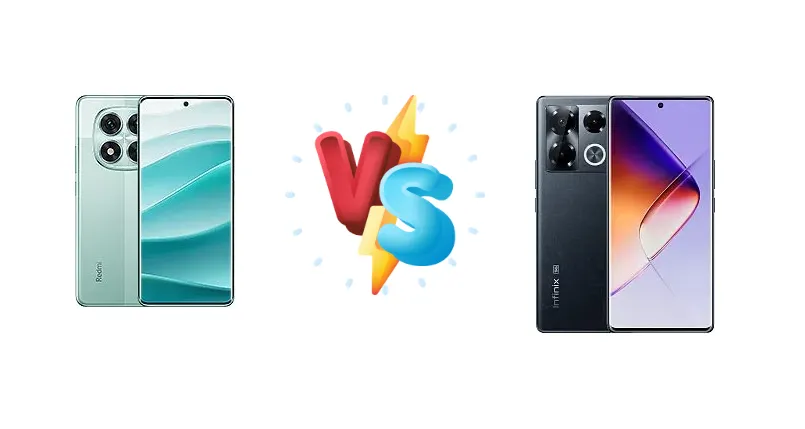
The sub-$300 smartphone market is fiercely competitive, and the Xiaomi Redmi Note 14 Pro 5G (India) and Infinix Note 40 Pro+ are two strong contenders. The Redmi focuses on a newer chipset and established brand recognition, while the Infinix pushes the boundaries with incredibly fast charging and a bright display. This comparison dives deep into the specs to determine which phone offers the best overall experience.
🏆 Quick Verdict
For the average user prioritizing sustained performance and a refined software experience, the Xiaomi Redmi Note 14 Pro 5G emerges as the winner. Its Dimensity 7300 Ultra, built on a 4nm process, provides a noticeable edge in efficiency and processing power, despite the Infinix’s impressive charging capabilities.
| Network |
|---|
| 2G bands | GSM 850 / 900 / 1800 / 1900 | GSM 850 / 900 / 1800 / 1900 |
| 3G bands | HSDPA 850 / 900 / 2100 - India | HSDPA 850 / 900 / 1700(AWS) / 1900 / 2100 |
| 4G bands | 1, 3, 5, 8, 28, 38, 40, 41 - India | 1, 2, 3, 4, 5, 7, 8, 12, 17, 20, 28, 38, 40, 41, 42, 66 |
| 5G bands | 1, 3, 5, 8, 28, 38, 40, 41, 77, 78 SA/NSA - India | 1, 3, 5, 7, 8, 12, 20, 28, 38, 40, 41, 66, 77, 78 SA/NSA |
| Speed | HSPA, LTE, 5G | HSPA, LTE, 5G |
| Technology | GSM / CDMA / HSPA / LTE / 5G | GSM / HSPA / LTE / 5G |
| Launch |
|---|
| Announced | 2024, September 26 | 2024, March 18 |
| Status | Available. Released 2024, September 26 | Available. Released 2024, March 19 |
| Body |
|---|
| Build | Glass front (Gorilla Glass Victus 2), plastic back or silicone polymer back (eco leather) | Glass front, plastic frame, silicone polymer (eco leather) back |
| Dimensions | 162.3 x 74.4 x 8.2 mm or 8.5 mm | 164.3 x 74.5 x 8.1 mm (6.47 x 2.93 x 0.32 in) |
| SIM | · Nano-SIM + eSIM· Nano-SIM + Nano-SIM | Nano-SIM + Nano-SIM |
| Weight | 190 g (6.70 oz) | 190 g or 196 g (6.70 oz) |
| Display |
|---|
| Protection | Corning Gorilla Glass Victus 2 | Corning Gorilla Glass |
| Resolution | 1220 x 2712 pixels, 20:9 ratio (~446 ppi density) | 1080 x 2436 pixels (~393 ppi density) |
| Size | 6.67 inches, 107.4 cm2 (~88.9% screen-to-body ratio) | 6.78 inches, 109.9 cm2 (~89.8% screen-to-body ratio) |
| Type | AMOLED, 68B colors, 120Hz, HDR10+, Dolby Vision, 3000 nits (peak) | AMOLED, 1B colors, 120Hz, 1300 nits (peak) |
| Platform |
|---|
| CPU | Octa-core (4x2.5 GHz Cortex-A78 & 4x2.0 GHz Cortex-A55) | Octa-core (2x2.2 GHz Cortex-A78 & 6x2.0 GHz Cortex-A55) |
| Chipset | Mediatek Dimensity 7300 Ultra (4 nm) | Mediatek Dimensity 7020 (6 nm) |
| GPU | Mali-G615 MC2 | IMG BXM-8-256 |
| OS | Android 14, up to 3 major Android upgrades, HyperOS | Android 14, up to 2 major Android upgrades, XOS 14 |
| Memory |
|---|
| Card slot | No | No |
| Internal | 128GB 8GB RAM, 256GB 8GB RAM, 256GB 12GB RAM, 512GB 12GB RAM | 256GB 12GB RAM, 512GB 12GB RAM |
| Main Camera |
|---|
| Features | LED flash, HDR, panorama | Dual-LED flash, HDR, panorama |
| Triple | 50 MP, f/1.5, 26mm (wide), 1/1.96", 0.8µm, PDAF, OIS
8 MP, f/2.2, 15mm, 120˚ (ultrawide), 1/4.0", 1.12µm
2 MP (macro) | 108 MP, f/1.8, 24mm (wide), 1/1.67", 0.64µm, PDAF, OIS
2 MP, f/2.4
2 MP, f/2.4 |
| Video | 4K@24/30fps, 1080p@30/60/120fps, gyro-EIS, OIS | 1440p@30fps, 1080p@30/60fps |
| Selfie camera |
|---|
| Features | HDR, panorama | Dual-LED flash |
| Single | 20 MP, f/2.2, 25mm (wide), 1/4.0", 0.7µm | 32 MP, f/2.2, (wide), 1/3.1", 0.7µm |
| Video | 1080p@30/60fps | 1440p@30fps, 1080p@30/60fps |
| Sound |
|---|
| 35mm jack | No | No |
| Loudspeaker | Yes, with stereo speakers | Yes, with stereo speakers |
| Comms |
|---|
| Bluetooth | 5.4, A2DP, LE, LHDC | Yes |
| Infrared port | Yes | Yes |
| NFC | Yes (market/region dependent) | Yes (market/region dependent) |
| Positioning | GPS, GLONASS, BDS, GALILEO, QZSS | GPS |
| Radio | Unspecified | FM radio |
| USB | USB Type-C 2.0, OTG | USB Type-C 2.0, OTG |
| WLAN | Wi-Fi 802.11 a/b/g/n/ac/6, dual-band, Wi-Fi Direct | Wi-Fi 802.11 a/b/g/n/ac, dual-band |
| Features |
|---|
| Sensors | Fingerprint (under display, optical), accelerometer, gyro, compass, proximity (ultrasonic) | Fingerprint (under display, optical), accelerometer, gyro, proximity, compass |
| Battery |
|---|
| Charging | 45W wired, PD3.0 | 100W wired, 50% in 12 min
20W wireless MagCharge
Reverse wired
Reverse wireless |
| Type | Si/C Li-Ion 5500 mAh | 4600 mAh |
| Misc |
|---|
| Colors | Titan Black, Phantom Purple, Spectre Blue, White | Obsidian Black, Vintage Green, Racing Edition |
| Models | 24090RA29C, 24090RA29I | X6851B |
| Price | ₹ 19,990 | About 290 EUR |
| SAR EU | 0.93 W/kg (head) 0.83 W/kg (body) | - |
Xiaomi Redmi Note 14 Pro 5G (India)
- More efficient Dimensity 7300 Ultra chipset
- Potentially better sustained performance
- Established brand reputation
- Slower charging speed (45W)
- Display brightness likely lower than Infinix
Infinix Note 40 Pro+
- Incredibly fast 100W wired charging
- Bright 1130 nit display
- 20W wireless MagCharge support
- Less efficient Dimensity 7020 chipset
- Potential for more thermal throttling
Display Comparison
The Infinix Note 40 Pro+ boasts a significantly brighter display, reaching a measured 1130 nits, making it ideal for outdoor use in direct sunlight. While the Redmi Note 14 Pro’s display specs aren’t provided, the brightness difference is substantial. The Infinix also benefits from MagCharge compatibility, suggesting a potentially higher-quality panel construction. However, without knowing the Redmi’s panel type (LTPO vs. standard OLED) or refresh rate, it’s difficult to fully assess its visual quality beyond brightness.
Camera Comparison
Without detailed camera specifications for either device, a direct comparison is challenging. However, the market segment suggests both will likely feature a primary sensor around 50-108MP. The absence of information regarding OIS (Optical Image Stabilization) is a key omission. The presence of OIS would significantly benefit low-light photography and video recording. We can assume both phones will include standard ultra-wide and macro lenses, but their quality will likely vary. Image processing algorithms will also play a crucial role in differentiating the final image quality.
Performance
The core difference lies in the chipsets. The Redmi Note 14 Pro 5G utilizes the Mediatek Dimensity 7300 Ultra, fabricated on a 4nm process. This smaller node generally translates to improved power efficiency and thermal management compared to the Infinix Note 40 Pro+'s Dimensity 7020 (6nm). The Redmi’s CPU configuration (4x2.5 GHz Cortex-A78 & 4x2.0 GHz Cortex-A55) also offers a slight clock speed advantage over the Infinix’s (2x2.2 GHz Cortex-A78 & 6x2.0 GHz Cortex-A55). This means the Redmi is likely to handle demanding tasks and games with less throttling and more consistent frame rates. The 4nm process will also contribute to longer battery life during intensive use.
Battery Life
The Infinix Note 40 Pro+ shines with its 100W wired charging, capable of reaching 50% charge in just 12 minutes. This is a significant advantage over the Redmi Note 14 Pro 5G’s 45W charging. The Infinix also includes 20W wireless MagCharge, reverse wired charging, and reverse wireless charging, offering unparalleled versatility. While the Infinix’s battery capacity isn’t specified, its active use score of 12:23h suggests good endurance. The Redmi’s battery capacity is also unknown, but the more efficient Dimensity 7300 Ultra could potentially offset a smaller battery size.
Buying Guide
Buy the Xiaomi Redmi Note 14 Pro 5G (India) if you need a phone that excels in everyday tasks and offers a smoother gaming experience thanks to its more efficient chipset. Buy the Infinix Note 40 Pro+ if you prioritize incredibly fast charging – 100W wired and 20W wireless MagCharge – and a very bright display, and are willing to potentially trade off some sustained performance.
Frequently Asked Questions
❓ Will the Dimensity 7020 in the Infinix Note 40 Pro+ overheat during prolonged gaming sessions?
The 6nm process of the Dimensity 7020 is less efficient than the 4nm Dimensity 7300 Ultra in the Redmi Note 14 Pro 5G. This means the Infinix is more likely to experience thermal throttling during extended gaming, potentially leading to reduced frame rates and performance.
❓ How practical is the 20W MagCharge wireless charging on the Infinix Note 40 Pro+?
While 20W wireless charging is a welcome addition, it's still slower than the 100W wired charging. MagCharge compatibility allows for easier alignment and potentially faster wireless charging speeds with compatible accessories, but it's primarily a convenience feature rather than a game-changer.
❓ Does the Redmi Note 14 Pro 5G support 5G carrier aggregation for faster data speeds?
Given its '5G' designation, the Redmi Note 14 Pro 5G almost certainly supports 5G carrier aggregation. However, the specific bands supported will vary depending on the Indian market and carrier compatibility. Checking the phone's specifications with your carrier is recommended.
❓ Is the 45W charging on the Redmi Note 14 Pro 5G slow compared to the competition?
While 45W is slower than the Infinix's 100W, it's still a respectable charging speed and will fully charge the phone in a reasonable timeframe. The efficiency of the Dimensity 7300 Ultra may also mean you won't need to charge as frequently.