
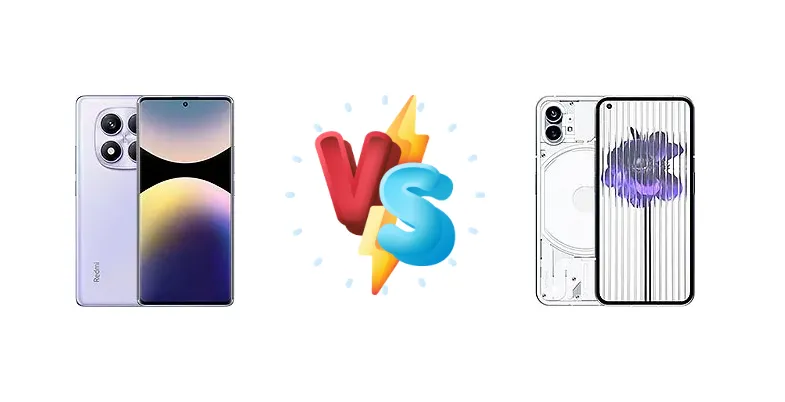
Xiaomi Redmi Note 14 Pro 4G vs. Nothing Phone (1): A Detailed Comparison
| Phones Images | |||||
|---|---|---|---|---|---|
|
🏆 Quick Verdict
For the average user prioritizing longevity and a brighter display, the Xiaomi Redmi Note 14 Pro 4G is the clear winner. Its exceptional 52:56h endurance rating and 1500 nit peak brightness significantly outperform the Nothing Phone (1). However, the Nothing Phone (1) remains a compelling option for those valuing a more polished software experience and faster charging.
| PHONES | ||
|---|---|---|
| Phone Names | Xiaomi Redmi Note 14 Pro 4G | Nothing Phone (1) |
| Network | ||
|---|---|---|
| 2G bands | GSM 850 / 900 / 1800 / 1900 | GSM 850 / 900 / 1800 / 1900 |
| 3G bands | HSDPA 850 / 900 / 1700(AWS) / 1900 / 2100 | HSDPA 800 / 850 / 900 / 1700(AWS) / 1900 / 2100 |
| 4G bands | 1, 2, 3, 4, 5, 7, 8, 12, 13, 17, 20, 26, 28, 38, 40, 41, 66 | 1, 2, 3, 4, 5, 7, 8, 12, 17, 18, 19, 20, 26, 28, 32, 34, 38, 39, 40, 41, 66 |
| 5G bands | - | 1, 3, 5, 7, 8, 20, 28, 38, 40, 41, 77, 78 SA/NSA |
| Speed | HSPA, LTE | HSPA, LTE, 5G |
| Technology | GSM / HSPA / LTE | GSM / HSPA / LTE / 5G |
| Launch | ||
|---|---|---|
| Announced | 2025, January 10 | 2022, July 12 |
| Status | Available. Released 2025, January 16 | Available. Released 2022, July 16 |
| Body | ||
|---|---|---|
| Build | Glass front (Gorilla Glass Victus 2), plastic back, aluminum frame | Glass front (Gorilla Glass 5), glass back (Gorilla Glass 5), aluminum frame |
| Dimensions | 162.2 x 74.9 x 8.2 mm (6.39 x 2.95 x 0.32 in) | 159.2 x 75.8 x 8.3 mm (6.27 x 2.98 x 0.33 in) |
| SIM | Nano-SIM + Nano-SIM | Nano-SIM + Nano-SIM |
| Weight | 180 g (6.35 oz) | 193.5 g (6.84 oz) |
| Display | ||
|---|---|---|
| Protection | Corning Gorilla Glass Victus 2, Mohs level 5 | Corning Gorilla Glass 5 |
| Resolution | 1080 x 2400 pixels, 20:9 ratio (~395 ppi density) | 1080 x 2400 pixels, 20:9 ratio (~402 ppi density) |
| Size | 6.67 inches, 107.4 cm2 (~88.4% screen-to-body ratio) | 6.55 inches, 103.6 cm2 (~85.8% screen-to-body ratio) |
| Type | AMOLED, 1B colors, 120Hz, 1920Hz PWM, 1200 nits (HBM), 1800 nits (peak) | OLED, 1B colors, 120Hz, 1440Hz PWM, HDR10+, 500 nits (typ), 1200 nits (peak) |
| Platform | ||
|---|---|---|
| CPU | Octa-core (2x2.2 GHz Cortex-A76 & 6x2.0 GHz Cortex-A55) | Octa-core (1x2.5 GHz Cortex-A78 & 3x2.4 GHz Cortex-A78 & 4x1.9 GHz Cortex-A55) |
| Chipset | Mediatek Helio G100 Ultra (6 nm) | Qualcomm SM7325-AE Snapdragon 778G+ 5G (6 nm) |
| GPU | Mali-G57 MC2 | Adreno 642L |
| OS | Android 14, HyperOS | Android 12, upgradable to Android 15, up to 3 major Android upgrades, Nothing OS 3.0 |
| Memory | ||
|---|---|---|
| Card slot | microSDXC (uses shared SIM slot) | No |
| Internal | 128GB 8GB RAM, 256GB 8GB RAM, 256GB 12GB RAM, 512GB 12GB RAM | 128GB 8GB RAM, 256GB 8GB RAM, 256GB 12GB RAM |
| Main Camera | ||
|---|---|---|
| Dual | - | 50 MP, f/1.9, 24mm (wide), 1/1.56", 1.0µm, PDAF, OIS 50 MP, f/2.2, 114˚ (ultrawide), 1/2.76", 0.64µm, AF |
| Features | LED flash, HDR, panorama | LED flash, panorama, HDR |
| Triple | 200 MP, f/1.7, 23mm (wide), 1/1.4", 0.56µm, multi-directional PDAF, OIS 8 MP, f/2.2, 15mm, 120˚ (ultrawide), 1/4.4", 1.0µm 2 MP (macro) | - |
| Video | 1080p@30/60fps, gyro-EIS | 4K@30fps, 1080p@30/60fps, gyro-EIS, live HDR |
| Selfie camera | ||
|---|---|---|
| Single | 32 MP, f/2.2, (wide) | 16 MP, f/2.5, (wide), 1/3.1", 1.0µm |
| Video | 1080p@30fps | 1080p@30fps |
| Sound | ||
|---|---|---|
| 35mm jack | Yes | No |
| Loudspeaker | Yes, with stereo speakers (with Dolby Atmos) | Yes, with stereo speakers |
| Comms | ||
|---|---|---|
| Bluetooth | 5.3, A2DP, LE | 5.2, A2DP, LE |
| Infrared port | Yes | - |
| NFC | Yes (market/region dependent) | Yes |
| Positioning | GPS, GALILEO, GLONASS, QZSS, BDS | GPS (L1), GLONASS (L1), BDS (B1I+B1c), GALILEO (E1), QZSS (L1) |
| Radio | FM radio | No |
| USB | USB Type-C 2.0, OTG | USB Type-C 2.0, OTG |
| WLAN | Wi-Fi 802.11 a/b/g/n/ac, dual-band | Wi-Fi 802.11 a/b/g/n/ac/6, dual-band |
| Features | ||
|---|---|---|
| Sensors | Fingerprint (under display, optical), accelerometer, proximity, gyro, compass | Fingerprint (under display, optical), accelerometer, proximity, gyro, compass |
| Battery | ||
|---|---|---|
| Charging | 45W wired | 33W wired, PD3.0, QC4, 50% in 30 min, 100% in 70 min 15W wireless 5W reverse wireless |
| Type | 5500 mAh | Li-Ion 4500 mAh (17.42 Wh) |
| Misc | ||
|---|---|---|
| Colors | Midnight Black, Aurora Purple, Ocean Blue | White, Black |
| Models | 24116RACCG | A063 |
| Price | € 179.90 / $ 245.00 / £ 172.99 | $ 539.00 / £ 234.77 / € 249.95 / ₹ 17,990 |
| SAR | - | 1.29 W/kg (head) 1.09 W/kg (body) |
| SAR EU | 0.80 W/kg (head) 0.98 W/kg (body) | 0.99 W/kg (head) 1.48 W/kg (body) |
| EU LABEL | ||
|---|---|---|
| Battery | 52:56h endurance, 1000 cycles | - |
| Energy | Class B | - |
| Free fall | Class B (180 falls) | - |
| Repairability | Class C | - |
Xiaomi Redmi Note 14 Pro 4G
- Exceptional battery life (52:56h endurance)
- Significantly brighter display (1500 nits)
- Faster wired charging (45W)
- Less powerful chipset compared to Snapdragon 778G+
- Camera specifications are unknown
Nothing Phone (1)
- More powerful Snapdragon 778G+ 5G chipset
- Wireless and reverse wireless charging
- Unique design and software experience (Nothing OS)
- Significantly shorter battery life
- Dimmer display (663 nits)
Display Comparison
The Redmi Note 14 Pro 4G’s display immediately stands out with its measured peak brightness of 1500 nits, a substantial improvement over the Nothing Phone (1)’s 663 nits. This translates to significantly better outdoor visibility, especially in direct sunlight. While both utilize 6nm chipsets, the display power draw on the Redmi will likely be higher to achieve this brightness. The Nothing Phone (1) doesn’t specify panel technology, but the Redmi’s brightness suggests it’s likely not utilizing a power-saving OLED panel. Color accuracy and refresh rate data are missing for the Redmi, but the brightness advantage is undeniable for users who spend significant time outdoors.
Camera Comparison
The context data for the Redmi Note 14 Pro 4G lacks camera specifics, making a direct comparison challenging. The Nothing Phone (1) highlights its photo and video capabilities, but details regarding sensor size and aperture are absent. Given the Redmi’s positioning, it’s reasonable to expect a competitive camera system, but without specifications, it’s difficult to assess its capabilities against the Nothing Phone (1). We can assume the Nothing Phone (1) likely has a more refined image processing pipeline, given Nothing’s focus on user experience. The absence of details on the Redmi suggests it may not be a primary selling point.
Performance
The Nothing Phone (1) leverages the Qualcomm Snapdragon 778G+ 5G, featuring a prime Cortex-A78 core clocked at 2.5 GHz, alongside three additional A78 cores. This architecture provides a performance edge over the Redmi Note 14 Pro 4G’s MediaTek Helio G100 Ultra, which utilizes two Cortex-A76 cores at 2.2 GHz and six Cortex-A55 cores at 2.0 GHz. While both are built on a 6nm process, the Snapdragon’s more advanced core design and 5G capabilities offer superior processing power and future-proofing. However, the Redmi’s chipset may offer better efficiency in certain tasks, potentially contributing to its longer battery life. The Nothing Phone (1) also benefits from potentially faster RAM speeds (LPDDR5 vs. potentially LPDDR4X on the Redmi, though not specified).
Battery Life
The Redmi Note 14 Pro 4G dominates in battery endurance, achieving an impressive 52:56h rating and 12:07h of active use. This is a significant leap over the Nothing Phone (1)’s 108h endurance rating (which is likely based on older testing methodologies). While the Nothing Phone (1) offers 33W wired charging, 15W wireless, and 5W reverse wireless, the Redmi Note 14 Pro 4G’s 45W wired charging provides a faster 0-100% time, though specific timings aren’t provided. The Redmi’s 1000 cycle battery claim suggests a focus on long-term battery health, a crucial factor for users who keep their phones for extended periods.
Buying Guide
Buy the Xiaomi Redmi Note 14 Pro 4G if you need a phone that will reliably last through two full days of moderate use, and if a bright, easily visible screen is paramount. Buy the Nothing Phone (1) if you prefer a cleaner, more minimalist software experience with unique design elements, and if you value the convenience of wireless charging and faster wired top-ups.