
Xiaomi Redmi Note 14 Pro 4G vs Google Pixel 7a: A Deep Dive into Value and Endurance
| Phones Images | |||||
|---|---|---|---|---|---|
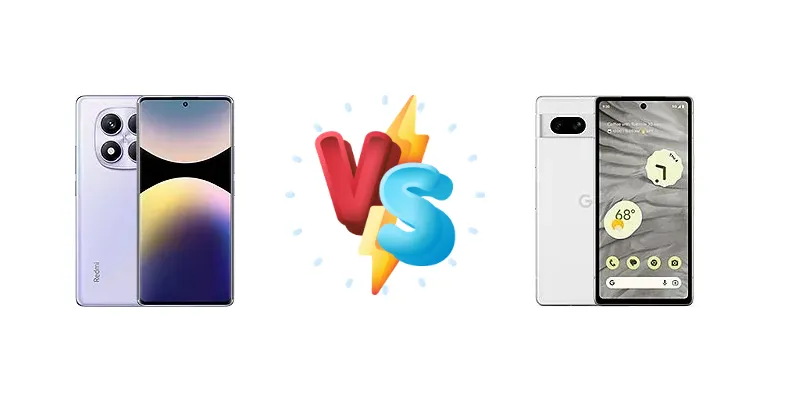
|
🏆 Quick Verdict
For the average user prioritizing longevity and a vibrant display, the Xiaomi Redmi Note 14 Pro 4G emerges as the winner. Its significantly longer battery endurance (52:56h vs 76h *old data*) and brighter 1500 nit screen outweigh the Pixel 7a’s processing advantage for everyday tasks.
| PHONES | ||
|---|---|---|
| Phone Names | Xiaomi Redmi Note 14 Pro 4G | Google Pixel 7a |
| Network | ||
|---|---|---|
| 2G bands | GSM 850 / 900 / 1800 / 1900 | GSM 850 / 900 / 1800 / 1900 |
| 3G bands | HSDPA 850 / 900 / 1700(AWS) / 1900 / 2100 | HSDPA 800 / 850 / 900 / 1700(AWS) / 1900 / 2100 |
| 4G bands | 1, 2, 3, 4, 5, 7, 8, 12, 13, 17, 20, 26, 28, 38, 40, 41, 66 | 1, 2, 3, 4, 5, 7, 8, 12, 13, 14, 17, 20, 25, 26, 28, 29, 30, 38, 40, 41, 48, 66, 71 - GWKK3, G0DZQ |
| 5G bands | - | 1, 2, 3, 5, 7, 8, 12, 14, 20, 25, 28, 30, 38, 41, 48, 66, 71, 77, 78 SA/NSA/Sub6 - GWKK3 |
| Speed | HSPA, LTE | HSPA, LTE, 5G |
| Technology | GSM / HSPA / LTE | GSM / HSPA / LTE / 5G |
| - | 1, 2, 3, 5, 7, 8, 12, 20, 25, 28, 38, 40, 41, 66, 75, 76, 77, 78, 79 SA/NSA/Sub6 - GHL1X, G82U8 | |
| Launch | ||
|---|---|---|
| Announced | 2025, January 10 | 2023, May 10 |
| Status | Available. Released 2025, January 16 | Available. Released 2023, May 10 |
| Body | ||
|---|---|---|
| Build | Glass front (Gorilla Glass Victus 2), plastic back, aluminum frame | Glass front (Gorilla Glass 3), aluminum frame, plastic back |
| Dimensions | 162.2 x 74.9 x 8.2 mm (6.39 x 2.95 x 0.32 in) | 152 x 72.9 x 9 mm (5.98 x 2.87 x 0.35 in) |
| SIM | Nano-SIM + Nano-SIM | Nano-SIM + eSIM |
| Weight | 180 g (6.35 oz) | 193.5 g (6.84 oz) |
| - | IP67 dust/water resistant (up to 1m for 30 min) | |
| Display | ||
|---|---|---|
| Protection | Corning Gorilla Glass Victus 2, Mohs level 5 | Corning Gorilla Glass 3 |
| Resolution | 1080 x 2400 pixels, 20:9 ratio (~395 ppi density) | 1080 x 2400 pixels, 20:9 ratio (~429 ppi density) |
| Size | 6.67 inches, 107.4 cm2 (~88.4% screen-to-body ratio) | 6.1 inches, 90.7 cm2 (~81.8% screen-to-body ratio) |
| Type | AMOLED, 1B colors, 120Hz, 1920Hz PWM, 1200 nits (HBM), 1800 nits (peak) | OLED, HDR, 90Hz |
| - | Always-on display | |
| Platform | ||
|---|---|---|
| CPU | Octa-core (2x2.2 GHz Cortex-A76 & 6x2.0 GHz Cortex-A55) | Octa-core (2x2.85 GHz Cortex-X1 & 2x2.35 GHz Cortex-A78 & 4x1.80 GHz Cortex-A55) |
| Chipset | Mediatek Helio G100 Ultra (6 nm) | Google Tensor G2 (5 nm) |
| GPU | Mali-G57 MC2 | Mali-G710 MP7 |
| OS | Android 14, HyperOS | Android 13, upgradable to Android 15, up to 5 major Android upgrades |
| Memory | ||
|---|---|---|
| Card slot | microSDXC (uses shared SIM slot) | No |
| Internal | 128GB 8GB RAM, 256GB 8GB RAM, 256GB 12GB RAM, 512GB 12GB RAM | 128GB 8GB RAM |
| - | UFS 3.1 | |
| Main Camera | ||
|---|---|---|
| Dual | - | 64 MP, f/1.9, 26mm (wide), 1/1.73", 0.8µm, dual pixel PDAF, OIS 13 MP, f/2.2, 120˚ (ultrawide), 1.12µm |
| Features | LED flash, HDR, panorama | Dual-LED flash, Pixel Shift, Auto-HDR, panorama |
| Triple | 200 MP, f/1.7, 23mm (wide), 1/1.4", 0.56µm, multi-directional PDAF, OIS 8 MP, f/2.2, 15mm, 120˚ (ultrawide), 1/4.4", 1.0µm 2 MP (macro) | - |
| Video | 1080p@30/60fps, gyro-EIS | 4K@30/60fps, 1080p@30/60/120/240fps, OIS |
| Selfie camera | ||
|---|---|---|
| Features | - | HDR, panorama |
| Single | 32 MP, f/2.2, (wide) | 13 MP, f/2.2, 20mm (ultrawide), 1.12µm |
| Video | 1080p@30fps | 4K@30fps, 1080p@30fps |
| Sound | ||
|---|---|---|
| 3.5mm jack | - | No |
| 35mm jack | Yes | No |
| Loudspeaker | Yes, with stereo speakers (with Dolby Atmos) | Yes, with stereo speakers |
| Comms | ||
|---|---|---|
| Bluetooth | 5.3, A2DP, LE | 5.3, A2DP, LE |
| Infrared port | Yes | - |
| NFC | Yes (market/region dependent) | Yes |
| Positioning | GPS, GALILEO, GLONASS, QZSS, BDS | GPS, GLONASS, GALILEO, BDS, QZSS, NavIC |
| Radio | FM radio | No |
| USB | USB Type-C 2.0, OTG | USB Type-C 3.2 |
| WLAN | Wi-Fi 802.11 a/b/g/n/ac, dual-band | Wi-Fi 802.11 a/b/g/n/ac/6e, tri-band |
| Features | ||
|---|---|---|
| Sensors | Fingerprint (under display, optical), accelerometer, proximity, gyro, compass | Fingerprint (under display, optical), accelerometer, gyro, proximity, compass, barometer |
| Battery | ||
|---|---|---|
| Charging | 45W wired | 18W wired, PD3.0 7.5W wireless |
| Type | 5500 mAh | Li-Po 4385 mAh |
| Misc | ||
|---|---|---|
| Colors | Midnight Black, Aurora Purple, Ocean Blue | Charcoal, Snow, Sea, Coral |
| Models | 24116RACCG | GWKK3, GHL1X, G0DZQ, G82U8 |
| Price | € 179.90 / $ 245.00 / £ 172.99 | € 179.90 / $ 150.00 / £ 170.00 / ₹ 25,980 |
| SAR EU | 0.80 W/kg (head) 0.98 W/kg (body) | - |
| EU LABEL | ||
|---|---|---|
| Battery | 52:56h endurance, 1000 cycles | - |
| Energy | Class B | - |
| Free fall | Class B (180 falls) | - |
| Repairability | Class C | - |
Xiaomi Redmi Note 14 Pro 4G
- Exceptional battery life (52:56h endurance)
- Very bright display (1500 nits)
- Faster 45W wired charging
- Less powerful processor than the Pixel 7a
- Camera performance likely inferior to the Pixel 7a
Google Pixel 7a
- Powerful Google Tensor G2 chipset
- Excellent camera software and image processing
- Wireless charging support
- Significantly shorter battery life
- Slower 18W wired charging
Display Comparison
The Redmi Note 14 Pro 4G boasts a significantly brighter display, reaching a measured 1500 nits compared to the Pixel 7a’s 1070 nits. This translates to superior visibility outdoors. While both likely utilize AMOLED panels (not specified in data), the Redmi’s peak brightness is a clear advantage. The Pixel 7a’s display quality is still good, but the Redmi Note 14 Pro offers a more comfortable viewing experience in bright conditions. We lack data on refresh rates or panel technology (LTPO) for either device, but the brightness difference is a key differentiator.
Camera Comparison
The Pixel 7a’s camera system is a known strength, leveraging Google’s computational photography expertise. While specific sensor details are missing, the Pixel 7a’s reputation for excellent image processing and video stabilization is well-established. The Redmi Note 14 Pro 4G’s camera capabilities are less known, and the context data only mentions 'Photo / Video' without specifics. Without sensor size or aperture information, it’s difficult to make a direct comparison, but the Pixel 7a likely holds an advantage in image quality, particularly in challenging lighting conditions. We can assume the Pixel 7a will have superior video recording capabilities.
Performance
The Google Pixel 7a’s Tensor G2 (5nm) chipset, with its Cortex-X1 prime core clocked at 2.85 GHz, demonstrably outperforms the Redmi Note 14 Pro 4G’s Mediatek Helio G100 Ultra (6nm) in raw processing power. The Tensor G2’s architecture, including the A78 and A55 cores, provides a more robust experience for demanding tasks like video editing or gaming. However, the Helio G100 Ultra is still capable for everyday use. The 6nm process node of the Helio G100 Ultra *should* offer reasonable efficiency, but the Tensor G2’s 5nm node is superior. The Pixel 7a will likely exhibit smoother performance in graphically intensive applications.
Battery Life
The Xiaomi Redmi Note 14 Pro 4G shines in battery endurance, achieving a remarkable 52:56h rating and 12:07h of active use. This significantly surpasses the Pixel 7a’s older 76h endurance rating. While the Pixel 7a offers 18W wired charging with PD3.0 and 7.5W wireless charging, the Redmi Note 14 Pro 4G’s 45W wired charging is considerably faster. The Redmi Note 14 Pro’s combination of efficient chipset and larger battery capacity results in a clear win for users prioritizing all-day (and multi-day) battery life. The Pixel 7a’s charging speeds are comparatively slow.
Buying Guide
Buy the Xiaomi Redmi Note 14 Pro 4G if you need exceptional battery life, a bright and easily visible display in direct sunlight, and prioritize value for money. Buy the Google Pixel 7a if you prefer a more powerful processor for demanding applications, prioritize Google’s camera software and ecosystem integration, and value faster software updates, even at the cost of battery life.