
Xiaomi Redmi Note 14 5G vs. Google Pixel 7a: A Deep Dive into Mid-Range Excellence
| Phones Images | |||||
|---|---|---|---|---|---|
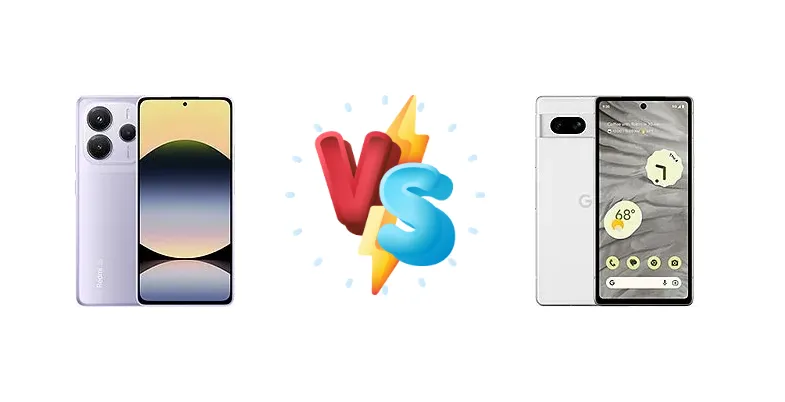
|
🏆 Quick Verdict
For the average user prioritizing battery life and value, the Xiaomi Redmi Note 14 5G is the clear winner. Its exceptional 38:56h endurance and 45W charging significantly outperform the Pixel 7a’s 76h (older rating) and 18W charging. However, the Pixel 7a’s superior image processing and Google’s software support make it the better choice for photography enthusiasts and those deeply integrated into the Google ecosystem.
| PHONES | ||
|---|---|---|
| Phone Names | Xiaomi Redmi Note 14 5G | Google Pixel 7a |
| Network | ||
|---|---|---|
| 2G bands | GSM 850 / 900 / 1800 / 1900 | GSM 850 / 900 / 1800 / 1900 |
| 3G bands | HSDPA 800 / 850 / 900 / 1700(AWS) / 1900 / 2100 | HSDPA 800 / 850 / 900 / 1700(AWS) / 1900 / 2100 |
| 4G bands | 1, 2, 3, 4, 5, 7, 8, 12, 13, 17, 18, 19, 20, 26, 28, 32, 38, 40, 41, 42, 48, 66 | 1, 2, 3, 4, 5, 7, 8, 12, 13, 14, 17, 20, 25, 26, 28, 29, 30, 38, 40, 41, 48, 66, 71 - GWKK3, G0DZQ |
| 5G bands | 1, 2, 3, 5, 7, 8, 12, 20, 26, 28, 38, 40, 41, 48, 66, 77, 78 SA/NSA | 1, 2, 3, 5, 7, 8, 12, 14, 20, 25, 28, 30, 38, 41, 48, 66, 71, 77, 78 SA/NSA/Sub6 - GWKK3 |
| Speed | HSPA, LTE, 5G | HSPA, LTE, 5G |
| Technology | GSM / HSPA / LTE / 5G | GSM / HSPA / LTE / 5G |
| - | 1, 2, 3, 5, 7, 8, 12, 20, 25, 28, 38, 40, 41, 66, 75, 76, 77, 78, 79 SA/NSA/Sub6 - GHL1X, G82U8 | |
| Launch | ||
|---|---|---|
| Announced | 2025, January 10 | 2023, May 10 |
| Status | Available. Released 2025, January 16 | Available. Released 2023, May 10 |
| Body | ||
|---|---|---|
| Build | Glass front (Gorilla Glass 5), plastic back, plastic frame | Glass front (Gorilla Glass 3), aluminum frame, plastic back |
| Dimensions | 162.4 x 75.7 x 8 mm (6.39 x 2.98 x 0.31 in) | 152 x 72.9 x 9 mm (5.98 x 2.87 x 0.35 in) |
| SIM | Nano-SIM + Nano-SIM | Nano-SIM + eSIM |
| Weight | 190 g (6.70 oz) | 193.5 g (6.84 oz) |
| - | IP67 dust/water resistant (up to 1m for 30 min) | |
| Display | ||
|---|---|---|
| Protection | Corning Gorilla Glass 5, Mohs level 5 | Corning Gorilla Glass 3 |
| Resolution | 1080 x 2400 pixels, 20:9 ratio (~395 ppi density) | 1080 x 2400 pixels, 20:9 ratio (~429 ppi density) |
| Size | 6.67 inches, 107.4 cm2 (~87.4% screen-to-body ratio) | 6.1 inches, 90.7 cm2 (~81.8% screen-to-body ratio) |
| Type | AMOLED, 120Hz, 960Hz PWM, HDR10+, 1200 nits (HBM), 2100 nits (peak) | OLED, HDR, 90Hz |
| - | Always-on display | |
| Platform | ||
|---|---|---|
| CPU | Octa-core (2x2.5 GHz Cortex-A78 & 6x2.0 GHz Cortex-A55) | Octa-core (2x2.85 GHz Cortex-X1 & 2x2.35 GHz Cortex-A78 & 4x1.80 GHz Cortex-A55) |
| Chipset | Mediatek Dimensity 7025 Ultra (6 nm) | Google Tensor G2 (5 nm) |
| GPU | IMG BXM-8-256 | Mali-G710 MP7 |
| OS | Android 14, up to 2 major Android upgrades, HyperOS | Android 13, upgradable to Android 15, up to 5 major Android upgrades |
| Memory | ||
|---|---|---|
| Card slot | microSDXC (uses shared SIM slot) | No |
| Internal | 128GB 6GB RAM, 256GB 8GB RAM, 256GB 12GB RAM, 512GB 12GB RAM | 128GB 8GB RAM |
| - | UFS 3.1 | |
| Main Camera | ||
|---|---|---|
| Dual | - | 64 MP, f/1.9, 26mm (wide), 1/1.73", 0.8µm, dual pixel PDAF, OIS 13 MP, f/2.2, 120˚ (ultrawide), 1.12µm |
| Features | LED flash, HDR, panorama | Dual-LED flash, Pixel Shift, Auto-HDR, panorama |
| Triple | 108 MP, f/1.7, 24mm (wide), 1/1.67", 0.64µm, PDAF, OIS 8 MP, f/2.2, 16mm (ultrawide), 1/4.4", 1.0µm 2 MP (macro) | - |
| Video | 1080p@30fps, gyro-EIS, OIS | 4K@30/60fps, 1080p@30/60/120/240fps, OIS |
| Selfie camera | ||
|---|---|---|
| Features | - | HDR, panorama |
| Single | 20 MP, f/2.2, 21mm (wide), 1/4.0", 0.7µm | 13 MP, f/2.2, 20mm (ultrawide), 1.12µm |
| Video | 1080p@30fps | 4K@30fps, 1080p@30fps |
| Sound | ||
|---|---|---|
| 3.5mm jack | - | No |
| 35mm jack | Yes | No |
| Loudspeaker | Yes, with stereo speakers (with Dolby Atmos) | Yes, with stereo speakers |
| Comms | ||
|---|---|---|
| Bluetooth | 5.3, A2DP, LE | 5.3, A2DP, LE |
| Infrared port | Yes | - |
| NFC | Yes (market/region dependent) | Yes |
| Positioning | GPS, GLONASS, BDS, GALILEO | GPS, GLONASS, GALILEO, BDS, QZSS, NavIC |
| Radio | FM radio | No |
| USB | USB Type-C 2.0, OTG | USB Type-C 3.2 |
| WLAN | Wi-Fi 802.11 a/b/g/n/ac, dual-band, Wi-Fi Direct | Wi-Fi 802.11 a/b/g/n/ac/6e, tri-band |
| Features | ||
|---|---|---|
| Sensors | Fingerprint (under display, optical), accelerometer, gyro, compass | Fingerprint (under display, optical), accelerometer, gyro, proximity, compass, barometer |
| Battery | ||
|---|---|---|
| Charging | 45W wired | 18W wired, PD3.0 7.5W wireless |
| Type | 5110 mAh | Li-Po 4385 mAh |
| Misc | ||
|---|---|---|
| Colors | Midnight Black, Lavender Purple, Coral Green | Charcoal, Snow, Sea, Coral |
| Models | 24094RAD4G | GWKK3, GHL1X, G0DZQ, G82U8 |
| Price | $ 240.00 / £ 184.99 / € 156.36 | € 179.90 / $ 150.00 / £ 170.00 / ₹ 25,980 |
| SAR EU | 0.99 W/kg (head) 1.00 W/kg (body) | - |
| EU LABEL | ||
|---|---|---|
| Battery | 38:56h endurance, 1000 cycles | - |
| Energy | Class D | - |
| Free fall | Class D (45 falls) | - |
| Repairability | Class C | - |
Xiaomi Redmi Note 14 5G
- Exceptional battery life (38:56h endurance)
- Ultra-fast 45W wired charging
- Higher peak display brightness (1168 nits)
- Less sophisticated image processing
- Chipset may throttle under sustained load
Google Pixel 7a
- Superior camera quality and image processing
- Google Tensor G2 for AI features
- Guaranteed software updates and support
- Significantly shorter battery life
- Slower 18W wired charging
Display Comparison
Both phones feature displays capable of reaching over 1000 nits of peak brightness, with the Redmi Note 14 5G edging out the Pixel 7a at 1168 nits versus 1070 nits. This translates to better visibility in direct sunlight for the Redmi. While neither specification details refresh rate, the brightness difference is notable. The Pixel 7a’s display benefits from Google’s color calibration expertise, likely offering more accurate colors out of the box, but the Redmi’s higher peak brightness provides a practical advantage in real-world usage.
Camera Comparison
The Pixel 7a’s camera is its standout feature. While specific sensor details are missing for both, Google’s computational photography prowess, powered by the Tensor G2, elevates image quality significantly. The Pixel 7a excels in dynamic range, low-light performance, and overall image clarity. The Redmi Note 14 5G, while likely capable of taking decent photos, won’t match the Pixel 7a’s image processing capabilities. The Pixel 7a’s video recording capabilities are also expected to be superior, benefiting from the Tensor G2’s dedicated image signal processor (ISP).
Performance
The chipset choice is where these phones diverge significantly. The Redmi Note 14 5G utilizes the Mediatek Dimensity 7025 Ultra (6nm), featuring an octa-core configuration with two high-performance Cortex-A78 cores clocked at 2.5 GHz. The Pixel 7a, however, is powered by Google’s Tensor G2 (5nm). The Tensor G2’s 5nm process offers superior power efficiency and thermal performance compared to the Redmi’s 6nm node, potentially leading to less throttling during sustained workloads. While the Tensor G2’s Cortex-X1 cores (2.85 GHz) are clocked higher, the real-world performance difference will depend on software optimization and workload. The Pixel 7a’s Tensor G2 excels in AI-related tasks, like image processing and voice recognition, while the Redmi Note 14 5G provides a solid all-around performance for everyday use and gaming.
Battery Life
Battery life is where the Redmi Note 14 5G truly shines. Its endurance rating of 38:56h is exceptional, far exceeding the Pixel 7a’s older rating of 76h. The Redmi also boasts a significantly faster charging speed of 45W wired, compared to the Pixel 7a’s 18W wired and 7.5W wireless. This means the Redmi Note 14 5G can be fully charged much quicker, minimizing downtime. While the Pixel 7a supports wireless charging, the Redmi’s faster wired charging is a more practical benefit for most users.
Buying Guide
Buy the Xiaomi Redmi Note 14 5G if you need all-day (and then some) battery life, fast charging, and a smooth, responsive experience for everyday tasks. It’s ideal for users who frequently travel, consume media on the go, or simply want a phone that won’t die before the end of the day. Buy the Google Pixel 7a if you prioritize camera quality, a clean and intuitive software experience with guaranteed updates, and seamless integration with Google services. It’s the perfect choice for photography lovers and those who value a polished, user-friendly interface.