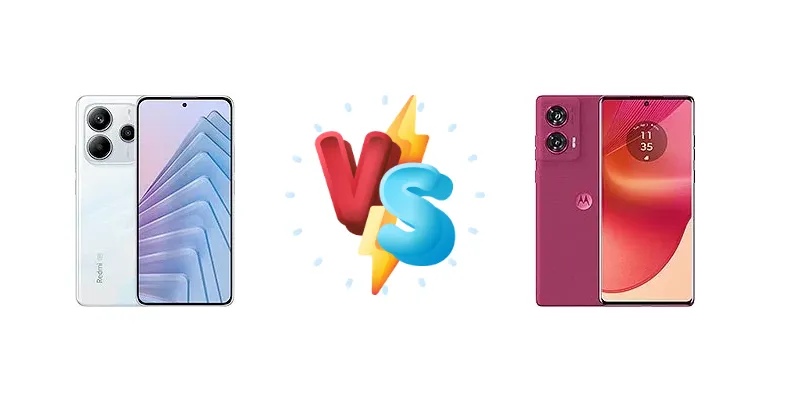
The mid-range 5G smartphone market is fiercely competitive, and the Xiaomi Redmi Note 14 5G (India) and Motorola Edge 50 Fusion represent compelling options. The Redmi Note 14 5G focuses on delivering strong performance with the MediaTek Dimensity 7025 Ultra, while the Edge 50 Fusion leverages Qualcomm’s Snapdragon 7s Gen 2 (or 6 Gen 1 in LATAM) and prioritizes fast charging and display quality. This comparison dissects their key differences to help you choose the right device.
🏆 Quick Verdict
For the average user prioritizing a balance of performance and fast charging, the Motorola Edge 50 Fusion emerges as the stronger contender. Its Snapdragon 7s Gen 2 (International) offers a more efficient architecture, coupled with significantly faster 68W charging. However, the Redmi Note 14 5G remains a viable option for those focused on raw CPU power within a budget.
| Network |
|---|
| 2G bands | GSM 850 / 900 / 1800 / 1900 | GSM 850 / 900 / 1800 / 1900 |
| 3G bands | HSDPA 850 / 900 / 2100 | HSDPA 850 / 900 / 1900 / 2100 |
| 4G bands | 1, 3, 5, 8, 28, 40, 41 | 1, 2, 3, 5, 7, 8, 18, 19, 20, 26, 28, 32, 38, 40, 41, 42, 71 - International |
| 5G bands | 1, 3, 5, 8, 28, 40, 78 SA/NSA | 1, 3, 5, 7, 8, 20, 26, 28, 38, 40, 41, 77, 78 SA/NSA |
| Speed | HSPA, LTE, 5G | HSPA, LTE, 5G |
| Technology | GSM / HSPA / LTE / 5G | GSM / HSPA / LTE / 5G |
| Launch |
|---|
| Announced | 2024, December 09 | 2024, April 16 |
| Status | Available. Released 2024, December 13 | Available. Released 2024, May 15 |
| Body |
|---|
| Build | Glass front, plastic back | Glass front, silicone polymer back (eco leather), plastic frame |
| Dimensions | 162.4 x 75.7 x 8 mm (6.39 x 2.98 x 0.31 in) | 161.9 x 73.1 x 7.9 mm (6.37 x 2.88 x 0.31 in) |
| SIM | Nano-SIM + Nano-SIM | · Nano-SIM + eSIM· Nano-SIM + Nano-SIM |
| Weight | 190 g (6.70 oz) | 174.9 g (6.17 oz) |
| Display |
|---|
| Protection | Corning Gorilla Glass 5 | Corning Gorilla Glass 5 |
| Resolution | 1080 x 2400 pixels, 20:9 ratio (~395 ppi density) | 1080 x 2400 pixels, 20:9 ratio (~393 ppi density) |
| Size | 6.67 inches, 107.4 cm2 (~87.4% screen-to-body ratio) | 6.7 inches, 108.4 cm2 (~91.6% screen-to-body ratio) |
| Type | AMOLED, 120Hz, HDR10+, 2100 nits (peak) | P-OLED, 1B colors, 120Hz (LATAM), 144Hz (INT), 1600 nits (peak) |
| Platform |
|---|
| CPU | Octa-core (2x2.5 GHz Cortex-A78 & 6x2.0 GHz Cortex-A55) | Octa-core (4x2.40 GHz Cortex-A78 & 4x1.95 GHz Cortex-A55) - InternationalOcta-core (4x2.2 GHz Cortex-A78 & 4x1.8 GHz Cortex-A55) - LATAM |
| Chipset | Mediatek Dimensity 7025 Ultra (6 nm) | Qualcomm SM7435-AB Snapdragon 7s Gen 2 (4 nm) - InternationalQualcomm SM6450 Snapdragon 6 Gen 1 (4 nm) - LATAM |
| GPU | IMG BXM-8-256 | Adreno 710 |
| OS | Android 14, HyperOS | Android 14, upgradable to Android 15, up to 3 major Android upgrades |
| Memory |
|---|
| Card slot | microSDXC (uses shared SIM slot) | No |
| Internal | 128GB 6GB RAM, 128GB 8GB RAM, 256GB 8GB RAM | 128GB 8GB RAM, 256GB 8GB RAM, 256GB 12GB RAM, 512GB 8GB RAM, 512GB 12GB RAM |
| Main Camera |
|---|
| Dual | - | 50 MP, f/1.9, (wide), 1/1.56", 1.0µm, multi-directional PDAF, OIS
13 MP, f/2.2, 120˚ (ultrawide), 1/3.0", 1.12µm, AF |
| Features | LED flash, HDR, panorama | LED flash, HDR, panorama |
| Triple | 50 MP, f/1.5, 26mm (wide), 1/1.95", 0.8µm, PDAF, OIS
8 MP, f/2.2, 21mm (ultrawide)
2 MP (macro) | - |
| Video | 1080p@30fps | 4K@30fps, 1080p@30/60/120fps, gyro-EIS |
| Selfie camera |
|---|
| Features | - | HDR |
| Single | 20 MP, f/2.2, (wide), 1/4.0", 0.7µm | 32 MP, f/2.5, (wide), 1/3.14", 0.7µm |
| Video | 1080p@30fps | 4K@30fps, 1080p@30fps |
| Sound |
|---|
| 35mm jack | Yes | No |
| Loudspeaker | Yes, with stereo speakers | Yes, with stereo speakers |
| Comms |
|---|
| Bluetooth | 5.3, A2DP, LE | 5.2, A2DP, LE |
| Infrared port | Yes | - |
| NFC | Yes (market/region dependent) | Yes |
| Positioning | GPS, GLONASS, BDS, GALILEO | GPS, GLONASS, GALILEO |
| Radio | FM radio | No |
| USB | USB Type-C 2.0, OTG | USB Type-C 2.0, OTG |
| WLAN | Wi-Fi 802.11 a/b/g/n/ac, dual-band, Wi-Fi Direct | Wi-Fi 802.11 a/b/g/n/ac, dual-band |
| Features |
|---|
| Sensors | Fingerprint (under display, optical), accelerometer, gyro, proximity, compass | Fingerprint (under display, optical), accelerometer, gyro, proximity, compass |
| Battery |
|---|
| Charging | 45W wired | 68W wired, 50% in 15 min |
| Type | 5110 mAh | 5000 mAh |
| Misc |
|---|
| Colors | Titan Black, Mystique White, Phantom Purple, Ivy Green, Crimson Art (Note 14 SE) | Forest Blue, Marshmallow Blue, Hot Pink |
| Models | 24094RAD4I | XT2429-1 |
| Price | ₹ 13,440 | € 208.99 / $ 245.00 / ₹ 18,667 |
| SAR | 0.84 W/kg (head) 0.73 W/kg (body) | - |
Xiaomi Redmi Note 14 5G (India)
- Potentially higher peak CPU performance (due to higher clocked A78 cores)
- Competitive pricing (likely)
- MediaTek’s Dimensity 7025 Ultra offers solid all-around performance
- Less efficient 6nm chipset
- Slower 45W charging
- Display brightness likely lower than Edge 50 Fusion
Motorola Edge 50 Fusion
- Faster 68W charging (50% in 15 min)
- More efficient 4nm Snapdragon 7s Gen 2 (International)
- Brighter 1322 nits display
- Longer battery life (12:40h active use)
- Slightly lower CPU clock speeds
- LATAM variant uses less powerful Snapdragon 6 Gen 1
- Price may be slightly higher
Display Comparison
The Motorola Edge 50 Fusion boasts a significantly brighter display, reaching a measured 1322 nits. This is a substantial advantage for outdoor visibility compared to the Redmi Note 14 5G, which lacks published brightness data. While both likely utilize AMOLED panels, the Edge 50 Fusion’s higher peak brightness and potentially better color calibration (based on Motorola’s track record) provide a superior viewing experience. The Redmi Note 14 5G’s display specifications are currently unknown, making a definitive comparison difficult, but it’s unlikely to match the Fusion’s brightness.
Camera Comparison
Detailed camera specifications are missing for both devices. However, given the market positioning, it’s reasonable to expect both phones to feature a primary camera around the 50MP mark. The Edge 50 Fusion’s potential for better image processing, stemming from Qualcomm’s ISP, could give it an edge in dynamic range and low-light performance. Without knowing sensor sizes and aperture values, a definitive camera comparison is impossible, but the Edge 50 Fusion’s overall hardware and software integration suggest a slight advantage. The Redmi Note 14 5G’s camera performance will likely rely heavily on software optimization.
Performance
The chipset choice is the core differentiator. The Motorola Edge 50 Fusion (International) utilizes the Qualcomm SM7435-AB Snapdragon 7s Gen 2, built on a 4nm process. This offers a clear efficiency advantage over the Redmi Note 14 5G’s MediaTek Dimensity 7025 Ultra (6nm). While the Redmi Note 14 5G’s CPU features slightly higher clocked Cortex-A78 cores (2.5 GHz vs 2.4 GHz), the Snapdragon 7s Gen 2’s more modern architecture and smaller node translate to better sustained performance and thermal management. The LATAM variant of the Edge 50 Fusion uses the Snapdragon 6 Gen 1, which is a step down in performance and efficiency. Both phones feature an octa-core CPU configuration with similar Cortex-A55 efficiency cores, but the Snapdragon’s Adreno GPU generally outperforms the Mali-G610 MC4 found in the Dimensity 7025.
Battery Life
The Motorola Edge 50 Fusion shines in the battery and charging department. Its 68W wired charging can deliver a 50% charge in just 15 minutes, a significant time saver. While the Redmi Note 14 5G offers 45W charging, it’s considerably slower. The Edge 50 Fusion also boasts an impressive 12:40h active use score, indicating excellent battery life. The Redmi Note 14 5G’s battery capacity is unknown, but the Snapdragon 7s Gen 2’s efficiency in the Edge 50 Fusion suggests it can achieve comparable or even better battery life despite potentially having a smaller battery.
Buying Guide
Buy the Xiaomi Redmi Note 14 5G (India) if you need maximum CPU performance for demanding tasks and are comfortable with slower charging speeds. Buy the Motorola Edge 50 Fusion if you prefer a more efficient processor, a brighter display, and the convenience of incredibly fast 68W charging, even if it means a slight trade-off in peak CPU performance.
Frequently Asked Questions
❓ Does the Dimensity 7025 Ultra in the Redmi Note 14 5G overheat during prolonged gaming sessions?
The 6nm process of the Dimensity 7025 Ultra is prone to more heat generation than the 4nm Snapdragon 7s Gen 2. While Xiaomi likely implements thermal management solutions, extended gaming at high settings may result in noticeable throttling, potentially impacting sustained performance. The Edge 50 Fusion’s Snapdragon 7s Gen 2 is better equipped to handle prolonged gaming without significant performance drops.
❓ Is the 68W charging on the Motorola Edge 50 Fusion compatible with Power Delivery (PD) chargers?
While the Motorola Edge 50 Fusion supports 68W charging, it utilizes Motorola’s proprietary TurboPower technology. While it *may* work with some PD chargers, it won’t achieve the full 68W speed unless you use the included charger. Using a standard PD charger will still charge the device, but at a slower rate.
❓ Which phone is better for video recording, and does either offer 4K at 60fps?
Without detailed camera specs, it's difficult to say definitively. However, the Snapdragon 7s Gen 2 in the Edge 50 Fusion generally offers superior video encoding capabilities. Both phones are *likely* to support 4K recording at 30fps, but 4K at 60fps is less certain and depends on the specific ISP implementation. The Edge 50 Fusion has a slight edge due to Qualcomm's video processing expertise.