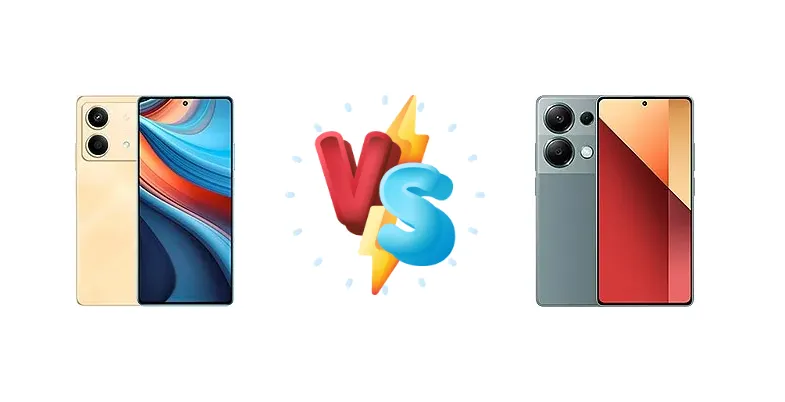
Xiaomi's Redmi Note 13 series offers a compelling range of options in the mid-range market. The Redmi Note 13R Pro and the Note 13 Pro 4G represent distinct approaches: the 13R Pro prioritizes processing power with a newer Dimensity chipset, while the 13 Pro 4G focuses on a faster charging experience and proven battery endurance. This comparison dissects the key differences to help you choose the right phone for your needs.
🏆 Quick Verdict
For the average user prioritizing all-around performance and future-proofing, the Xiaomi Redmi Note 13R Pro emerges as the better choice. Its Dimensity 6080 chipset offers a noticeable performance edge over the Helio G99 Ultra, despite the Note 13 Pro 4G’s faster charging. However, users who heavily value battery life and quick top-ups will find the Note 13 Pro 4G more appealing.
| Network |
|---|
| 2G bands | GSM 850 / 900 / 1800 / 1900 | GSM 850 / 900 / 1800 / 1900 |
| 3G bands | HSDPA 850 / 900 / 2100 | HSDPA 850 / 900 / 1700(AWS) / 1900 / 2100 |
| 4G bands | 1, 3, 5, 8, 34, 38, 39, 40, 41 | 1, 2, 3, 4, 5, 7, 8, 12, 13, 17, 18, 19, 20, 26, 28, 38, 40, 41, 66 |
| 5G bands | 1, 5, 8, 28, 41, 78 SA/NSA | - |
| Speed | HSPA, LTE, 5G | HSPA, LTE |
| Technology | GSM / CDMA / HSPA / LTE / 5G | GSM / HSPA / LTE |
| Launch |
|---|
| Announced | 2023, November 20 | 2024, January 15 |
| Status | Available. Released 2023, November 20 | Available. Released 2024, January 15 |
| Body |
|---|
| Build | - | Glass front (Gorilla Glass 5), plastic frame, plastic back |
| Dimensions | 161.1 x 75 x 7.7 mm (6.34 x 2.95 x 0.30 in) | 161.1 x 75 x 8 mm (6.34 x 2.95 x 0.31 in) |
| SIM | Nano-SIM + Nano-SIM | Nano-SIM + Nano-SIM |
| Weight | 175 g (6.17 oz) | 188 g (6.63 oz) |
| Display |
|---|
| Protection | Corning Gorilla Glass | Corning Gorilla Glass 5 |
| Resolution | 1080 x 2400 pixels, 20:9 ratio (~395 ppi density) | 1080 x 2400 pixels, 20:9 ratio (~395 ppi density) |
| Size | 6.67 inches, 107.4 cm2 (~88.9% screen-to-body ratio) | 6.67 inches, 107.4 cm2 (~88.9% screen-to-body ratio) |
| Type | OLED, 1B colors, 120Hz, 1000 nits (peak) | AMOLED, 1B colors, 120Hz, 500 nits (typ), 1000 nits (HBM), 1300 nits (peak) |
| Platform |
|---|
| CPU | Octa-core (2x2.4 GHz Cortex-A76 & 6x2.0 GHz Cortex-A55) | Octa-core (2x2.2 GHz Cortex-A76 & 6x2.0 GHz Cortex-A55) |
| Chipset | Mediatek Dimensity 6080 (6 nm) | Mediatek Helio G99 Ultra |
| GPU | Mali-G57 MC2 | Mali-G57 MC2 |
| OS | Android 13, MIUI 14 | Android 13, up to 3 major Android upgrades, HyperOS |
| Memory |
|---|
| Card slot | No | microSDXC (uses shared SIM slot) |
| Internal | 256GB 12GB RAM | 128GB 8GB RAM, 256GB 8GB RAM, 256GB 12GB RAM, 512GB 8GB RAM, 512GB 12GB RAM |
| Main Camera |
|---|
| Dual | 108 MP, f/1.7, (wide), 0.64µm, PDAF
Auxiliary lens | - |
| Features | LED flash, HDR, panorama | LED flash, HDR, panorama |
| Triple | - | 200 MP, f/1.7, 23mm (wide), 1/1.4", 0.56µm, multi-directional PDAF, OIS
8 MP, f/2.2, 15mm, 120˚ (ultrawide), 1/4.4", 1.0µm
2 MP (macro) |
| Video | 1080p@30fps | 1080p@30/60fps |
| Selfie camera |
|---|
| Features | HDR | - |
| Single | 16 MP, (wide) | 16 MP, f/2.4, (wide), 1/3.0", 1.0µm |
| Video | 1080p@30fps | 1080p@30/60fps |
| Sound |
|---|
| 35mm jack | Yes | Yes |
| Loudspeaker | Yes | Yes, with dual speakers |
| Comms |
|---|
| Bluetooth | 5.3, A2DP, LE | 5.2, A2DP, LE |
| Infrared port | Yes | Yes |
| NFC | Yes | Yes (market/region dependent) |
| Positioning | GPS, GLONASS, GALILEO, BDS | GPS, GLONASS, GALILEO, BDS |
| Radio | No | FM radio |
| USB | USB Type-C 2.0 | USB Type-C 2.0, OTG |
| WLAN | Wi-Fi 802.11 a/b/g/n/ac, dual-band | Wi-Fi 802.11 a/b/g/n/ac, dual-band |
| Features |
|---|
| Sensors | Fingerprint (side-mounted), accelerometer, gyro, proximity, compass | Fingerprint (under display, optical), accelerometer, gyro, compass |
| Battery |
|---|
| Charging | 33W wired | 67W wired, 50% in 16 min, 100% in 46 min |
| Type | Li-Po 5000 mAh | 5000 mAh |
| Misc |
|---|
| Colors | Black, Blue, Gold | Midnight Black, Lavender Purple, Forest Green |
| Models | 2311FRAFDC | 23117RA68G, 2312FPCA6G |
| Price | About 260 EUR | € 92.00 / $ 269.99 / £ 299.99 |
| SAR | - | 1.09 W/kg (head) 1.09 W/kg (body) |
| SAR EU | - | 0.99 W/kg (head) 0.99 W/kg (body) |
Xiaomi Redmi Note 13R Pro
- More powerful Dimensity 6080 chipset
- Potentially better power efficiency with 6nm process
- Likely better long-term software support
- Slower 33W charging
- Display brightness likely lower than Note 13 Pro 4G
- Battery capacity unknown
Xiaomi Redmi Note 13 Pro 4G
- Significantly faster 67W charging
- Excellent battery life (11:36h active use)
- Brighter display (1047 nits)
- Less powerful Helio G99 Ultra chipset
- Potentially less future-proof
- Image processing may be overly saturated
Display Comparison
The Redmi Note 13 Pro 4G boasts a significantly brighter display, reaching a measured peak of 1047 nits. This is a substantial advantage for outdoor use under direct sunlight. While the 13R Pro’s display specifications aren’t provided, it’s likely to be dimmer. Both phones likely utilize AMOLED panels, common in this price bracket, but the 13 Pro 4G’s brightness is a clear win. The absence of refresh rate data for the 13R Pro makes a direct comparison difficult, but the 13 Pro 4G’s brightness is a key differentiator.
Camera Comparison
Detailed camera specifications beyond 'Photo/Video' are missing for both devices. However, given Xiaomi’s typical strategy, both phones likely feature a primary camera around 50MP. The Note 13 Pro 4G’s image processing is likely tuned for vibrant, social media-ready photos, while the 13R Pro might lean towards a more natural look. Without sensor size or aperture information, it’s difficult to definitively declare a winner. The presence of OIS (Optical Image Stabilization) on either device would be a significant advantage, but this is unknown.
Performance
The core difference lies in the chipsets. The Redmi Note 13R Pro’s Mediatek Dimensity 6080 (6nm) offers a performance advantage over the Note 13 Pro 4G’s Helio G99 Ultra. The Dimensity 6080 features newer Cortex-A76 cores clocked at 2.4 GHz, compared to the G99 Ultra’s 2.2 GHz A76 cores. This translates to faster app loading times and smoother multitasking. The 6nm process node of the Dimensity 6080 also contributes to better power efficiency. While both CPUs have the same number of cores (Octa-core with 2x performance and 6x efficiency cores), the architectural improvements in the Dimensity 6080 give it the edge.
Battery Life
The Redmi Note 13 Pro 4G excels in charging speed with its 67W wired charging, achieving 50% charge in just 16 minutes and a full charge in 46 minutes. The 13R Pro is limited to 33W charging, which will take considerably longer. However, the Note 13 Pro 4G’s active use battery score of 11:36h demonstrates excellent endurance. While the 13R Pro’s battery capacity is unknown, the more efficient Dimensity 6080 could potentially offset the slower charging, but the 13 Pro 4G’s proven battery life is a strong point.
Buying Guide
Buy the Xiaomi Redmi Note 13R Pro if you need a phone capable of handling demanding apps and games with greater ease, and appreciate a more modern chipset for potential software updates. Buy the Xiaomi Redmi Note 13 Pro 4G if you prefer a phone with exceptional battery life, incredibly fast charging, and a brighter display for outdoor visibility, even if it means sacrificing some raw processing power.
Frequently Asked Questions
❓ Will the Helio G99 Ultra in the Note 13 Pro 4G struggle with graphically intensive games like Genshin Impact?
The Helio G99 Ultra is a capable chipset, but it will likely require reduced graphics settings and frame rates to achieve a smooth experience in demanding games like Genshin Impact. The Dimensity 6080 in the 13R Pro will offer a noticeably better gaming experience with higher, more consistent frame rates.
❓ How much faster is the 67W charging on the Note 13 Pro 4G compared to the 33W charging on the 13R Pro in real-world use?
The 67W charging on the Note 13 Pro 4G is significantly faster. It can reach 100% charge in approximately 46 minutes, while the 33W charging on the 13R Pro will likely take over an hour and a half. This difference is particularly noticeable for users who frequently need to quickly top up their battery.
❓ Does the Redmi Note 13R Pro support 5G connectivity?
No, the Redmi Note 13R Pro does not support 5G connectivity. It utilizes a 4G LTE modem, which is consistent with the Note 13 Pro 4G.
❓ Is the difference in CPU performance between the Dimensity 6080 and Helio G99 Ultra noticeable for everyday tasks like browsing and social media?
For basic tasks like browsing and social media, the difference may not be immediately apparent. However, the Dimensity 6080 will provide a smoother and more responsive experience when multitasking or switching between apps, and will handle more demanding applications with greater ease.