
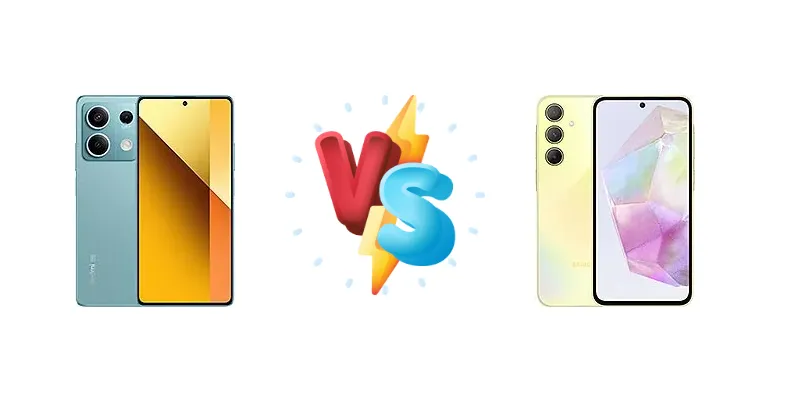
Xiaomi Redmi Note 13 vs. Samsung Galaxy A35: A Deep Dive Comparison
| Phones Images | |||||
|---|---|---|---|---|---|
|
🏆 Quick Verdict
For the average user prioritizing longevity, the Samsung Galaxy A35 emerges as the winner. Its significantly longer 12:26h active use battery life, coupled with the more efficient 5nm Exynos 1380 chipset, outweighs the Redmi Note 13’s slightly brighter display and faster charging.
| PHONES | ||
|---|---|---|
| Phone Names | Xiaomi Redmi Note 13 | Samsung Galaxy A35 |
| Network | ||
|---|---|---|
| 2G bands | GSM 850 / 900 / 1800 / 1900 | GSM 850 / 900 / 1800 / 1900 |
| 3G bands | HSDPA 800 / 850 / 900 / 1700(AWS) / 1900 / 2100 - International | HSDPA 850 / 900 / 1700(AWS) / 1900 / 2100 |
| 4G bands | 1, 2, 3, 4, 5, 7, 8, 12, 13, 17, 18, 19, 20, 26, 28, 32, 38, 40, 41, 66 - International | 1, 2, 3, 4, 5, 7, 8, 12, 13, 17, 20, 25, 26, 28, 32, 38, 40, 41, 66 |
| 5G bands | 1, 3, 5, 7, 8, 20, 28, 38, 40, 41, 66, 77, 78 SA/NSA - International | 1, 3, 5, 7, 8, 26, 28, 40, 41, 66, 77, 78 SA/NSA/Sub6 |
| Speed | HSPA, LTE, 5G | HSPA, LTE, 5G |
| Technology | GSM / HSPA / LTE / 5G | GSM / HSPA / LTE / 5G |
| Launch | ||
|---|---|---|
| Announced | 2024, January 04 | 2024, March 11 |
| Status | Available. Released 2024, January 10 | Available. Released 2024, March 15 |
| Body | ||
|---|---|---|
| Build | Glass front (Gorilla Glass 5), plastic frame, plastic back | Glass front (Gorilla Glass Victus+), plastic frame, glass back |
| Dimensions | 161.1 x 75 x 7.6 mm (6.34 x 2.95 x 0.30 in) | 161.7 x 78 x 8.2 mm (6.37 x 3.07 x 0.32 in) |
| SIM | Nano-SIM + Nano-SIM | · Nano-SIM + eSIM· Nano-SIM + Nano-SIM |
| Weight | 174.5 g (6.14 oz) | 209 g (7.37 oz) |
| Display | ||
|---|---|---|
| Protection | Corning Gorilla Glass 5 | Corning Gorilla Glass Victus+ |
| Resolution | 1080 x 2400 pixels, 20:9 ratio (~395 ppi density) | 1080 x 2340 pixels, 19.5:9 ratio (~390 ppi density) |
| Size | 6.67 inches, 107.4 cm2 (~88.9% screen-to-body ratio) | 6.6 inches, 106.9 cm2 (~84.8% screen-to-body ratio) |
| Type | AMOLED, 1B colors*, 120Hz, 1920Hz PWM, 1000 nits (peak) | Super AMOLED, 120Hz, 1000 nits (HBM) |
| Platform | ||
|---|---|---|
| CPU | Octa-core (2x2.4 GHz Cortex-A76 & 6x2.0 GHz Cortex-A55) | Octa-core (4x2.4 GHz Cortex-A78 & 4x2.0 GHz Cortex-A55) |
| Chipset | Mediatek Dimensity 6080 (6 nm) | Exynos 1380 (5 nm) |
| GPU | Mali-G57 MC2 | Mali-G68 MP5 |
| OS | Android 13, upgradable to Android 14, up to 2 major Android upgrades, HyperOS | Android 14, up to 4 major Android upgrades, One UI 7 |
| Memory | ||
|---|---|---|
| Card slot | microSDXC (uses shared SIM slot) | microSDXC (uses shared SIM slot) |
| Internal | 128GB 6GB RAM, 128GB 8GB RAM, 256GB 8GB RAM, 256GB 12GB RAM, 512GB 12GB RAM | 128GB 4GB RAM, 128GB 6GB RAM, 128GB 8GB RAM, 256GB 6GB RAM, 256GB 8GB RAM, 256GB 12GB RAM |
| Main Camera | ||
|---|---|---|
| Features | LED flash, HDR, panorama | LED flash, panorama, HDR |
| Triple | 108 MP, f/1.7, (wide), 1/1.67", 0.64µm, PDAF 8 MP, f/2.2, (ultrawide) Auxiliary lens | 50 MP, f/1.8, (wide), 1/1.96", PDAF, OIS 8 MP, f/2.2, 123˚, (ultrawide), 1/4.0", 1.12µm 5 MP (macro) |
| Video | 1080p@30fps | 4K@30fps, 1080p@30/60fps, gyro-EIS |
| Selfie camera | ||
|---|---|---|
| Features | HDR, panorama | - |
| Single | 16 MP, f/2.4, (wide) | 13 MP, f/2.2, (wide), 1/3.06", 1.12µm |
| Video | 1080p@30fps | 4K@30fps, 1080p@30fps |
| Sound | ||
|---|---|---|
| 35mm jack | Yes | No |
| Loudspeaker | Yes | Yes, with stereo speakers |
| Comms | ||
|---|---|---|
| Bluetooth | 5.3, A2DP, LE | 5.3, A2DP, LE |
| Infrared port | Yes | - |
| NFC | Yes (market/region dependent) | Yes (market/region dependent) |
| Positioning | GPS, GLONASS | GPS, GALILEO, GLONASS, BDS, QZSS |
| Radio | No | No |
| USB | USB Type-C 2.0, OTG | USB Type-C 2.0, OTG |
| WLAN | Wi-Fi 802.11 a/b/g/n/ac, dual-band | Wi-Fi 802.11 a/b/g/n/ac/6, dual-band, Wi-Fi Direct |
| Features | ||
|---|---|---|
| Sensors | Fingerprint (side-mounted), accelerometer, gyro, proximity, compass | Fingerprint (under display, optical), accelerometer, gyro, compass |
| Battery | ||
|---|---|---|
| Charging | 33W wired | 25W wired |
| Type | Li-Po 5000 mAh | Li-Ion 5000 mAh |
| Misc | ||
|---|---|---|
| Colors | Graphite black (Stealth Black), Arctic White, Ocean Teal, Prism Gold | Iceblue, Lilac, Navy, Lemon |
| Models | 2312DRAABG, 2312DRAABI | SM-A356E, SM-A356E/DS, SM-A356B, SM-A356B/DS, SM-A356U, SM-A356U1 |
| Price | $ 118.38 / £ 206.65 / € 150.99 / ₹ 15,950 | $ 138.00 / C$ 419.99 / £ 205.99 / € 259.99 / ₹ 18,299 |
| SAR | 1.07 W/kg (head) 0.99 W/kg (body) | 0.81 W/kg (head) |
| SAR EU | 0.94 W/kg (head) 1.00 W/kg (body) | 0.44 W/kg (head) 0.92 W/kg (body) |
Xiaomi Redmi Note 13
- Brighter display for outdoor use (991 nits)
- Faster 33W wired charging
- Potentially more affordable price point
- Shorter battery life (9:49h active use)
- Less powerful chipset (Dimensity 6080)
- Less efficient 6nm process
Samsung Galaxy A35
- Significantly longer battery life (12:26h active use)
- More powerful and efficient chipset (Exynos 1380, 5nm)
- Potentially better camera performance
- Slower 25W wired charging
- Slightly lower peak display brightness
- Potentially higher price
Display Comparison
Both devices feature capable displays, but with subtle differences. The Samsung Galaxy A35 boasts a slightly brighter panel at 1024 nits, compared to the Redmi Note 13’s 991 nits, offering a marginal advantage in direct sunlight. While both likely utilize AMOLED technology (though not explicitly stated), the lack of refresh rate information prevents a full assessment of smoothness. The A35’s higher peak brightness will be more noticeable when viewing HDR content. Bezels appear comparable based on available imagery, and without color accuracy measurements, it’s difficult to definitively declare a winner in color reproduction.
Camera Comparison
Without detailed camera specs, a direct comparison is limited. However, the market positioning suggests the Galaxy A35 likely features a more sophisticated camera system. While both phones likely include a primary sensor, the A35’s image signal processor (ISP) within the Exynos 1380 will likely offer more advanced image processing capabilities. The Redmi Note 13’s inclusion of a 2MP macro lens is a common, but often underwhelming, feature in this price range. The A35’s larger sensor (likely) and potentially better software algorithms will likely result in superior image quality, particularly in low-light conditions. OIS (Optical Image Stabilization) is a feature likely present on the A35, but not confirmed on the Redmi Note 13.
Performance
The chipset is where the most significant difference lies. The Samsung Galaxy A35’s Exynos 1380, built on a 5nm process, offers a clear architectural advantage over the Redmi Note 13’s Mediatek Dimensity 6080 (6nm). The A35 utilizes Cortex-A78 cores (4x2.4 GHz) which are more performant than the A76 cores (2x2.4 GHz) found in the Redmi Note 13. This translates to snappier app launches, smoother multitasking, and improved gaming performance. The 5nm fabrication process of the Exynos 1380 also contributes to better thermal efficiency, potentially reducing throttling during sustained workloads. While both phones have 8GB of RAM (assumed based on market segment), the Exynos 1380’s superior architecture will deliver a more responsive user experience.
Battery Life
Battery life is a key differentiator. The Samsung Galaxy A35 delivers an impressive 12:26h of active use, significantly outperforming the Redmi Note 13’s 9:49h. This difference is likely attributable to the more efficient 5nm Exynos 1380 chipset. While the Redmi Note 13 offers faster 33W wired charging, the A35’s superior battery capacity and efficiency mean you’ll likely need to charge it less frequently. The A35’s 25W charging, while slower, is still adequate for overnight charging or topping up during the day.
Buying Guide
Buy the Xiaomi Redmi Note 13 if you need maximum screen brightness for outdoor visibility and prioritize faster 33W charging for quick top-ups. Buy the Samsung Galaxy A35 if you value exceptional battery life, a more powerful processor for smoother multitasking and gaming, and a potentially longer software support lifecycle.