
Xiaomi Redmi Note 13 vs. Motorola Moto G84: A Deep Dive into Battery, Performance, and Value
| Phones Images | |||||
|---|---|---|---|---|---|
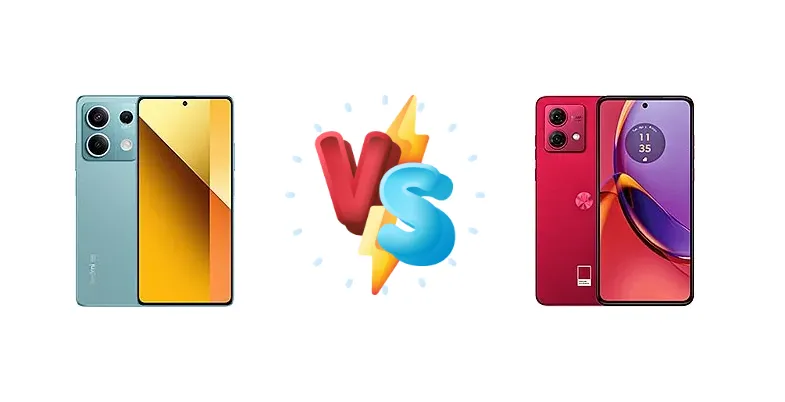
|
🏆 Quick Verdict
For the average user prioritizing all-day battery life and consistent performance, the Motorola Moto G84 emerges as the better choice. Its impressive 12:31 active use score significantly outpaces the Redmi Note 13’s 9:49, making it ideal for heavy users. However, the Redmi Note 13 offers a slight performance edge for demanding tasks.
| PHONES | ||
|---|---|---|
| Phone Names | Xiaomi Redmi Note 13 | Motorola Moto G84 |
| Network | ||
|---|---|---|
| 2G bands | GSM 850 / 900 / 1800 / 1900 | GSM 850 / 900 / 1800 / 1900 |
| 3G bands | HSDPA 800 / 850 / 900 / 1700(AWS) / 1900 / 2100 - International | HSDPA 850 / 900 / 1700(AWS) / 1900 / 2100 - LATAM |
| 4G bands | 1, 2, 3, 4, 5, 7, 8, 12, 13, 17, 18, 19, 20, 26, 28, 32, 38, 40, 41, 66 - International | 1, 2, 3, 4, 5, 7, 8, 12, 13, 17, 25, 26, 28, 38, 40, 41, 42, 66 - LATAM |
| 5G bands | 1, 3, 5, 7, 8, 20, 28, 38, 40, 41, 66, 77, 78 SA/NSA - International | 1, 2, 3, 5, 7, 26, 28, 40, 66, 78 SA/NSA/Sub6 - LATAM |
| Speed | HSPA, LTE, 5G | HSPA, LTE, 5G |
| Technology | GSM / HSPA / LTE / 5G | GSM / HSPA / LTE / 5G |
| Launch | ||
|---|---|---|
| Announced | 2024, January 04 | 2023, August 24 |
| Status | Available. Released 2024, January 10 | Available. Released 2023, September 08 |
| Body | ||
|---|---|---|
| Build | Glass front (Gorilla Glass 5), plastic frame, plastic back | Glass front, plastic frame, plastic back or eco leather back |
| Dimensions | 161.1 x 75 x 7.6 mm (6.34 x 2.95 x 0.30 in) | 160 x 74.4 x 7.6 mm (6.30 x 2.93 x 0.30 in) |
| SIM | Nano-SIM + Nano-SIM | Nano-SIM + Nano-SIM |
| Weight | 174.5 g (6.14 oz) | 166.8 g (5.86 oz) |
| Display | ||
|---|---|---|
| Protection | Corning Gorilla Glass 5 | - |
| Resolution | 1080 x 2400 pixels, 20:9 ratio (~395 ppi density) | 1080 x 2400 pixels, 20:9 ratio (~405 ppi density) |
| Size | 6.67 inches, 107.4 cm2 (~88.9% screen-to-body ratio) | 6.5 inches, 102.0 cm2 (~85.7% screen-to-body ratio) |
| Type | AMOLED, 1B colors*, 120Hz, 1920Hz PWM, 1000 nits (peak) | P-OLED, 1B colors, 120Hz, 1300 nits (peak) |
| Platform | ||
|---|---|---|
| CPU | Octa-core (2x2.4 GHz Cortex-A76 & 6x2.0 GHz Cortex-A55) | Octa-core (2x2.2 GHz Kryo 660 Gold & 6x1.7 GHz Kryo 660 Silver) |
| Chipset | Mediatek Dimensity 6080 (6 nm) | Qualcomm SM6375 Snapdragon 695 5G (6 nm) |
| GPU | Mali-G57 MC2 | Adreno 619 |
| OS | Android 13, upgradable to Android 14, up to 2 major Android upgrades, HyperOS | Android 13, upgradable to Android 15 |
| Memory | ||
|---|---|---|
| Card slot | microSDXC (uses shared SIM slot) | microSDXC (uses shared SIM slot) |
| Internal | 128GB 6GB RAM, 128GB 8GB RAM, 256GB 8GB RAM, 256GB 12GB RAM, 512GB 12GB RAM | 256GB 8GB RAM, 256GB 12GB RAM |
| Main Camera | ||
|---|---|---|
| Dual | - | 50 MP, f/1.9 (wide), 1/1.5", 1.0µm, PDAF, OIS 8 MP, f/2.2, 120˚ (ultrawide), 1/4.0", 1.12µm, AF |
| Features | LED flash, HDR, panorama | LED flash, HDR, panorama |
| Triple | 108 MP, f/1.7, (wide), 1/1.67", 0.64µm, PDAF 8 MP, f/2.2, (ultrawide) Auxiliary lens | - |
| Video | 1080p@30fps | 1080p@30/60fps |
| Selfie camera | ||
|---|---|---|
| Features | HDR, panorama | - |
| Single | 16 MP, f/2.4, (wide) | 16 MP, f/2.5, (wide), 1.0µm |
| Video | 1080p@30fps | 1080p@30fps |
| Sound | ||
|---|---|---|
| 35mm jack | Yes | Yes |
| Loudspeaker | Yes | Yes, with stereo speakers |
| Comms | ||
|---|---|---|
| Bluetooth | 5.3, A2DP, LE | 5.1, A2DP, LE |
| Infrared port | Yes | - |
| NFC | Yes (market/region dependent) | Yes (market/region dependent) |
| Positioning | GPS, GLONASS | GPS, GLONASS, GALILEO |
| Radio | No | FM radio (market/region dependent) |
| USB | USB Type-C 2.0, OTG | USB Type-C 2.0 |
| WLAN | Wi-Fi 802.11 a/b/g/n/ac, dual-band | Wi-Fi 802.11 a/b/g/n/ac, dual-band, Wi-Fi Direct |
| Features | ||
|---|---|---|
| Sensors | Fingerprint (side-mounted), accelerometer, gyro, proximity, compass | Fingerprint (under display, optical), accelerometer, gyro, proximity, compass |
| Battery | ||
|---|---|---|
| Charging | 33W wired | 30W wired |
| Type | Li-Po 5000 mAh | Li-Po 5000 mAh |
| Misc | ||
|---|---|---|
| Colors | Graphite black (Stealth Black), Arctic White, Ocean Teal, Prism Gold | Marshmallow Blue, Midnight Blue, Viva Magenta |
| Models | 2312DRAABG, 2312DRAABI | XT2347, XT2347-1, XT2347-2 |
| Price | $ 118.38 / £ 206.65 / € 150.99 / ₹ 15,950 | $ 399.00 / £ 189.99 / € 169.00 |
| SAR | 1.07 W/kg (head) 0.99 W/kg (body) | - |
| SAR EU | 0.94 W/kg (head) 1.00 W/kg (body) | - |
Xiaomi Redmi Note 13
- Potentially faster processing with Dimensity 6080
- Slightly faster 33W charging
- May offer more RAM/storage options (market dependent)
- Significantly shorter battery life
- Less efficient chipset
- Camera specs are unknown
Motorola Moto G84
- Exceptional battery life (12:31h active use)
- Efficient Snapdragon 695 chipset
- Clean Motorola software experience
- Slightly slower processor
- Slower 30W charging
- Camera specs are unknown
Display Comparison
Both the Redmi Note 13 and Moto G84 feature displays capable of reaching approximately 1000 nits of peak brightness – 991 nits for the Redmi Note 13 and 996 nits for the Moto G84 – ensuring excellent visibility even in direct sunlight. While both offer a good viewing experience, the lack of information regarding panel technology (like OLED or AMOLED) and refresh rates limits a deeper comparison. The similarity in peak brightness suggests comparable outdoor usability, but the absence of details like PWM dimming frequency prevents assessing potential eye strain for sensitive users.
Camera Comparison
The provided data only indicates that the Moto G84 has a 'Photo / Video' camera, lacking specifics on sensor size or resolution. This makes a direct comparison difficult. However, given the market positioning, it’s likely both phones feature similar mid-range camera setups. Without detailed specifications, it’s reasonable to assume image quality will be comparable, with processing algorithms playing a larger role in differentiating the final results. The absence of information on Optical Image Stabilization (OIS) is a significant omission, as OIS dramatically improves low-light performance and video stability.
Performance
The core difference lies in the chipsets. The Redmi Note 13 utilizes the Mediatek Dimensity 6080, a 6nm octa-core processor with a configuration of 2x2.4 GHz Cortex-A76 and 6x2.0 GHz Cortex-A55 cores. This contrasts with the Motorola Moto G84’s Qualcomm Snapdragon 695 5G, also a 6nm chip, but with a different core arrangement: 2x2.2 GHz Kryo 660 Gold and 6x1.7 GHz Kryo 660 Silver. While clock speeds are slightly higher on the Dimensity 6080, the architectural differences and Qualcomm’s optimizations mean the real-world performance gap may be smaller than it appears on paper. The Snapdragon 695 is known for its efficient power consumption, contributing to the Moto G84’s superior battery life.
Battery Life
The Motorola Moto G84 decisively wins in battery endurance. Its active use score of 12:31h is a substantial improvement over the Redmi Note 13’s 9:49h. The older endurance rating of 117h further reinforces this advantage. While the Redmi Note 13 offers 33W wired charging, slightly faster than the Moto G84’s 30W, the difference is unlikely to offset the significant gap in overall battery life. The Snapdragon 695’s efficiency clearly translates into longer usage times between charges.
Buying Guide
Buy the Xiaomi Redmi Note 13 if you need a phone capable of handling moderately demanding games and applications, and you don't mind charging more frequently. Its Dimensity 6080 chipset provides a noticeable performance boost over the Moto G84’s Snapdragon 695. Buy the Motorola Moto G84 if you prioritize exceptional battery life, reliable performance for everyday tasks, and a clean software experience. It’s the perfect companion for users who are constantly on the go and need a phone that can last through a full day – and then some – without needing a recharge.