
Google Pixel 8a vs. Xiaomi Redmi Note 13: A Deep Dive into Mid-Range Champions
| Phones Images | |||||
|---|---|---|---|---|---|
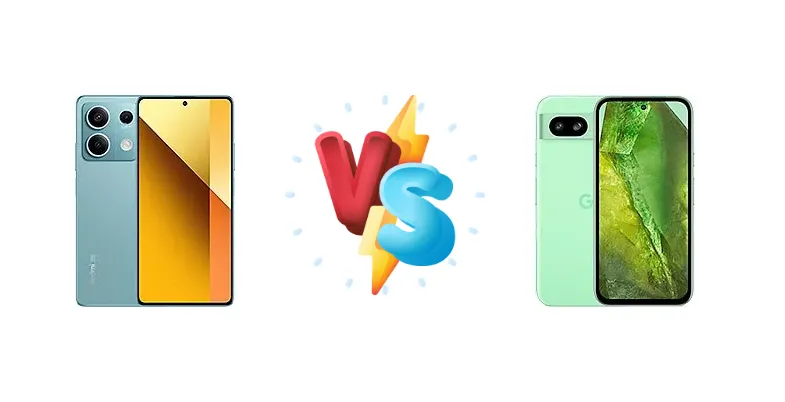
|
🏆 Quick Verdict
For the average user prioritizing software experience and camera quality, the Google Pixel 8a is the clear winner. However, the Xiaomi Redmi Note 13 excels in battery endurance, offering nearly double the usage time, making it ideal for power users and those frequently away from a charger.
| PHONES | ||
|---|---|---|
| Phone Names | Xiaomi Redmi Note 13 | Google Pixel 8a |
| Network | ||
|---|---|---|
| 2G bands | GSM 850 / 900 / 1800 / 1900 | GSM 850 / 900 / 1800 / 1900 |
| 3G bands | HSDPA 800 / 850 / 900 / 1700(AWS) / 1900 / 2100 - International | HSDPA 800 / 850 / 900 / 1700(AWS) / 1900 / 2100 |
| 4G bands | 1, 2, 3, 4, 5, 7, 8, 12, 13, 17, 18, 19, 20, 26, 28, 32, 38, 40, 41, 66 - International | 1, 2, 3, 4, 5, 7, 8, 12, 17, 18, 19, 20, 26, 28, 32, 38, 40, 41, 42, 66 - G6GPR (International) |
| 5G bands | 1, 3, 5, 7, 8, 20, 28, 38, 40, 41, 66, 77, 78 SA/NSA - International | 1, 2, 3, 5, 7, 8, 12, 20, 26, 28, 38, 40, 41, 66, 75, 76, 77, 78 SA/NSA/Sub6 - G6GPR (International) |
| Speed | HSPA, LTE, 5G | HSPA, LTE, 5G |
| Technology | GSM / HSPA / LTE / 5G | GSM / HSPA / LTE / 5G |
| Launch | ||
|---|---|---|
| Announced | 2024, January 04 | 2024, May 07 |
| Status | Available. Released 2024, January 10 | Available. Released 2024, May 14 |
| Body | ||
|---|---|---|
| Build | Glass front (Gorilla Glass 5), plastic frame, plastic back | Glass front (Gorilla Glass 3), aluminum frame, plastic back |
| Dimensions | 161.1 x 75 x 7.6 mm (6.34 x 2.95 x 0.30 in) | 152.1 x 72.7 x 8.9 mm (5.99 x 2.86 x 0.35 in) |
| SIM | Nano-SIM + Nano-SIM | Nano-SIM + eSIM |
| Weight | 174.5 g (6.14 oz) | 188 g (6.63 oz) |
| Display | ||
|---|---|---|
| Protection | Corning Gorilla Glass 5 | Corning Gorilla Glass 3, Mohs level 5 |
| Resolution | 1080 x 2400 pixels, 20:9 ratio (~395 ppi density) | 1080 x 2400 pixels, 20:9 ratio (~430 ppi density) |
| Size | 6.67 inches, 107.4 cm2 (~88.9% screen-to-body ratio) | 6.1 inches, 90.3 cm2 (~81.6% screen-to-body ratio) |
| Type | AMOLED, 1B colors*, 120Hz, 1920Hz PWM, 1000 nits (peak) | OLED, HDR, 120Hz, 2000 nits (peak) |
| Platform | ||
|---|---|---|
| CPU | Octa-core (2x2.4 GHz Cortex-A76 & 6x2.0 GHz Cortex-A55) | Nona-core (1x3.0 GHz Cortex-X3 & 4x2.45 GHz Cortex-A715 & 4x2.15 GHz Cortex-A510) |
| Chipset | Mediatek Dimensity 6080 (6 nm) | Google Tensor G3 (4 nm) |
| GPU | Mali-G57 MC2 | Immortalis-G715s MC10 |
| OS | Android 13, upgradable to Android 14, up to 2 major Android upgrades, HyperOS | Android 14, upgradable to Android 16, up to 7 major Android upgrades |
| Memory | ||
|---|---|---|
| Card slot | microSDXC (uses shared SIM slot) | No |
| Internal | 128GB 6GB RAM, 128GB 8GB RAM, 256GB 8GB RAM, 256GB 12GB RAM, 512GB 12GB RAM | 128GB 8GB RAM, 256GB 8GB RAM |
| Main Camera | ||
|---|---|---|
| Dual | - | 64 MP (16 MP eff.), f/1.9, 26mm (wide), 1/1.73", 0.8µm, dual pixel PDAF, OIS 13 MP, f/2.2, 120˚ (ultrawide), 1.12µm |
| Features | LED flash, HDR, panorama | Dual-LED flash, Pixel Shift, Ultra HDR, panorama, Best Take |
| Triple | 108 MP, f/1.7, (wide), 1/1.67", 0.64µm, PDAF 8 MP, f/2.2, (ultrawide) Auxiliary lens | - |
| Video | 1080p@30fps | 4K@30/60fps, 1080p@30/60/120/240fps, OIS |
| Selfie camera | ||
|---|---|---|
| Features | HDR, panorama | HDR, panorama |
| Single | 16 MP, f/2.4, (wide) | 13 MP, f/2.2, 20mm (ultrawide), 1.12µm |
| Video | 1080p@30fps | 4K@30fps, 1080p@30/60fps |
| Sound | ||
|---|---|---|
| 35mm jack | Yes | No |
| Loudspeaker | Yes | Yes, with stereo speakers |
| Comms | ||
|---|---|---|
| Bluetooth | 5.3, A2DP, LE | 5.3, A2DP, LE |
| Infrared port | Yes | - |
| NFC | Yes (market/region dependent) | Yes |
| Positioning | GPS, GLONASS | GPS, GLONASS, GALILEO, BDS, QZSS, NavIC |
| Radio | No | No |
| USB | USB Type-C 2.0, OTG | USB Type-C 3.2 |
| WLAN | Wi-Fi 802.11 a/b/g/n/ac, dual-band | Wi-Fi 802.11 a/b/g/n/ac/6e, dual/tri-band (market/region dependent) |
| Features | ||
|---|---|---|
| Sensors | Fingerprint (side-mounted), accelerometer, gyro, proximity, compass | Fingerprint (under display, optical), accelerometer, gyro, proximity, compass, barometer |
| Battery | ||
|---|---|---|
| Charging | 33W wired | 18W wired, PD3.0 7.5W wireless Bypass charging |
| Type | Li-Po 5000 mAh | Li-Po 4492 mAh |
| Misc | ||
|---|---|---|
| Colors | Graphite black (Stealth Black), Arctic White, Ocean Teal, Prism Gold | Obsidian, Porcelain, Bay, Aloe |
| Models | 2312DRAABG, 2312DRAABI | GKV4X, G6GPR, G8HHN, G576D |
| Price | $ 118.38 / £ 206.65 / € 150.99 / ₹ 15,950 | $ 229.98 / C$ 417.99 / £ 279.00 / € 299.99 / ₹ 33,300 |
| SAR | 1.07 W/kg (head) 0.99 W/kg (body) | - |
| SAR EU | 0.94 W/kg (head) 1.00 W/kg (body) | - |
| EU LABEL | ||
|---|---|---|
| Battery | - | 40:06h endurance, 1000 cycles |
| Energy | - | Class B |
| Free fall | - | Class A (270 falls) |
| Repairability | - | Class B |
Xiaomi Redmi Note 13
- Exceptional camera performance with Google’s AI features
- Superior processing power with the Tensor G3 chipset
- Long-term software support and guaranteed updates
- Slower charging speed (18W) compared to the Redmi Note 13
- Potentially higher price point
Google Pixel 8a
- Outstanding battery life and endurance
- Bright and vibrant display
- More affordable price
- Less powerful processor compared to the Tensor G3
- Less sophisticated camera system
Display Comparison
The Pixel 8a boasts a significantly brighter display, reaching 1508 nits compared to the Redmi Note 13’s 991 nits. This translates to superior visibility outdoors under direct sunlight. While both displays are likely OLED, the Pixel 8a’s higher brightness and Google’s color calibration likely deliver more accurate and vibrant colors. The Redmi Note 13’s brightness is still respectable, but the Pixel 8a offers a more premium viewing experience. We lack PWM frequency data for both, but the Pixel 8a’s OLED panel is likely to have a higher refresh rate, contributing to smoother scrolling and animations.
Camera Comparison
The Pixel 8a’s camera system is where it truly shines, leveraging Google’s computational photography expertise. While specific sensor details are missing for both, the Pixel 8a’s image processing algorithms are renowned for their dynamic range, detail, and accurate color reproduction. The Tensor G3’s dedicated image signal processor (ISP) plays a crucial role in this. The Redmi Note 13 likely features a more standard camera setup, focusing on providing acceptable image quality in good lighting conditions. The Pixel 8a’s superior processing power will also enable features like Magic Eraser and Photo Unblur, enhancing the overall photography experience.
Performance
The Google Pixel 8a’s Tensor G3 chipset, built on a 4nm process, represents a substantial leap in performance and efficiency over the Redmi Note 13’s Mediatek Dimensity 6080 (6nm). The Tensor G3’s nona-core CPU configuration, featuring a Cortex-X3 prime core, provides significantly faster processing speeds for demanding tasks like video editing and gaming. While the Dimensity 6080 is capable for everyday use, the Tensor G3’s integrated AI capabilities enhance features like voice assistant and image processing. The Pixel 8a’s LPDDR5x RAM (speculation based on Pixel lineage) will also contribute to faster app loading and multitasking compared to the Redmi Note 13’s likely LPDDR4x configuration.
Battery Life
Battery life is a key differentiator. The Redmi Note 13 achieves an impressive 9:49h of active use, but the Pixel 8a blows it away with 11:25h. Furthermore, the Pixel 8a boasts a remarkable 40:06h endurance rating and a claimed 1000 charge cycles, suggesting exceptional long-term battery health. While the Redmi Note 13 supports 33W wired charging, the Pixel 8a offers 18W wired charging with PD3.0 and 7.5W wireless charging, plus bypass charging. The Pixel 8a’s superior battery endurance and charging versatility make it the clear winner for users prioritizing longevity.
Buying Guide
Buy the Xiaomi Redmi Note 13 if you need a phone that can reliably last through two full days of moderate use, and value a bright, easily visible display. Buy the Google Pixel 8a if you prioritize a clean Android experience, exceptional camera performance powered by Google’s Tensor G3 chip, and long-term software support with guaranteed updates.