
Redmi Note 13 Pro vs. Nothing Phone (2a) Plus: A Deep Dive into Mid-Range Champions
| Phones Images | |||||
|---|---|---|---|---|---|
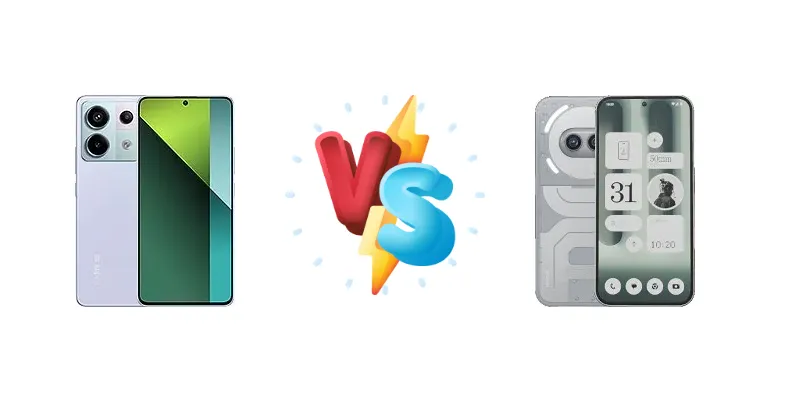
|
🏆 Quick Verdict
For the average user prioritizing battery life and consistent performance, the Nothing Phone (2a) Plus emerges as the winner. Its significantly longer 16:34h active use score, coupled with a capable Dimensity 7350 Pro chipset, outweighs the Redmi Note 13 Pro’s brighter display and faster charging.
| PHONES | ||
|---|---|---|
| Phone Names | Xiaomi Redmi Note 13 Pro | Nothing Phone (2a) Plus |
| Network | ||
|---|---|---|
| 2G bands | GSM 850 / 900 / 1800 / 1900 | GSM 850 / 900 / 1800 / 1900 |
| 3G bands | HSDPA 800 / 850 / 900 / 1700(AWS) / 1900 / 2100 - International | HSDPA 800 / 850 / 900 / 1700(AWS) / 1900 / 2100 |
| 4G bands | 1, 2, 3, 4, 5, 7, 8, 12, 13, 17, 18, 19, 20, 26, 28, 32, 38, 40, 41, 66 - International | 1, 3, 4, 5, 7, 8, 18, 19, 20, 26, 28, 38, 39, 40, 41, 42, 66 |
| 5G bands | 1, 3, 5, 7, 8, 20, 28, 38, 40, 41, 66, 77, 78 SA/NSA - International | 1, 3, 5, 7, 8, 20, 28, 38, 40, 41, 66, 77, 78 SA/NSA |
| Speed | HSPA, LTE, 5G | HSPA, LTE, 5G |
| Technology | GSM / CDMA / HSPA / CDMA2000 / LTE / 5G | GSM / HSPA / LTE / 5G |
| Launch | ||
|---|---|---|
| Announced | 2023, September 21 | 2024, July 31 |
| Status | Available. Released 2023, September 21 | Available. Released 2024, August 03 |
| Body | ||
|---|---|---|
| Build | Glass front (Gorilla Glass Victus), plastic frame, glass back | Glass front (Gorilla Glass 5), plastic frame, plastic back |
| Dimensions | 161.2 x 74.2 x 8 mm (6.35 x 2.92 x 0.31 in) | 161.7 x 76.3 x 8.5 mm (6.37 x 3.00 x 0.33 in) |
| SIM | · Nano-SIM + eSIM· Nano-SIM + Nano-SIM | Nano-SIM + Nano-SIM |
| Weight | 187 g (6.60 oz) | 190 g (6.70 oz) |
| Display | ||
|---|---|---|
| Protection | Corning Gorilla Glass Victus | Corning Gorilla Glass 5 |
| Resolution | 1220 x 2712 pixels, 20:9 ratio (~446 ppi density) | 1080 x 2412 pixels, 20:9 ratio (~395 ppi density) |
| Size | 6.67 inches, 107.4 cm2 (~89.8% screen-to-body ratio) | 6.7 inches, 107.5 cm2 (~87.1% screen-to-body ratio) |
| Type | AMOLED, 68B colors, 120Hz, 1920Hz PWM, Dolby Vision, 500 nits (typ), 1200 nits (HBM), 1800 nits (peak) | AMOLED, 1B colors, 120Hz, 2160Hz PWM, HDR10+, 700 nits (typ), 1100 nits (HBM), 1300 nits (peak) |
| Platform | ||
|---|---|---|
| CPU | Octa-core (4x2.40 GHz Cortex-A78 & 4x1.95 GHz Cortex-A55) | Octa-core (2x3.0 GHz Cortex-A715 & 6x 2.0 GHz Cortex-A510) |
| Chipset | Qualcomm SM7435-AB Snapdragon 7s Gen 2 (4 nm) | Mediatek Dimensity 7350 Pro (4 nm) |
| GPU | Adreno 710 | Mali-G610 MC4 |
| OS | Android 13, up to 3 major Android upgrades, HyperOS | Android 14, up to 3 major Android upgrades, Nothing OS 3.0 |
| Memory | ||
|---|---|---|
| Card slot | No | No |
| Internal | 128GB 8GB RAM, 256GB 8GB RAM, 256GB 12GB RAM, 512GB 12GB RAM, 512GB 16GB RAM | 256GB 8GB RAM, 256GB 12GB RAM |
| Main Camera | ||
|---|---|---|
| Dual | - | 50 MP, f/1.9, 24mm (wide), 1/1.57", 1.0µm, PDAF, OIS 50 MP, f/2.2, 114˚ (ultrawide), 1/2.76", 0.64µm |
| Features | Dual-LED dual-tone flash, HDR, panorama | LED flash, panorama, HDR |
| Triple | 200 MP, f/1.7, 23mm (wide), 1/1.4", 0.56µm, multi-directional PDAF, OIS 8 MP, f/2.2, 118˚ (ultrawide), 1/4.0", 1.12µm 2 MP (macro) | - |
| Video | 4K@30fps, 1080p@30/60/120fps, gyro-EIS | 4K@30fps, 1080p@60/120fps, gyro-EIS |
| Selfie camera | ||
|---|---|---|
| Features | HDR, panorama | HDR |
| Single | 16 MP, f/2.4, (wide), 1/3.06", 1.0µm | 50 MP, f/2.2, (wide), 1/2.76" |
| Video | 1080p@30/60fps | 4K@30fps |
| Sound | ||
|---|---|---|
| 35mm jack | Yes | No |
| Loudspeaker | Yes, with stereo speakers | Yes, with stereo speakers |
| Comms | ||
|---|---|---|
| Bluetooth | 5.2, A2DP, LE | 5.3, A2DP, LE |
| Infrared port | Yes | - |
| NFC | Yes (market/region dependent) | Yes, 360˚ |
| Positioning | GPS, GLONASS, BDS (B1I+B1c), GALILEO, QZSS | GPS, GALILEO, GLONASS, BDS, QZSS |
| Radio | Unspecified | No |
| USB | USB Type-C 2.0, OTG | USB Type-C 2.0, OTG |
| WLAN | Wi-Fi 802.11 a/b/g/n/ac, dual-band | Wi-Fi 802.11 a/b/g/n/ac/6, dual-band, Wi-Fi Direct |
| Features | ||
|---|---|---|
| Sensors | Fingerprint (under display, optical), accelerometer, gyro, compass | Fingerprint (under display, optical), accelerometer, gyro, proximity, compass |
| Battery | ||
|---|---|---|
| Charging | 67W wired, PD3.0, 50% in 17 min, 100% in 44 min | 50W wired, 50% in 21 min, 100% in 56 min |
| Type | Li-Po 5100 mAh | 5000 mAh |
| Misc | ||
|---|---|---|
| Colors | Midnight Black, Aurora Purple (Coral Purple), Ocean Teal, Arctic White, Olive Green, Scarlet Red | Black, Grey |
| Models | 2312DRA50C, 2312CRAD3C, 2312DRA50G, 2312DRA50I | A142P |
| Price | € 220.35 / $ 269.99 / £ 229.00 / ₹ 23,499 | € 269.90 / ₹ 22,599 |
| SAR | 1.09 W/kg (head) 1.03 W/kg (body) | - |
| SAR EU | 1.00 W/kg (head) 1.00 W/kg (body) | - |
Xiaomi Redmi Note 13 Pro
- Brighter display for outdoor visibility (1331 nits)
- Faster 67W wired charging
- Potentially more aggressive pricing (based on Xiaomi's market strategy)
- Significantly shorter battery life (10:16h active use)
- Less powerful CPU architecture compared to Dimensity 7350 Pro
Nothing Phone (2a) Plus
- Exceptional battery life (16:34h active use)
- More modern CPU architecture (Dimensity 7350 Pro)
- Clean and streamlined software experience (typical of Nothing)
- Slower 50W wired charging
- Lower peak display brightness (1097 nits)
Display Comparison
The Redmi Note 13 Pro boasts a brighter display, reaching a measured 1331 nits, making it more readable under direct sunlight compared to the Nothing Phone (2a) Plus’s 1097 nits. While both utilize 4nm chipsets, the display brightness difference is a tangible benefit for outdoor users. However, neither specification details refresh rate or panel type, leaving room for further investigation. The Redmi Note 13 Pro’s higher peak brightness is a clear advantage for media consumption in bright environments.
Camera Comparison
Unfortunately, the provided data lacks detailed camera specifications beyond 'Photo / Video' for both devices. Without sensor size, aperture, or OIS information, a direct comparison is difficult. However, given Xiaomi’s history, the Redmi Note 13 Pro likely emphasizes high megapixel counts, while Nothing typically focuses on computational photography. Users prioritizing image quality should seek detailed camera reviews before making a decision. The absence of specifics makes it impossible to determine a clear winner based on the provided data.
Performance
Under the hood, the Nothing Phone (2a) Plus features the Mediatek Dimensity 7350 Pro, utilizing a 2x3.0 GHz Cortex-A715 core configuration alongside 6x 2.0 GHz Cortex-A510 cores. This contrasts with the Redmi Note 13 Pro’s Qualcomm SM7435-AB Snapdragon 7s Gen 2, which employs a 4x2.40 GHz Cortex-A78 and 4x1.95 GHz Cortex-A55 setup. While clock speeds aren’t everything, the Dimensity 7350 Pro’s newer architecture suggests a performance edge in multi-threaded tasks and potentially gaming. Both are built on a 4nm process, indicating good efficiency, but the Nothing Phone (2a) Plus’s CPU configuration is likely to deliver a smoother experience with demanding applications.
Battery Life
The Nothing Phone (2a) Plus significantly outperforms the Redmi Note 13 Pro in battery life, achieving an impressive 16:34h of active use compared to the Redmi’s 10:16h. This nearly 6-hour difference is substantial and will be noticeable for heavy users. While the Redmi Note 13 Pro offers faster 67W wired charging (50% in 17 min, 100% in 44 min) compared to the Nothing Phone (2a) Plus’s 50W (50% in 21 min, 100% in 56 min), the longer runtime of the Nothing Phone (2a) Plus mitigates the charging speed disparity. The Nothing Phone (2a) Plus prioritizes longevity, while the Redmi Note 13 Pro focuses on quick top-ups.
Buying Guide
Buy the Xiaomi Redmi Note 13 Pro if you need a display that excels in outdoor visibility, peaking at 1331 nits, and value the convenience of 67W fast charging. Buy the Nothing Phone (2a) Plus if you prioritize all-day battery life, a clean software experience, and a more powerful processor for demanding tasks, even if it means slightly slower charging speeds.