
Xiaomi Redmi Note 13 Pro vs Motorola Edge 50 Fusion: A Deep Dive Comparison
| Phones Images | |||||
|---|---|---|---|---|---|
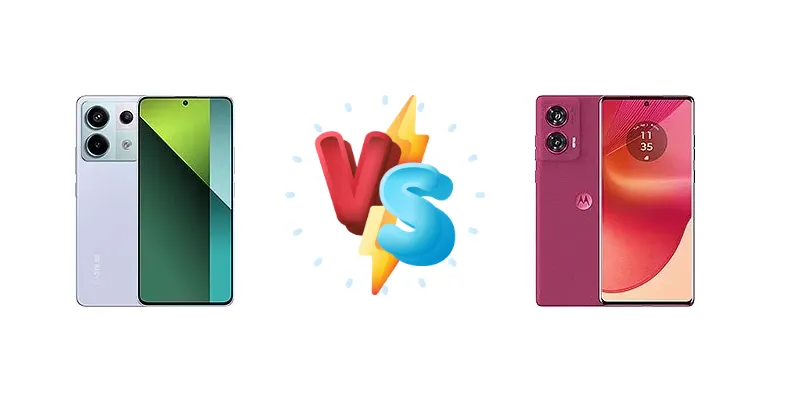
|
🏆 Quick Verdict
For most users, the Motorola Edge 50 Fusion emerges as the slightly better choice, primarily due to its superior battery life – achieving 12:40h in active use compared to the Redmi Note 13 Pro’s 10:16h. However, the Redmi Note 13 Pro remains a strong contender, especially if the price is significantly lower.
| PHONES | ||
|---|---|---|
| Phone Names | Xiaomi Redmi Note 13 Pro | Motorola Edge 50 Fusion |
| Network | ||
|---|---|---|
| 2G bands | GSM 850 / 900 / 1800 / 1900 | GSM 850 / 900 / 1800 / 1900 |
| 3G bands | HSDPA 800 / 850 / 900 / 1700(AWS) / 1900 / 2100 - International | HSDPA 850 / 900 / 1900 / 2100 |
| 4G bands | 1, 2, 3, 4, 5, 7, 8, 12, 13, 17, 18, 19, 20, 26, 28, 32, 38, 40, 41, 66 - International | 1, 2, 3, 5, 7, 8, 18, 19, 20, 26, 28, 32, 38, 40, 41, 42, 71 - International |
| 5G bands | 1, 3, 5, 7, 8, 20, 28, 38, 40, 41, 66, 77, 78 SA/NSA - International | 1, 3, 5, 7, 8, 20, 26, 28, 38, 40, 41, 77, 78 SA/NSA |
| Speed | HSPA, LTE, 5G | HSPA, LTE, 5G |
| Technology | GSM / CDMA / HSPA / CDMA2000 / LTE / 5G | GSM / HSPA / LTE / 5G |
| Launch | ||
|---|---|---|
| Announced | 2023, September 21 | 2024, April 16 |
| Status | Available. Released 2023, September 21 | Available. Released 2024, May 15 |
| Body | ||
|---|---|---|
| Build | Glass front (Gorilla Glass Victus), plastic frame, glass back | Glass front, silicone polymer back (eco leather), plastic frame |
| Dimensions | 161.2 x 74.2 x 8 mm (6.35 x 2.92 x 0.31 in) | 161.9 x 73.1 x 7.9 mm (6.37 x 2.88 x 0.31 in) |
| SIM | · Nano-SIM + eSIM· Nano-SIM + Nano-SIM | · Nano-SIM + eSIM· Nano-SIM + Nano-SIM |
| Weight | 187 g (6.60 oz) | 174.9 g (6.17 oz) |
| Display | ||
|---|---|---|
| Protection | Corning Gorilla Glass Victus | Corning Gorilla Glass 5 |
| Resolution | 1220 x 2712 pixels, 20:9 ratio (~446 ppi density) | 1080 x 2400 pixels, 20:9 ratio (~393 ppi density) |
| Size | 6.67 inches, 107.4 cm2 (~89.8% screen-to-body ratio) | 6.7 inches, 108.4 cm2 (~91.6% screen-to-body ratio) |
| Type | AMOLED, 68B colors, 120Hz, 1920Hz PWM, Dolby Vision, 500 nits (typ), 1200 nits (HBM), 1800 nits (peak) | P-OLED, 1B colors, 120Hz (LATAM), 144Hz (INT), 1600 nits (peak) |
| Platform | ||
|---|---|---|
| CPU | Octa-core (4x2.40 GHz Cortex-A78 & 4x1.95 GHz Cortex-A55) | Octa-core (4x2.40 GHz Cortex-A78 & 4x1.95 GHz Cortex-A55) - InternationalOcta-core (4x2.2 GHz Cortex-A78 & 4x1.8 GHz Cortex-A55) - LATAM |
| Chipset | Qualcomm SM7435-AB Snapdragon 7s Gen 2 (4 nm) | Qualcomm SM7435-AB Snapdragon 7s Gen 2 (4 nm) - InternationalQualcomm SM6450 Snapdragon 6 Gen 1 (4 nm) - LATAM |
| GPU | Adreno 710 | Adreno 710 |
| OS | Android 13, up to 3 major Android upgrades, HyperOS | Android 14, upgradable to Android 15, up to 3 major Android upgrades |
| Memory | ||
|---|---|---|
| Card slot | No | No |
| Internal | 128GB 8GB RAM, 256GB 8GB RAM, 256GB 12GB RAM, 512GB 12GB RAM, 512GB 16GB RAM | 128GB 8GB RAM, 256GB 8GB RAM, 256GB 12GB RAM, 512GB 8GB RAM, 512GB 12GB RAM |
| Main Camera | ||
|---|---|---|
| Dual | - | 50 MP, f/1.9, (wide), 1/1.56", 1.0µm, multi-directional PDAF, OIS 13 MP, f/2.2, 120˚ (ultrawide), 1/3.0", 1.12µm, AF |
| Features | Dual-LED dual-tone flash, HDR, panorama | LED flash, HDR, panorama |
| Triple | 200 MP, f/1.7, 23mm (wide), 1/1.4", 0.56µm, multi-directional PDAF, OIS 8 MP, f/2.2, 118˚ (ultrawide), 1/4.0", 1.12µm 2 MP (macro) | - |
| Video | 4K@30fps, 1080p@30/60/120fps, gyro-EIS | 4K@30fps, 1080p@30/60/120fps, gyro-EIS |
| Selfie camera | ||
|---|---|---|
| Features | HDR, panorama | HDR |
| Single | 16 MP, f/2.4, (wide), 1/3.06", 1.0µm | 32 MP, f/2.5, (wide), 1/3.14", 0.7µm |
| Video | 1080p@30/60fps | 4K@30fps, 1080p@30fps |
| Sound | ||
|---|---|---|
| 35mm jack | Yes | No |
| Loudspeaker | Yes, with stereo speakers | Yes, with stereo speakers |
| Comms | ||
|---|---|---|
| Bluetooth | 5.2, A2DP, LE | 5.2, A2DP, LE |
| Infrared port | Yes | - |
| NFC | Yes (market/region dependent) | Yes |
| Positioning | GPS, GLONASS, BDS (B1I+B1c), GALILEO, QZSS | GPS, GLONASS, GALILEO |
| Radio | Unspecified | No |
| USB | USB Type-C 2.0, OTG | USB Type-C 2.0, OTG |
| WLAN | Wi-Fi 802.11 a/b/g/n/ac, dual-band | Wi-Fi 802.11 a/b/g/n/ac, dual-band |
| Features | ||
|---|---|---|
| Sensors | Fingerprint (under display, optical), accelerometer, gyro, compass | Fingerprint (under display, optical), accelerometer, gyro, proximity, compass |
| Battery | ||
|---|---|---|
| Charging | 67W wired, PD3.0, 50% in 17 min, 100% in 44 min | 68W wired, 50% in 15 min |
| Type | Li-Po 5100 mAh | 5000 mAh |
| Misc | ||
|---|---|---|
| Colors | Midnight Black, Aurora Purple (Coral Purple), Ocean Teal, Arctic White, Olive Green, Scarlet Red | Forest Blue, Marshmallow Blue, Hot Pink |
| Models | 2312DRA50C, 2312CRAD3C, 2312DRA50G, 2312DRA50I | XT2429-1 |
| Price | € 220.35 / $ 269.99 / £ 229.00 / ₹ 23,499 | € 208.99 / $ 245.00 / ₹ 18,667 |
| SAR | 1.09 W/kg (head) 1.03 W/kg (body) | - |
| SAR EU | 1.00 W/kg (head) 1.00 W/kg (body) | - |
Xiaomi Redmi Note 13 Pro
- Potentially lower price point
- 67W fast charging
- Bright display (1331 nits)
- Shorter battery life (10:16h)
- Regional chipset variations not addressed in marketing
Motorola Edge 50 Fusion
- Longer battery life (12:40h)
- Faster 50% charge time (15 minutes)
- Snapdragon 7s Gen 2 (International version)
- Snapdragon 6 Gen 1 in LATAM region
- Slightly higher price
Display Comparison
Both the Redmi Note 13 Pro and Motorola Edge 50 Fusion boast excellent displays, achieving very similar peak brightness levels at 1331 nits and 1322 nits respectively. This ensures excellent visibility even in direct sunlight. While neither manufacturer specifies panel technology (LTPO or not), the high brightness and color accuracy suggest quality AMOLED panels. Bezels appear comparable based on available imagery, and the lack of detailed color gamut data prevents a definitive assessment of color accuracy differences.
Camera Comparison
Detailed camera analysis is hampered by the lack of sensor size and aperture information. Both phones are advertised as having capable camera systems, but the marketing focuses on megapixel counts rather than optical quality. The absence of details regarding Optical Image Stabilization (OIS) is also concerning. Without this data, it’s difficult to assess low-light performance or video stabilization capabilities. We can assume both will offer acceptable results in good lighting conditions, but the Redmi Note 13 Pro’s marketing suggests a greater emphasis on photographic features.
Performance
The core performance of these devices hinges on the chipset. Internationally, both utilize the Qualcomm SM7435-AB Snapdragon 7s Gen 2 (4nm). This 4nm process node is crucial for thermal efficiency, minimizing throttling during sustained workloads. However, the Motorola Edge 50 Fusion has a significant regional variation: in Latin America, it ships with the Qualcomm SM6450 Snapdragon 6 Gen 1. This represents a substantial performance downgrade, impacting gaming and multitasking. Both phones share the same CPU configuration (Octa-core with 4x2.40 GHz Cortex-A78 & 4x1.95 GHz Cortex-A55), but the GPU performance will differ significantly between the 7s Gen 2 and 6 Gen 1.
Battery Life
Battery life is a clear differentiator. The Motorola Edge 50 Fusion achieves an impressive 12:40h of active use, significantly outperforming the Redmi Note 13 Pro’s 10:16h. While the Redmi Note 13 Pro offers 67W wired charging (reaching 50% in 17 minutes and 100% in 44 minutes), the Edge 50 Fusion’s 68W charging is slightly faster, hitting 50% in 15 minutes. This faster charging, combined with the larger battery endurance, makes the Edge 50 Fusion the better choice for users prioritizing all-day battery life.
Buying Guide
Buy the Xiaomi Redmi Note 13 Pro if you prioritize a potentially lower price point and are comfortable with slightly shorter battery life. Buy the Motorola Edge 50 Fusion if you value longer battery endurance and are willing to pay a small premium, especially if you are in a region receiving the Snapdragon 7s Gen 2 variant. LATAM buyers *must* verify the chipset before purchase.