
Google Pixel 8a vs. Xiaomi Redmi Note 13 Pro: A Deep Dive into Mid-Range Excellence
| Phones Images | |||||
|---|---|---|---|---|---|
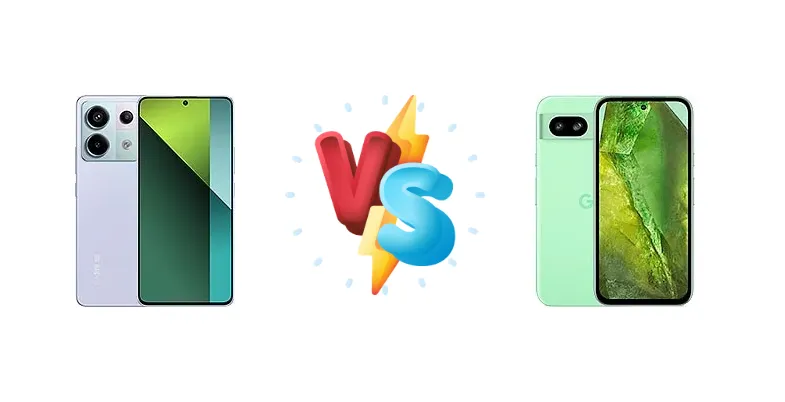
|
🏆 Quick Verdict
For the average user prioritizing camera quality and software experience, the Google Pixel 8a is the clear winner. Its Tensor G3 chip and exceptional image processing deliver consistently impressive results. However, the Redmi Note 13 Pro offers a compelling alternative for those who value faster charging and a brighter display, especially at a potentially lower price point.
| PHONES | ||
|---|---|---|
| Phone Names | Xiaomi Redmi Note 13 Pro | Google Pixel 8a |
| Network | ||
|---|---|---|
| 2G bands | GSM 850 / 900 / 1800 / 1900 | GSM 850 / 900 / 1800 / 1900 |
| 3G bands | HSDPA 800 / 850 / 900 / 1700(AWS) / 1900 / 2100 - International | HSDPA 800 / 850 / 900 / 1700(AWS) / 1900 / 2100 |
| 4G bands | 1, 2, 3, 4, 5, 7, 8, 12, 13, 17, 18, 19, 20, 26, 28, 32, 38, 40, 41, 66 - International | 1, 2, 3, 4, 5, 7, 8, 12, 17, 18, 19, 20, 26, 28, 32, 38, 40, 41, 42, 66 - G6GPR (International) |
| 5G bands | 1, 3, 5, 7, 8, 20, 28, 38, 40, 41, 66, 77, 78 SA/NSA - International | 1, 2, 3, 5, 7, 8, 12, 20, 26, 28, 38, 40, 41, 66, 75, 76, 77, 78 SA/NSA/Sub6 - G6GPR (International) |
| Speed | HSPA, LTE, 5G | HSPA, LTE, 5G |
| Technology | GSM / CDMA / HSPA / CDMA2000 / LTE / 5G | GSM / HSPA / LTE / 5G |
| Launch | ||
|---|---|---|
| Announced | 2023, September 21 | 2024, May 07 |
| Status | Available. Released 2023, September 21 | Available. Released 2024, May 14 |
| Body | ||
|---|---|---|
| Build | Glass front (Gorilla Glass Victus), plastic frame, glass back | Glass front (Gorilla Glass 3), aluminum frame, plastic back |
| Dimensions | 161.2 x 74.2 x 8 mm (6.35 x 2.92 x 0.31 in) | 152.1 x 72.7 x 8.9 mm (5.99 x 2.86 x 0.35 in) |
| SIM | · Nano-SIM + eSIM· Nano-SIM + Nano-SIM | Nano-SIM + eSIM |
| Weight | 187 g (6.60 oz) | 188 g (6.63 oz) |
| Display | ||
|---|---|---|
| Protection | Corning Gorilla Glass Victus | Corning Gorilla Glass 3, Mohs level 5 |
| Resolution | 1220 x 2712 pixels, 20:9 ratio (~446 ppi density) | 1080 x 2400 pixels, 20:9 ratio (~430 ppi density) |
| Size | 6.67 inches, 107.4 cm2 (~89.8% screen-to-body ratio) | 6.1 inches, 90.3 cm2 (~81.6% screen-to-body ratio) |
| Type | AMOLED, 68B colors, 120Hz, 1920Hz PWM, Dolby Vision, 500 nits (typ), 1200 nits (HBM), 1800 nits (peak) | OLED, HDR, 120Hz, 2000 nits (peak) |
| Platform | ||
|---|---|---|
| CPU | Octa-core (4x2.40 GHz Cortex-A78 & 4x1.95 GHz Cortex-A55) | Nona-core (1x3.0 GHz Cortex-X3 & 4x2.45 GHz Cortex-A715 & 4x2.15 GHz Cortex-A510) |
| Chipset | Qualcomm SM7435-AB Snapdragon 7s Gen 2 (4 nm) | Google Tensor G3 (4 nm) |
| GPU | Adreno 710 | Immortalis-G715s MC10 |
| OS | Android 13, up to 3 major Android upgrades, HyperOS | Android 14, upgradable to Android 16, up to 7 major Android upgrades |
| Memory | ||
|---|---|---|
| Card slot | No | No |
| Internal | 128GB 8GB RAM, 256GB 8GB RAM, 256GB 12GB RAM, 512GB 12GB RAM, 512GB 16GB RAM | 128GB 8GB RAM, 256GB 8GB RAM |
| Main Camera | ||
|---|---|---|
| Dual | - | 64 MP (16 MP eff.), f/1.9, 26mm (wide), 1/1.73", 0.8µm, dual pixel PDAF, OIS 13 MP, f/2.2, 120˚ (ultrawide), 1.12µm |
| Features | Dual-LED dual-tone flash, HDR, panorama | Dual-LED flash, Pixel Shift, Ultra HDR, panorama, Best Take |
| Triple | 200 MP, f/1.7, 23mm (wide), 1/1.4", 0.56µm, multi-directional PDAF, OIS 8 MP, f/2.2, 118˚ (ultrawide), 1/4.0", 1.12µm 2 MP (macro) | - |
| Video | 4K@30fps, 1080p@30/60/120fps, gyro-EIS | 4K@30/60fps, 1080p@30/60/120/240fps, OIS |
| Selfie camera | ||
|---|---|---|
| Features | HDR, panorama | HDR, panorama |
| Single | 16 MP, f/2.4, (wide), 1/3.06", 1.0µm | 13 MP, f/2.2, 20mm (ultrawide), 1.12µm |
| Video | 1080p@30/60fps | 4K@30fps, 1080p@30/60fps |
| Sound | ||
|---|---|---|
| 35mm jack | Yes | No |
| Loudspeaker | Yes, with stereo speakers | Yes, with stereo speakers |
| Comms | ||
|---|---|---|
| Bluetooth | 5.2, A2DP, LE | 5.3, A2DP, LE |
| Infrared port | Yes | - |
| NFC | Yes (market/region dependent) | Yes |
| Positioning | GPS, GLONASS, BDS (B1I+B1c), GALILEO, QZSS | GPS, GLONASS, GALILEO, BDS, QZSS, NavIC |
| Radio | Unspecified | No |
| USB | USB Type-C 2.0, OTG | USB Type-C 3.2 |
| WLAN | Wi-Fi 802.11 a/b/g/n/ac, dual-band | Wi-Fi 802.11 a/b/g/n/ac/6e, dual/tri-band (market/region dependent) |
| Features | ||
|---|---|---|
| Sensors | Fingerprint (under display, optical), accelerometer, gyro, compass | Fingerprint (under display, optical), accelerometer, gyro, proximity, compass, barometer |
| Battery | ||
|---|---|---|
| Charging | 67W wired, PD3.0, 50% in 17 min, 100% in 44 min | 18W wired, PD3.0 7.5W wireless Bypass charging |
| Type | Li-Po 5100 mAh | Li-Po 4492 mAh |
| Misc | ||
|---|---|---|
| Colors | Midnight Black, Aurora Purple (Coral Purple), Ocean Teal, Arctic White, Olive Green, Scarlet Red | Obsidian, Porcelain, Bay, Aloe |
| Models | 2312DRA50C, 2312CRAD3C, 2312DRA50G, 2312DRA50I | GKV4X, G6GPR, G8HHN, G576D |
| Price | € 220.35 / $ 269.99 / £ 229.00 / ₹ 23,499 | $ 229.98 / C$ 417.99 / £ 279.00 / € 299.99 / ₹ 33,300 |
| SAR | 1.09 W/kg (head) 1.03 W/kg (body) | - |
| SAR EU | 1.00 W/kg (head) 1.00 W/kg (body) | - |
| EU LABEL | ||
|---|---|---|
| Battery | - | 40:06h endurance, 1000 cycles |
| Energy | - | Class B |
| Free fall | - | Class A (270 falls) |
| Repairability | - | Class B |
Xiaomi Redmi Note 13 Pro
- Superior camera performance and image processing
- Longer battery life and endurance
- Guaranteed software updates from Google
- Slower charging speed (18W)
- Potentially higher price point
Google Pixel 8a
- Faster 67W wired charging
- Brighter display (though slightly less bright than Pixel)
- Potentially lower price point
- Shorter battery life
- Less advanced camera system
Display Comparison
The Pixel 8a’s display boasts a measured peak brightness of 1508 nits, significantly exceeding the Redmi Note 13 Pro’s 1331 nits. This translates to superior visibility in direct sunlight. While both utilize 4nm chipsets, the display tech differs; the Pixel 8a likely employs OLED technology (implied by Pixel lineage) offering superior contrast, while the Redmi Note 13 Pro’s panel type isn’t specified, but is likely AMOLED. The higher brightness of the Pixel 8a benefits users who frequently use their phones outdoors, while the Redmi Note 13 Pro still provides a very bright and vibrant viewing experience.
Camera Comparison
The Pixel 8a’s camera system is its standout feature, leveraging Google’s renowned computational photography expertise. While specific sensor details aren’t provided, the Pixel’s image processing algorithms consistently deliver exceptional dynamic range and detail. The Redmi Note 13 Pro’s camera capabilities are less defined, with the context data only mentioning 'Photo / Video'. Given the Redmi’s market positioning, it likely relies on a high-resolution main sensor (potentially 200MP, based on other Redmi models) but lacks the sophisticated software processing of the Pixel. Users prioritizing image quality, especially in challenging lighting conditions, will find the Pixel 8a’s camera far superior.
Performance
The Google Pixel 8a is powered by Google’s Tensor G3, a nona-core processor built on a 4nm process, featuring a Cortex-X3 prime core clocked at 3.0 GHz. This contrasts with the Redmi Note 13 Pro’s Qualcomm Snapdragon 7s Gen 2 (also 4nm) with an octa-core configuration peaking at 2.40 GHz. The Tensor G3’s architecture, with its focus on AI and machine learning, provides a performance edge in tasks like image processing and voice recognition. While the Snapdragon 7s Gen 2 is a capable chip, the Tensor G3’s more advanced core configuration and dedicated AI processing unit give the Pixel 8a an advantage in demanding applications. The Pixel 8a’s CPU architecture (A715 cores) is also a generation newer than the Redmi’s (A78 cores).
Battery Life
The Google Pixel 8a dominates in battery endurance, achieving an impressive 40:06h endurance rating and an active use score of 11:25h. This is significantly better than the Redmi Note 13 Pro’s 10:16h active use score. While the Redmi Note 13 Pro compensates with 67W wired charging (50% in 17 minutes, 100% in 44 minutes), the Pixel 8a’s superior battery life reduces the need for frequent charging. The Pixel 8a’s 18W charging is slower, but its exceptional battery efficiency mitigates this drawback. The Pixel 8a also boasts 1000 charge cycles, suggesting a longer lifespan.
Buying Guide
Buy the Xiaomi Redmi Note 13 Pro if you need a vibrant display for media consumption, prioritize extremely fast 67W charging, and are comfortable with Xiaomi’s MIUI software. Buy the Google Pixel 8a if you prefer a best-in-class camera experience, guaranteed software updates directly from Google, and a cleaner Android interface. The Pixel 8a is the better choice for photography enthusiasts and those seeking long-term usability.