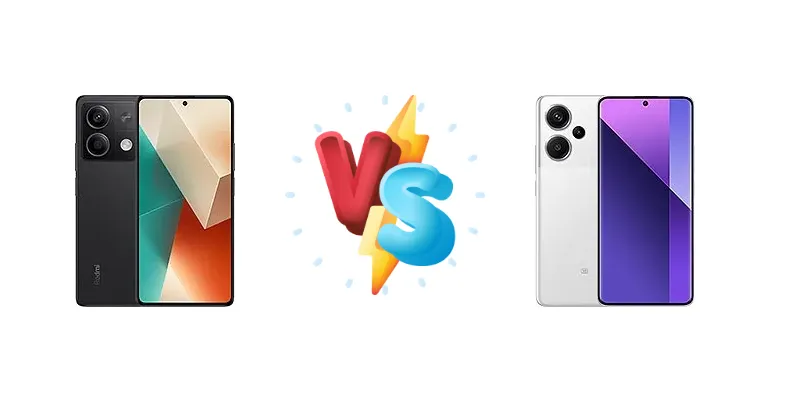
Xiaomi's Redmi Note series consistently delivers impressive value, but the lineup can be confusing. We're pitting the Redmi Note 13 (China variant) against the Redmi Note 13 Pro+ to dissect the key differences, focusing on performance, display, and charging capabilities. This comparison is crucial for users seeking a balance between affordability and features.
🏆 Quick Verdict
For the average user prioritizing speed and convenience, the Redmi Note 13 Pro+ is the clear winner. Its significantly faster 120W charging and more powerful Dimensity 7200 Ultra chipset justify the price premium, offering a smoother and more responsive experience. However, the Redmi Note 13 remains a compelling option for budget-conscious buyers.
| Network |
|---|
| 2G bands | GSM 850 / 900 / 1800 / 1900 | GSM 850 / 900 / 1800 / 1900 |
| 3G bands | HSDPA 850 / 900 / 2100 | HSDPA 800 / 850 / 900 / 1700(AWS) / 1900 / 2100 - International |
| 4G bands | 1, 3, 5, 8, 34, 38, 39, 40, 41 | 1, 2, 3, 4, 5, 7, 8, 12, 13, 17, 18, 19, 20, 26, 28, 32, 38, 40, 41, 66 - International |
| 5G bands | 1, 5, 8, 28, 41, 78 SA/NSA | 1, 3, 5, 7, 8, 20, 28, 38, 40, 41, 66, 77, 78 SA/NSA- International |
| Speed | HSPA, LTE, 5G | HSPA, LTE, 5G |
| Technology | GSM / CDMA / HSPA / CDMA2000 / LTE / 5G | GSM / CDMA / HSPA / EVDO / LTE / 5G |
| Launch |
|---|
| Announced | 2023, September 21 | 2023, September 21 |
| Status | Available. Released 2023, September 21 | Available. Released 2023, September 21 |
| Body |
|---|
| Build | - | Glass front (Gorilla Glass Victus), glass back or silicone polymer back (eco leather) |
| Dimensions | 161.1 x 75 x 7.6 mm (6.34 x 2.95 x 0.30 in) | 161.4 x 74.2 x 8.9 mm (6.35 x 2.92 x 0.35 in) |
| SIM | Nano-SIM + Nano-SIM | · Nano-SIM + eSIM· Nano-SIM + Nano-SIM |
| Weight | 173.5 g (6.14 oz) | 199 g or 204.5 g (7.02 oz) |
| Display |
|---|
| Protection | Corning Gorilla Glass 5 | Corning Gorilla Glass Victus |
| Resolution | 1080 x 2400 pixels, 20:9 ratio (~395 ppi density) | 1220 x 2712 pixels, 20:9 ratio (~446 ppi density) |
| Size | 6.67 inches, 107.4 cm2 (~88.9% screen-to-body ratio) | 6.67 inches, 107.4 cm2 (~89.7% screen-to-body ratio) |
| Type | AMOLED, 1B colors, 120Hz, 1000 nits (peak) | AMOLED, 68B colors, 120Hz, 1920Hz PWM, Dolby Vision, HDR10+, 1800 nits (peak) |
| Platform |
|---|
| CPU | Octa-core (2x2.4 GHz Cortex-A76 & 6x2.0 GHz Cortex-A55) | Octa-core (2x2.8 GHz Cortex-A715 & 6x2.0 GHz Cortex-A510) |
| Chipset | Mediatek Dimensity 6080 (6 nm) | Mediatek Dimensity 7200 Ultra (4 nm) |
| GPU | Mali-G57 MC2 | Mali-G610 MC4 |
| OS | Android 13, MIUI 14 | Android 13, up to 3 major Android upgrades, HyperOS |
| Memory |
|---|
| Card slot | No | No |
| Internal | 128GB 6GB RAM, 128GB 8GB RAM, 256GB 8GB RAM, 256GB 12GB RAM | 256GB 8GB RAM, 256GB 12GB RAM, 512GB 8GB RAM, 512GB 12GB RAM, 512GB 16GB RAM |
| Main Camera |
|---|
| Dual | 108 MP, f/1.7, (wide), 0.64µm, PDAF
Auxiliary lens | - |
| Features | LED flash, HDR, panorama | Dual-LED dual-tone flash, HDR, panorama |
| Triple | - | 200 MP, f/1.7, 23mm (wide), 1/1.4", 0.56µm, multi-directional PDAF, OIS
8 MP, f/2.2, 16mm, 120˚ (ultrawide), 1/4.0", 1.12µm
2 MP (macro) |
| Video | 1080p@30fps | 4K@24/30fps, 1080p@30/60/120fps, gyro-EIS |
| Selfie camera |
|---|
| Features | HDR | HDR, panorama |
| Single | 16 MP, (wide) | 16 MP, f/2.4, (wide) |
| Video | 1080p@30fps | 1080p@30/60fps |
| Sound |
|---|
| 35mm jack | Yes | No |
| Loudspeaker | Yes | Yes, with stereo speakers |
| Comms |
|---|
| Bluetooth | 5.3, A2DP, LE | 5.3, A2DP, LE |
| Infrared port | Yes | Yes |
| NFC | No | Yes (market/region dependent) |
| Positioning | GPS, GLONASS, GALILEO, BDS | GPS, GLONASS, BDS, GALILEO, QZSS |
| Radio | No | No |
| USB | USB Type-C 2.0 | USB Type-C 2.0, OTG |
| WLAN | Wi-Fi 802.11 a/b/g/n/ac, dual-band | Wi-Fi 802.11 a/b/g/n/ac/6, dual-band, Wi-Fi Direct |
| Features |
|---|
| Sensors | Fingerprint (side-mounted), accelerometer, gyro, proximity, compass | Fingerprint (under display, optical), accelerometer, gyro, proximity, compass |
| Battery |
|---|
| Charging | 33W wired | 120W wired, PD3.0, 100% in 19 min |
| Type | Li-Po 5000 mAh | Li-Po 5000 mAh |
| Misc |
|---|
| Colors | Black, White, Blue | Midnight Black (Fushion Black), Moonlight White (Fushion White), Aurora Purple, Fushion Purple, Camo Green |
| Models | 2312DRAABC | 23090RA98C, 23090RA98G, 23090RA98I |
| Price | About 250 EUR | $ 299.98 / £ 299.00 / € 208.98 / ₹ 24,999 |
| SAR | - | 1.09 W/kg (head) 0.85 W/kg (body) |
| SAR EU | - | 0.98 W/kg (head) 1.00 W/kg (body) |
Xiaomi Redmi Note 13 (China)
- More affordable price point
- Decent performance for everyday tasks
- Reliable Mediatek Dimensity 6080 chipset
- Significantly slower charging (33W)
- Likely less powerful camera system
- Potentially lower display brightness
Xiaomi Redmi Note 13 Pro+
- Ultra-fast 120W charging
- More powerful Dimensity 7200 Ultra chipset
- Brighter and potentially higher-quality display
- Higher price tag
- May not be significantly faster for basic tasks
- Potential for increased heat under sustained load (though 4nm helps)
Display Comparison
The Redmi Note 13 Pro+ boasts a significantly brighter display, reaching a measured peak of 1283 nits. This translates to superior visibility outdoors under direct sunlight, a clear advantage for users frequently exposed to bright environments. While the Redmi Note 13’s display specifications aren’t provided, it’s reasonable to assume a lower peak brightness. The Pro+’s panel likely benefits from a more advanced backlight configuration, contributing to its higher brightness and potentially improved contrast. The absence of LTPO technology in either model suggests both utilize standard refresh rate panels, though the Pro+ may offer a higher maximum refresh rate (speculation based on market positioning).
Camera Comparison
Without detailed camera specifications for both devices, a direct comparison is limited. However, the Pro+ model, given its higher price point and 'Pro+' designation, likely features a more sophisticated camera system. We can infer a larger main sensor and potentially optical image stabilization (OIS) on the Pro+, leading to better low-light performance and sharper images. The Redmi Note 13’s camera is likely geared towards casual photography, while the Pro+ aims to deliver a more versatile and high-quality imaging experience. The inclusion of a 2MP macro camera on either device is largely a marketing tactic, offering limited practical benefit due to the small sensor size and low resolution.
Performance
The core difference lies in the chipsets. The Redmi Note 13 utilizes the Mediatek Dimensity 6080, built on a 6nm process. This is a capable chip for everyday tasks, powered by a CPU configuration of 2x2.4 GHz Cortex-A76 cores and 6x2.0 GHz Cortex-A55 cores. However, the Redmi Note 13 Pro+ steps up to the Mediatek Dimensity 7200 Ultra, fabricated on a more efficient 4nm node. This smaller process node allows for greater transistor density, resulting in improved performance and thermal efficiency. The Pro+’s CPU, featuring 2x2.8 GHz Cortex-A715 cores and 6x2.0 GHz Cortex-A510 cores, offers a noticeable performance uplift, particularly in demanding applications and gaming. The architectural shift from Cortex-A76 to A715 represents a generational leap in CPU performance.
Battery Life
The Redmi Note 13 offers 33W wired charging, a respectable speed but significantly slower than the Redmi Note 13 Pro+'s blazing-fast 120W charging. The Pro+ can reportedly reach 100% charge in just 19 minutes, a game-changer for users who prioritize minimal downtime. While the Redmi Note 13’s battery capacity isn’t specified, the Pro+’s active use score of 10 hours and 38 minutes demonstrates excellent battery life, likely achieved through a combination of efficient chipset and optimized software. The faster charging of the Pro+ effectively mitigates any potential concerns about battery life, allowing for quick top-ups throughout the day.
Buying Guide
Buy the Xiaomi Redmi Note 13 (China) if you need a reliable daily driver for basic tasks, social media, and light gaming, and prioritize affordability above all else. Buy the Xiaomi Redmi Note 13 Pro+ if you prefer a faster, more responsive phone with significantly quicker charging, a brighter display, and are willing to spend more for a premium experience. The Pro+ caters to users who demand more from their smartphone.
Frequently Asked Questions
❓ Does the Dimensity 7200 Ultra in the Redmi Note 13 Pro+ get noticeably warmer during extended gaming sessions compared to the Dimensity 6080?
While the 4nm process of the Dimensity 7200 Ultra is more efficient, its higher performance ceiling means it *can* generate more heat under sustained load. However, Xiaomi likely incorporates thermal management solutions (heat pipes, graphite sheets) to mitigate this. The Dimensity 6080 will likely remain cooler, but at the cost of performance. Expect the Pro+ to potentially experience some throttling during very long gaming sessions, but overall offer a smoother experience.
❓ Is the 120W charging on the Redmi Note 13 Pro+ safe for long-term battery health?
Xiaomi implements various safety mechanisms to protect the battery during fast charging, including optimized charging algorithms and temperature control. While fast charging *can* theoretically contribute to slightly faster battery degradation over several years, the convenience and reduced downtime offered by 120W charging generally outweigh this concern for most users. Modern battery technology is designed to withstand fast charging cycles.
❓ How does the difference in CPU architecture (Cortex-A76 vs A715) translate to real-world app loading times?
The Cortex-A715 cores in the Pro+ offer a significant architectural improvement over the Cortex-A76 cores in the standard Note 13. This translates to faster app launch times, smoother multitasking, and a more responsive user interface. You'll notice the difference most when switching between demanding apps or loading large files.