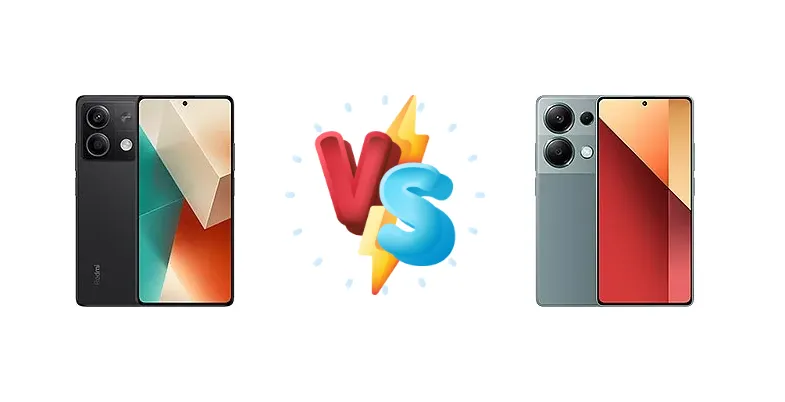
Xiaomi's Redmi Note series consistently delivers impressive value, but the proliferation of models can be confusing. We're pitting the China-market Redmi Note 13, powered by the Mediatek Dimensity 6080, against the globally available Redmi Note 13 Pro 4G, featuring the Helio G99 Ultra, to determine which offers the best blend of performance, battery life, and features for the price-conscious consumer.
🏆 Quick Verdict
For most users, the Redmi Note 13 Pro 4G emerges as the stronger choice. Its significantly faster 67W charging, coupled with a respectable 11:36h active use battery life, outweighs the modest CPU performance advantage of the Redmi Note 13. The brighter display is also a key benefit.
| Network |
|---|
| 2G bands | GSM 850 / 900 / 1800 / 1900 | GSM 850 / 900 / 1800 / 1900 |
| 3G bands | HSDPA 850 / 900 / 2100 | HSDPA 850 / 900 / 1700(AWS) / 1900 / 2100 |
| 4G bands | 1, 3, 5, 8, 34, 38, 39, 40, 41 | 1, 2, 3, 4, 5, 7, 8, 12, 13, 17, 18, 19, 20, 26, 28, 38, 40, 41, 66 |
| 5G bands | 1, 5, 8, 28, 41, 78 SA/NSA | - |
| Speed | HSPA, LTE, 5G | HSPA, LTE |
| Technology | GSM / CDMA / HSPA / CDMA2000 / LTE / 5G | GSM / HSPA / LTE |
| Launch |
|---|
| Announced | 2023, September 21 | 2024, January 15 |
| Status | Available. Released 2023, September 21 | Available. Released 2024, January 15 |
| Body |
|---|
| Build | - | Glass front (Gorilla Glass 5), plastic frame, plastic back |
| Dimensions | 161.1 x 75 x 7.6 mm (6.34 x 2.95 x 0.30 in) | 161.1 x 75 x 8 mm (6.34 x 2.95 x 0.31 in) |
| SIM | Nano-SIM + Nano-SIM | Nano-SIM + Nano-SIM |
| Weight | 173.5 g (6.14 oz) | 188 g (6.63 oz) |
| Display |
|---|
| Protection | Corning Gorilla Glass 5 | Corning Gorilla Glass 5 |
| Resolution | 1080 x 2400 pixels, 20:9 ratio (~395 ppi density) | 1080 x 2400 pixels, 20:9 ratio (~395 ppi density) |
| Size | 6.67 inches, 107.4 cm2 (~88.9% screen-to-body ratio) | 6.67 inches, 107.4 cm2 (~88.9% screen-to-body ratio) |
| Type | AMOLED, 1B colors, 120Hz, 1000 nits (peak) | AMOLED, 1B colors, 120Hz, 500 nits (typ), 1000 nits (HBM), 1300 nits (peak) |
| Platform |
|---|
| CPU | Octa-core (2x2.4 GHz Cortex-A76 & 6x2.0 GHz Cortex-A55) | Octa-core (2x2.2 GHz Cortex-A76 & 6x2.0 GHz Cortex-A55) |
| Chipset | Mediatek Dimensity 6080 (6 nm) | Mediatek Helio G99 Ultra |
| GPU | Mali-G57 MC2 | Mali-G57 MC2 |
| OS | Android 13, MIUI 14 | Android 13, up to 3 major Android upgrades, HyperOS |
| Memory |
|---|
| Card slot | No | microSDXC (uses shared SIM slot) |
| Internal | 128GB 6GB RAM, 128GB 8GB RAM, 256GB 8GB RAM, 256GB 12GB RAM | 128GB 8GB RAM, 256GB 8GB RAM, 256GB 12GB RAM, 512GB 8GB RAM, 512GB 12GB RAM |
| Main Camera |
|---|
| Dual | 108 MP, f/1.7, (wide), 0.64µm, PDAF
Auxiliary lens | - |
| Features | LED flash, HDR, panorama | LED flash, HDR, panorama |
| Triple | - | 200 MP, f/1.7, 23mm (wide), 1/1.4", 0.56µm, multi-directional PDAF, OIS
8 MP, f/2.2, 15mm, 120˚ (ultrawide), 1/4.4", 1.0µm
2 MP (macro) |
| Video | 1080p@30fps | 1080p@30/60fps |
| Selfie camera |
|---|
| Features | HDR | - |
| Single | 16 MP, (wide) | 16 MP, f/2.4, (wide), 1/3.0", 1.0µm |
| Video | 1080p@30fps | 1080p@30/60fps |
| Sound |
|---|
| 35mm jack | Yes | Yes |
| Loudspeaker | Yes | Yes, with dual speakers |
| Comms |
|---|
| Bluetooth | 5.3, A2DP, LE | 5.2, A2DP, LE |
| Infrared port | Yes | Yes |
| NFC | No | Yes (market/region dependent) |
| Positioning | GPS, GLONASS, GALILEO, BDS | GPS, GLONASS, GALILEO, BDS |
| Radio | No | FM radio |
| USB | USB Type-C 2.0 | USB Type-C 2.0, OTG |
| WLAN | Wi-Fi 802.11 a/b/g/n/ac, dual-band | Wi-Fi 802.11 a/b/g/n/ac, dual-band |
| Features |
|---|
| Sensors | Fingerprint (side-mounted), accelerometer, gyro, proximity, compass | Fingerprint (under display, optical), accelerometer, gyro, compass |
| Battery |
|---|
| Charging | 33W wired | 67W wired, 50% in 16 min, 100% in 46 min |
| Type | Li-Po 5000 mAh | 5000 mAh |
| Misc |
|---|
| Colors | Black, White, Blue | Midnight Black, Lavender Purple, Forest Green |
| Models | 2312DRAABC | 23117RA68G, 2312FPCA6G |
| Price | About 250 EUR | € 92.00 / $ 269.99 / £ 299.99 |
| SAR | - | 1.09 W/kg (head) 1.09 W/kg (body) |
| SAR EU | - | 0.99 W/kg (head) 0.99 W/kg (body) |
Xiaomi Redmi Note 13 (China)
- Potentially slightly faster CPU performance
- More efficient 6nm chipset
- Lower price (likely)
- Slower 33W charging
- Likely dimmer display
- Unknown battery life
Xiaomi Redmi Note 13 Pro 4G
- Excellent 11:36h battery life
- Ultra-fast 67W charging
- Brighter 1047 nit display
- Slightly slower CPU performance
- Helio G99 Ultra is an older chipset
- May be more expensive
Display Comparison
The Redmi Note 13 Pro 4G boasts a notably brighter display, reaching a measured peak of 1047 nits. This is a significant advantage for outdoor visibility compared to the Redmi Note 13, where peak brightness data is unavailable. While both likely utilize LCD panels given the price point, the Pro's higher brightness makes a tangible difference in real-world usage. Bezels are expected to be similar on both devices, and color accuracy will likely be typical for this segment – adequate, but not professional-grade.
Camera Comparison
Both phones are expected to feature multi-camera systems, but detailed sensor information is limited. The Redmi Note 13 Pro 4G's camera is marketed as 'Photo / Video' focused, suggesting a greater emphasis on image and video quality. Without specific sensor size or aperture details, it's difficult to make a definitive judgment. It's safe to assume both will include a standard wide lens, ultrawide, and potentially a macro lens – the usefulness of the latter is questionable on both devices. Image processing will likely differ, with Xiaomi's software algorithms playing a significant role in the final image quality.
Performance
The Redmi Note 13's Dimensity 6080, built on a 6nm process, offers a slight edge in CPU performance thanks to its higher clocked Cortex-A76 cores (2.4 GHz vs 2.2 GHz on the Pro's Helio G99 Ultra). However, the real-world impact of this difference will be minimal for most tasks. The Helio G99 Ultra is still a capable performer, and both phones share the same Cortex-A55 efficiency cores. The 6nm node of the Dimensity 6080 *could* translate to slightly better thermal efficiency, but this is difficult to quantify without dedicated testing. Both devices will likely be paired with similar amounts of RAM, impacting multitasking more than the CPU difference.
Battery Life
The Redmi Note 13 Pro 4G shines in the battery department. Its active use score of 11 hours and 36 minutes demonstrates excellent endurance. Crucially, it supports 67W wired charging, achieving 50% charge in just 16 minutes and a full charge in 46 minutes. The Redmi Note 13 is limited to 33W charging, meaning significantly longer charging times. While the Redmi Note 13's battery capacity is unknown, the Pro's faster charging and strong endurance make it the clear winner for users who prioritize minimizing downtime.
Buying Guide
Buy the Xiaomi Redmi Note 13 (China) if you prioritize raw CPU performance for demanding applications and don't mind slower charging. Buy the Xiaomi Redmi Note 13 Pro 4G if you value all-day battery life, incredibly fast charging, and a brighter, more visible display in outdoor conditions. The Pro model is the better all-rounder.
Frequently Asked Questions
❓ Is the Helio G99 Ultra in the Redmi Note 13 Pro 4G prone to overheating during extended gaming sessions?
The Helio G99 Ultra is generally a thermally efficient chipset. While it may get warm during prolonged gaming, it's unlikely to experience significant throttling due to its design and the Redmi Note 13 Pro 4G's likely thermal management system. However, sustained peak performance will inevitably generate heat.
❓ How does the 6nm process of the Dimensity 6080 in the Redmi Note 13 impact real-world battery life compared to the Helio G99 Ultra?
The 6nm process *should* contribute to slightly improved power efficiency in the Redmi Note 13. However, the Redmi Note 13 Pro 4G's larger battery and significantly faster charging capabilities likely negate any efficiency gains from the Dimensity 6080, resulting in a better overall user experience regarding battery life and convenience.
❓ Will the Redmi Note 13 Pro 4G's 67W charging work with any USB-PD charger, or do I need the Xiaomi-supplied charger?
While the Redmi Note 13 Pro 4G supports fast charging, it doesn't necessarily require the Xiaomi-supplied charger to achieve optimal speeds. However, to guarantee 67W charging, it's recommended to use a charger that specifically supports Xiaomi's proprietary fast charging protocol or a USB-PD charger capable of delivering at least 65W.