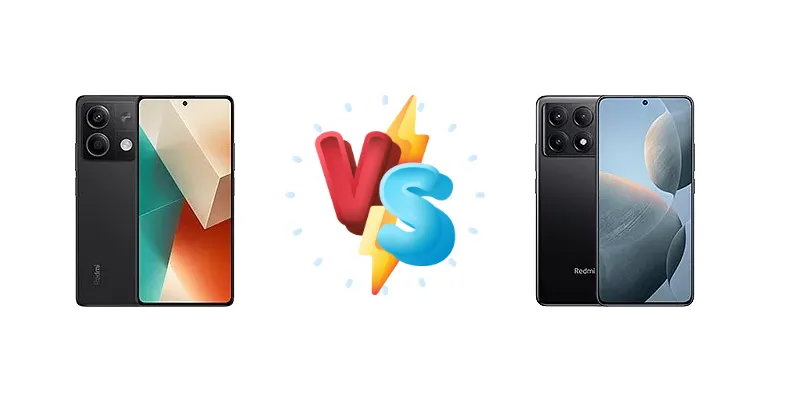
Xiaomi's Redmi lineup offers a compelling range of smartphones, but navigating the options can be tricky. We're pitting the Redmi K70E, a performance-focused model, against the Redmi Note 13, a more mainstream offering, to determine which device delivers the best experience for your money. The core difference lies in their chipsets and charging capabilities, impacting everything from gaming to daily usage.
🏆 Quick Verdict
For most users, the Redmi K70E is the superior choice. Its Dimensity 8300 Ultra provides significantly faster performance and its 90W charging is a game-changer. While the Note 13 offers good value, the K70E's performance leap justifies the price difference for power users and gamers.
| Network |
|---|
| 2G bands | GSM 850 / 900 / 1800 / 1900 | GSM 850 / 900 / 1800 / 1900 |
| 3G bands | HSDPA 850 / 900 / 2100 | HSDPA 800 / 850 / 900 / 1700(AWS) / 2100 |
| 4G bands | 1, 3, 5, 8, 34, 38, 39, 40, 41 | 1, 3, 4, 5, 8, 18, 19, 26, 28, 34, 38, 39, 40, 41, 42, 48, 66 |
| 5G bands | 1, 5, 8, 28, 41, 78 SA/NSA | 1, 3, 5, 8, 28, 38, 41, 48, 66, 77, 78 SA/NSA |
| Speed | HSPA, LTE, 5G | HSPA, LTE, 5G |
| Technology | GSM / CDMA / HSPA / CDMA2000 / LTE / 5G | GSM / CDMA / HSPA / CDMA2000 / LTE / 5G |
| Launch |
|---|
| Announced | 2023, September 21 | 2023, November 29 |
| Status | Available. Released 2023, September 21 | Available. Released 2023, November 29 |
| Body |
|---|
| Dimensions | 161.1 x 75 x 7.6 mm (6.34 x 2.95 x 0.30 in) | 160.5 x 74.3 x 8.1 mm (6.32 x 2.93 x 0.32 in) |
| SIM | Nano-SIM + Nano-SIM | Nano-SIM + Nano-SIM |
| Weight | 173.5 g (6.14 oz) | 198 g (6.98 oz) |
| Display |
|---|
| Protection | Corning Gorilla Glass 5 | - |
| Resolution | 1080 x 2400 pixels, 20:9 ratio (~395 ppi density) | 1220 x 2712 pixels, 20:9 ratio (~446 ppi density) |
| Size | 6.67 inches, 107.4 cm2 (~88.9% screen-to-body ratio) | 6.67 inches, 107.4 cm2 (~90.1% screen-to-body ratio) |
| Type | AMOLED, 1B colors, 120Hz, 1000 nits (peak) | OLED, 68B colors, 120Hz, Dolby Vision, HDR10+, 1800 nits (peak) |
| Platform |
|---|
| CPU | Octa-core (2x2.4 GHz Cortex-A76 & 6x2.0 GHz Cortex-A55) | Octa-core (1x3.35 GHz Cortex-A715 & 3x3.20 GHz Cortex-A715 & 4x2.20 GHz Cortex-A510) |
| Chipset | Mediatek Dimensity 6080 (6 nm) | Mediatek Dimensity 8300 Ultra (4 nm) |
| GPU | Mali-G57 MC2 | Mali G615-MC6 |
| OS | Android 13, MIUI 14 | Android 14, HyperOS |
| Memory |
|---|
| Card slot | No | No |
| Internal | 128GB 6GB RAM, 128GB 8GB RAM, 256GB 8GB RAM, 256GB 12GB RAM | 256GB 8GB RAM, 256GB 12GB RAM, 512GB 12GB RAM, 1TB 16GB RAM |
| Main Camera |
|---|
| Dual | 108 MP, f/1.7, (wide), 0.64µm, PDAF
Auxiliary lens | - |
| Features | LED flash, HDR, panorama | LED flash, HDR, panorama |
| Triple | - | 64 MP, (wide), 1/2.0", PDAF, OIS
8 MP, 120˚, (ultrawide)
2 MP (macro) |
| Video | 1080p@30fps | 4K@24/30fps, 1080p@30/60/120/240/960fps, 720p@1920fps, gyro-EIS |
| Selfie camera |
|---|
| Features | HDR | HDR, panorama |
| Single | 16 MP, (wide) | 16 MP, (wide) |
| Video | 1080p@30fps | 1080p@30/60fps, gyro-EIS |
| Sound |
|---|
| 35mm jack | Yes | No |
| Loudspeaker | Yes | Yes, with stereo speakers |
| Comms |
|---|
| Bluetooth | 5.3, A2DP, LE | 5.4, A2DP, LE |
| Infrared port | Yes | Yes |
| NFC | No | Yes |
| Positioning | GPS, GLONASS, GALILEO, BDS | GPS, GALILEO, GLONASS, QZSS, BDS (B1I+B1c) |
| Radio | No | No |
| USB | USB Type-C 2.0 | USB Type-C, OTG |
| WLAN | Wi-Fi 802.11 a/b/g/n/ac, dual-band | Wi-Fi 802.11 a/b/g/n/ac/6, dual-band, Wi-Fi Direct |
| Features |
|---|
| Sensors | Fingerprint (side-mounted), accelerometer, gyro, proximity, compass | Fingerprint (under display, optical), accelerometer, proximity, gyro, compass |
| Battery |
|---|
| Charging | 33W wired | 90W wired, PD3.0, QC2, 100% in 34 min |
| Type | Li-Po 5000 mAh | Li-Po 5500 mAh |
| Misc |
|---|
| Colors | Black, White, Blue | Black, White, Mint |
| Models | 2312DRAABC | 2311DRK48C |
| Price | About 250 EUR | About 260 EUR |
Xiaomi Redmi Note 13 (China)
- More affordable price point
- Good for everyday tasks
- Decent battery life
- Significantly slower performance
- Slower charging speed
Xiaomi Redmi K70E
- Exceptional performance with Dimensity 8300 Ultra
- Ultra-fast 90W charging
- Better thermal management
- Higher price tag
- Potentially slightly lower battery capacity (unconfirmed)
Display Comparison
While both phones likely feature LCD panels (data not provided), the focus here is on performance, not display quality. We can assume the K70E, being a higher-tier device, may have a slightly higher peak brightness and potentially better color calibration, but this is speculative without further data. The absence of LTPO technology on either device suggests standard refresh rate management, impacting battery life during dynamic content.
Camera Comparison
Without specific camera sensor details, it’s difficult to make a definitive comparison. However, given the K70E’s positioning, it’s reasonable to expect a larger main sensor and potentially more advanced image processing capabilities. The Note 13 likely focuses on providing a functional camera experience, while the K70E aims for higher image quality and detail. We can assume both phones will include standard features like HDR and night mode, but the K70E’s processing power will likely result in superior low-light performance.
Performance
The performance gap between these two devices is substantial. The Redmi K70E’s Mediatek Dimensity 8300 Ultra, built on a 4nm process, is a significant upgrade over the Note 13’s Dimensity 6080 (6nm). The K70E’s CPU configuration – 1x3.35 GHz Cortex-A715, 3x3.20 GHz Cortex-A715, and 4x2.20 GHz Cortex-A510 – offers a more powerful and efficient core arrangement compared to the Note 13’s 2x2.4 GHz Cortex-A76 & 6x2.0 GHz Cortex-A55. This translates to faster app loading times, smoother multitasking, and a much better gaming experience. The 4nm node of the K70E also contributes to better thermal efficiency, reducing the likelihood of performance throttling during extended gaming sessions.
Battery Life
The Redmi K70E’s 90W wired charging is a standout feature, capable of charging the device to 100% in just 34 minutes. This is a massive advantage over the Note 13’s 33W charging. While battery capacity isn’t specified, the faster charging speed of the K70E mitigates any potential disadvantage from a slightly smaller battery. The K70E also supports PD3.0 and QC2, offering broader compatibility with chargers.
Buying Guide
Buy the Xiaomi Redmi Note 13 (China) if you prioritize affordability and a balanced experience for everyday tasks like social media, browsing, and light gaming. Buy the Xiaomi Redmi K70E if you demand faster performance for demanding games, multitasking, and appreciate the convenience of incredibly fast charging – especially if you frequently find yourself needing to top up quickly.
Frequently Asked Questions
❓ Will the Redmi K70E get noticeably hotter than the Redmi Note 13 during extended gaming sessions?
The Redmi K70E, despite its more powerful processor, is likely to manage heat better due to the 4nm manufacturing process of the Dimensity 8300 Ultra. This process is more efficient, generating less heat compared to the 6nm Dimensity 6080 in the Note 13. While both phones may warm up, the K70E should experience less thermal throttling, maintaining higher performance for longer.
❓ Is the 90W charging on the K70E safe for the battery's long-term health?
Xiaomi implements intelligent charging algorithms that manage the charging process to minimize battery degradation. While 90W is fast, the phone dynamically adjusts the charging rate as the battery fills, reducing stress on the cells. The K70E’s charging system is designed to balance speed and battery longevity.
❓ Can the Redmi K70E handle demanding games like Genshin Impact at high settings?
Yes, the Dimensity 8300 Ultra in the Redmi K70E is more than capable of running Genshin Impact at high settings. Expect smooth frame rates and a playable experience, though you may need to adjust settings slightly for optimal performance and battery life. The Note 13 would struggle to maintain consistent performance at high settings.