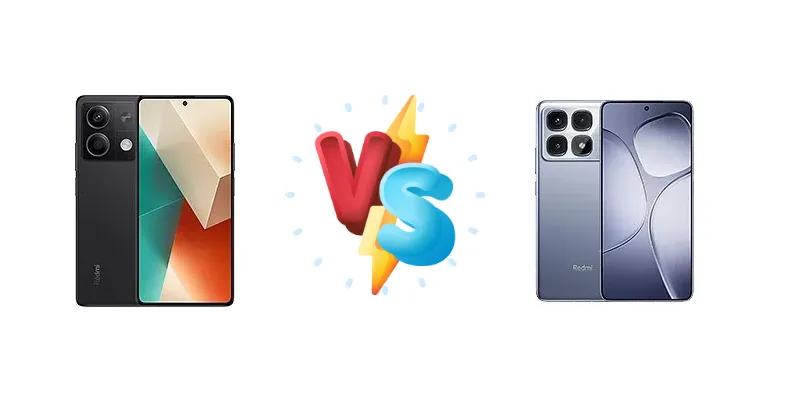
Xiaomi's Redmi lineup offers a broad spectrum of devices, from budget-friendly options to near-flagship performers. This comparison pits the Redmi Note 13 (China variant) – a solid all-rounder – against the Redmi K70 Ultra, a performance-focused device boasting the latest MediaTek Dimensity 9300+ chipset. We'll dissect the key differences to determine which phone best suits your needs and budget.
🏆 Quick Verdict
For the average user prioritizing value and everyday tasks, the Redmi Note 13 provides a capable experience. However, the Redmi K70 Ultra is the clear winner for power users, gamers, and those demanding the fastest charging speeds, thanks to its significantly more powerful Dimensity 9300+ and 120W charging.
| Network |
|---|
| 2G bands | GSM 850 / 900 / 1800 / 1900 | GSM 850 / 900 / 1800 / 1900 |
| 3G bands | HSDPA 850 / 900 / 2100 | HSDPA 800 / 850 / 900 / 1700(AWS) / 2100 |
| 4G bands | 1, 3, 5, 8, 34, 38, 39, 40, 41 | 1, 3, 4, 5, 7, 8, 18, 19, 26, 28, 34, 38, 39, 40, 41, 42, 48, 66 |
| 5G bands | 1, 5, 8, 28, 41, 78 SA/NSA | 1, 3, 5, 7, 8, 28, 66, 38, 40, 41, 48, 77, 78 SA/NSA |
| Speed | HSPA, LTE, 5G | HSPA, LTE, 5G |
| Technology | GSM / CDMA / HSPA / CDMA2000 / LTE / 5G | GSM / CDMA / HSPA / CDMA2000 / LTE / 5G |
| Launch |
|---|
| Announced | 2023, September 21 | 2024, July 19 |
| Status | Available. Released 2023, September 21 | Available. Released 2024, July 19 |
| Body |
|---|
| Build | - | Glass front, aluminum frame |
| Dimensions | 161.1 x 75 x 7.6 mm (6.34 x 2.95 x 0.30 in) | 160.4 x 75.1 x 8.4 mm (6.31 x 2.96 x 0.33 in) |
| SIM | Nano-SIM + Nano-SIM | Nano-SIM + Nano-SIM |
| Weight | 173.5 g (6.14 oz) | 211 g (7.44 oz) |
| Display |
|---|
| Protection | Corning Gorilla Glass 5 | Scratch/drop-resistant glass |
| Resolution | 1080 x 2400 pixels, 20:9 ratio (~395 ppi density) | 1220 x 2712 pixels, 20:9 ratio (~446 ppi density) |
| Size | 6.67 inches, 107.4 cm2 (~88.9% screen-to-body ratio) | 6.67 inches, 107.4 cm2 (~89.1% screen-to-body ratio) |
| Type | AMOLED, 1B colors, 120Hz, 1000 nits (peak) | OLED, 68B colors, 144Hz, Dolby Vision, HDR10+, 1600 nits (HBM), 4000 nits (peak) |
| Platform |
|---|
| CPU | Octa-core (2x2.4 GHz Cortex-A76 & 6x2.0 GHz Cortex-A55) | Octa-core (1x3.25 GHz Cortex-X4 & 3x2.85 GHz Cortex-X4 & 4x2.0 GHz Cortex-A720) |
| Chipset | Mediatek Dimensity 6080 (6 nm) | Mediatek Dimensity 9300+ (4 nm) |
| GPU | Mali-G57 MC2 | Immortalis-G720 MC12 |
| OS | Android 13, MIUI 14 | Android 14, HyperOS |
| Memory |
|---|
| Card slot | No | No |
| Internal | 128GB 6GB RAM, 128GB 8GB RAM, 256GB 8GB RAM, 256GB 12GB RAM | 256GB 12GB RAM, 512GB 12GB RAM, 512GB 16GB RAM, 1TB 16GB RAM, 1TB 24GB RAM |
| Main Camera |
|---|
| Dual | 108 MP, f/1.7, (wide), 0.64µm, PDAF
Auxiliary lens | - |
| Features | LED flash, HDR, panorama | Color spectrum sensor, Dual-LED dual-tone flash, HDR, panorama |
| Triple | - | 50 MP, f/1.7, 23mm (wide), 1/1.56", 1.0µm, PDAF, OIS
8 MP, 119˚ (ultrawide), 1/4.0", 1.12µm
2 MP (macro) |
| Video | 1080p@30fps | 8K@24/30fps, 4K@24/30/60fps, 1080p@30/60/120/240/960fps, gyro-EIS |
| Selfie camera |
|---|
| Features | HDR | HDR |
| Single | 16 MP, (wide) | 20 MP, (wide), 1/2.0", 0.8µm |
| Video | 1080p@30fps | 1080p@30fps |
| Sound |
|---|
| 35mm jack | Yes | No |
| Loudspeaker | Yes | Yes, with stereo speakers |
| Comms |
|---|
| Bluetooth | 5.3, A2DP, LE | 5.4, A2DP, LE, LHDC 5 |
| Infrared port | Yes | Yes |
| NFC | No | Yes |
| Positioning | GPS, GLONASS, GALILEO, BDS | GPS (L1+L5), BDS (B1I+B1C+B2a+B2b), GALILEO (E1+E5a+E5b), QZSS (L1+L5), NavIC (L5), GLONASS |
| Radio | No | Unspecified |
| USB | USB Type-C 2.0 | USB Type-C |
| WLAN | Wi-Fi 802.11 a/b/g/n/ac, dual-band | Wi-Fi 802.11 a/b/g/n/ac/6/7, dual-band, Wi-Fi Direct |
| Features |
|---|
| Sensors | Fingerprint (side-mounted), accelerometer, gyro, proximity, compass | Fingerprint (under display, optical), accelerometer, gyro, proximity, compass |
| Battery |
|---|
| Charging | 33W wired | 120W wired, PD3.0, 100% in 24 min |
| Type | Li-Po 5000 mAh | Li-Po 5500 mAh |
| Misc |
|---|
| Colors | Black, White, Blue | Black, White, Violet, Green Championship Edition, Orange Championship Edition |
| Models | 2312DRAABC | 2407FRK8EC |
| Price | About 250 EUR | About 330 EUR |
Xiaomi Redmi Note 13 (China)
- More affordable price point
- Good efficiency with the Dimensity 6080
- Sufficient for everyday tasks
- Significantly lower performance than the K70 Ultra
- Slower 33W charging
Xiaomi Redmi K70 Ultra
- Flagship-level performance with Dimensity 9300+
- Ultra-fast 120W charging
- Likely superior camera system
- Higher price tag
- Potentially higher power consumption
Display Comparison
While both devices likely feature LCD or AMOLED panels (data not provided), the core difference lies elsewhere. The focus here is on performance, not display fidelity. We can assume the K70 Ultra, being a higher-tier device, will likely have a higher peak brightness and potentially a higher refresh rate, but without specific display specs, it's difficult to quantify. The Note 13's display will likely prioritize efficiency.
Camera Comparison
Without detailed camera specifications, a direct comparison is limited. However, the K70 Ultra, as a flagship-leaning device, is expected to feature a more sophisticated camera system with a larger sensor and potentially optical image stabilization (OIS). The Note 13 will likely offer a competent camera for everyday photography, but will fall short in low-light conditions and dynamic range compared to the K70 Ultra. We can anticipate the K70 Ultra will offer more detailed images and better video recording capabilities.
Performance
The performance gap is substantial. The Redmi K70 Ultra’s Dimensity 9300+ (4nm) is a flagship-level chipset featuring a 1x3.25 GHz Cortex-X4 prime core, 3x2.85 GHz Cortex-X4 performance cores, and 4x2.0 GHz Cortex-A720 efficiency cores. This contrasts sharply with the Redmi Note 13’s Dimensity 6080 (6nm), which utilizes 2x2.4 GHz Cortex-A76 and 6x2.0 GHz Cortex-A55 cores. The 4nm process of the 9300+ offers superior power efficiency and thermal performance, translating to sustained performance during demanding tasks. The K70 Ultra will demonstrably outperform the Note 13 in gaming, video editing, and any CPU/GPU-intensive application. The K70 Ultra's architecture, with its X4 cores, is designed for peak performance, while the Note 13's focuses on balanced efficiency.
Battery Life
The Redmi K70 Ultra’s 120W wired charging is a game-changer, promising a full charge in just 24 minutes. This is a significant advantage over the Redmi Note 13’s 33W charging. While battery capacity isn't specified for either device, the faster charging of the K70 Ultra mitigates any potential disadvantage from a smaller battery size. Users who frequently need to top up their phone will greatly benefit from the K70 Ultra’s charging speed.
Buying Guide
Buy the Xiaomi Redmi Note 13 (China) if you need a reliable daily driver for social media, browsing, and light gaming, and prioritize affordability. It's ideal for users who don't require cutting-edge performance. Buy the Xiaomi Redmi K70 Ultra if you prefer a smartphone capable of handling demanding games, intensive multitasking, and benefit from incredibly fast charging, even if it comes at a higher price point.
Frequently Asked Questions
❓ Will the Dimensity 9300+ in the K70 Ultra get noticeably hot during extended gaming sessions?
While the Dimensity 9300+ is a powerful chip, its 4nm process and Xiaomi's thermal management solutions (likely including vapor chamber cooling) are designed to mitigate overheating. However, sustained peak performance will inevitably generate heat. Expect some warmth, but not to the point of significant throttling, especially compared to older generation chipsets.
❓ Is the 33W charging on the Redmi Note 13 slow compared to other phones in its price range?
33W charging is becoming increasingly common in the mid-range segment. While not as fast as the K70 Ultra’s 120W, it’s still respectable and will fully charge the device overnight. It's a trade-off for the lower price point.
❓ Does the Redmi K70 Ultra support PD3.0 charging, and can I use a different charger?
Yes, the Redmi K70 Ultra explicitly supports PD3.0 charging. You can use a compatible PD3.0 charger, but to achieve the full 120W charging speed, you'll need a charger specifically rated for that wattage and supporting the correct Power Delivery protocol.