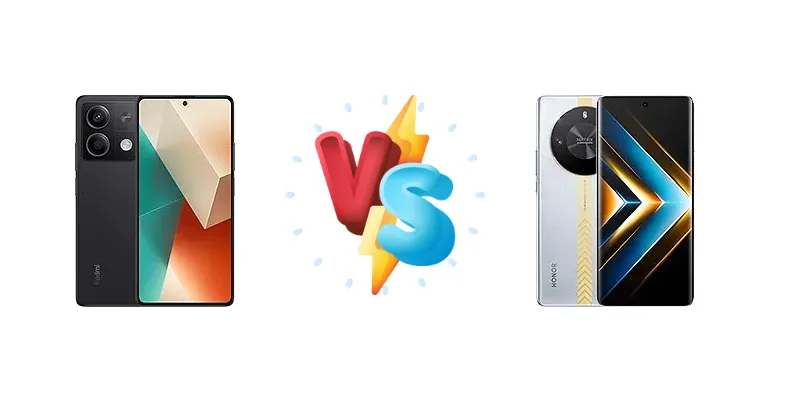
The Xiaomi Redmi Note 13 (China) and Honor X50 GT represent distinct approaches to the mid-range smartphone market. The Redmi Note 13 focuses on delivering a solid all-around experience at a competitive price, while the Honor X50 GT aims for near-flagship performance with its older, but still potent, Snapdragon 8+ Gen 1 chipset. This comparison dissects the key differences to help you determine which device best suits your needs.
🏆 Quick Verdict
For the average user prioritizing everyday tasks and moderate gaming, the Honor X50 GT is the clear winner. The Snapdragon 8+ Gen 1 offers significantly superior processing power and GPU performance compared to the Dimensity 6080, justifying the potential price premium. However, the Redmi Note 13 remains a viable option for budget-conscious buyers.
| Network |
|---|
| 2G bands | GSM 850 / 900 / 1800 / 1900 | GSM 850 / 900 / 1800 / 1900 |
| 3G bands | HSDPA 850 / 900 / 2100 | HSDPA 850 / 900 / 1700(AWS) / 1900 / 2100 |
| 4G bands | 1, 3, 5, 8, 34, 38, 39, 40, 41 | LTE |
| 5G bands | 1, 5, 8, 28, 41, 78 SA/NSA | SA/NSA |
| Speed | HSPA, LTE, 5G | HSPA, LTE, 5G |
| Technology | GSM / CDMA / HSPA / CDMA2000 / LTE / 5G | GSM / CDMA / HSPA / CDMA2000 / LTE / 5G |
| Launch |
|---|
| Announced | 2023, September 21 | 2024, January 04 |
| Status | Available. Released 2023, September 21 | Available. Released 2024, January 09 |
| Body |
|---|
| Dimensions | 161.1 x 75 x 7.6 mm (6.34 x 2.95 x 0.30 in) | 163.6 x 75.5 x 8 mm (6.44 x 2.97 x 0.31 in) |
| SIM | Nano-SIM + Nano-SIM | Nano-SIM + Nano-SIM |
| Weight | 173.5 g (6.14 oz) | 192 g (6.77 oz) |
| Display |
|---|
| Protection | Corning Gorilla Glass 5 | - |
| Resolution | 1080 x 2400 pixels, 20:9 ratio (~395 ppi density) | 1220 x 2652 pixels, 19.5:9 ratio (~431 ppi density) |
| Size | 6.67 inches, 107.4 cm2 (~88.9% screen-to-body ratio) | 6.78 inches, 112.6 cm2 (~91.2% screen-to-body ratio) |
| Type | AMOLED, 1B colors, 120Hz, 1000 nits (peak) | AMOLED, 1B colors, 120Hz |
| Platform |
|---|
| CPU | Octa-core (2x2.4 GHz Cortex-A76 & 6x2.0 GHz Cortex-A55) | Octa-core (1x3.0 GHz Cortex-X2 & 3x2.5 GHz Cortex-A710 & 4x1.80 GHz Cortex-A510) |
| Chipset | Mediatek Dimensity 6080 (6 nm) | Qualcomm SM8475 Snapdragon 8+ Gen 1 (4 nm) |
| GPU | Mali-G57 MC2 | Adreno 730 |
| OS | Android 13, MIUI 14 | Android 13, MagicOS 7.2 |
| Memory |
|---|
| Card slot | No | No |
| Internal | 128GB 6GB RAM, 128GB 8GB RAM, 256GB 8GB RAM, 256GB 12GB RAM | 256GB 12GB RAM, 256GB 16GB RAM, 512GB 16GB RAM, 1TB 16GB RAM |
| Main Camera |
|---|
| Dual | 108 MP, f/1.7, (wide), 0.64µm, PDAF
Auxiliary lens | 108 MP, f/1.8, (wide), 1/1.67", PDAF
Auxiliary lens |
| Features | LED flash, HDR, panorama | LED flash, panorama, HDR |
| Video | 1080p@30fps | 4K@30fps, 1080p@30fps |
| Selfie camera |
|---|
| Features | HDR | - |
| Single | 16 MP, (wide) | 8 MP, f/2.0, (wide) |
| Video | 1080p@30fps | 1080p@30fps |
| Sound |
|---|
| 35mm jack | Yes | No |
| Loudspeaker | Yes | Yes |
| Comms |
|---|
| Bluetooth | 5.3, A2DP, LE | 5.2, A2DP, LE, aptX HD |
| Infrared port | Yes | - |
| NFC | No | Yes |
| Positioning | GPS, GLONASS, GALILEO, BDS | GPS, GLONASS, GALILEO, BDS |
| Radio | No | No |
| USB | USB Type-C 2.0 | USB Type-C 2.0, OTG |
| WLAN | Wi-Fi 802.11 a/b/g/n/ac, dual-band | Wi-Fi 802.11 a/b/g/n/ac/6, dual-band, Wi-Fi Direct |
| Features |
|---|
| Sensors | Fingerprint (side-mounted), accelerometer, gyro, proximity, compass | Fingerprint (under display, optical), accelerometer, gyro, ultrasound proximity, compass |
| Battery |
|---|
| Charging | 33W wired | 35W wired
7.5W reverse wired |
| Type | Li-Po 5000 mAh | Li-Po 5800 mAh |
| Misc |
|---|
| Colors | Black, White, Blue | Black, Silver |
| Models | 2312DRAABC | ALP-AN00 |
| Price | About 250 EUR | About 260 EUR |
Xiaomi Redmi Note 13 (China)
- More affordable price point
- Decent performance for everyday tasks
- Likely lighter and more compact design
- Significantly weaker performance compared to the X50 GT
- Less efficient chipset leading to potentially shorter battery life
- May lack advanced camera features
Honor X50 GT
- Superior performance with Snapdragon 8+ Gen 1
- Better thermal management for sustained performance
- Faster charging and reverse charging capabilities
- Higher price tag
- Potentially larger and heavier design
- May experience more battery drain during intensive use
Display Comparison
Neither device's display specifications are provided, so a direct comparison is limited. However, given the X50 GT's positioning, it likely features a higher quality panel with potentially higher peak brightness and color accuracy. The Redmi Note 13, being a more budget-oriented device, may utilize a slightly less advanced display technology. The absence of LTPO technology in either device suggests standard refresh rate implementations, impacting power efficiency during dynamic content viewing.
Camera Comparison
Without specific camera sensor details, a detailed comparison is challenging. However, the X50 GT, positioned as a performance-focused device, likely incorporates a more capable main camera sensor with a larger size and wider aperture for improved low-light performance. The Redmi Note 13 will likely focus on providing a functional camera system for everyday photography, but may lack the advanced features and image quality of the X50 GT. The inclusion of OIS (Optical Image Stabilization) on the X50 GT would further enhance its camera capabilities.
Performance
The core difference lies in the chipsets. The Honor X50 GT’s Snapdragon 8+ Gen 1 (4nm) is a significant leap ahead of the Redmi Note 13’s Dimensity 6080 (6nm). The Snapdragon 8+ Gen 1 boasts a Cortex-X2 prime core clocked at 3.0 GHz, alongside three Cortex-A710 performance cores and four Cortex-A510 efficiency cores. This contrasts with the Redmi Note 13’s dual Cortex-A76 and six Cortex-A55 configuration. The 4nm process node of the Snapdragon 8+ Gen 1 translates to better thermal efficiency and sustained performance under load, minimizing throttling during extended gaming sessions. The X50 GT will deliver a noticeably smoother experience in graphically intensive applications and multitasking.
Battery Life
The Redmi Note 13 offers 33W wired charging, while the Honor X50 GT steps it up to 35W. While the difference is marginal, the X50 GT also includes 7.5W reverse wired charging, a feature absent on the Redmi Note 13. The actual battery capacity of both devices is unknown, but the Snapdragon 8+ Gen 1’s superior efficiency could offset a potentially smaller battery size on the X50 GT, resulting in comparable real-world battery life. The faster charging on the X50 GT will, however, reduce downtime.
Buying Guide
Buy the Xiaomi Redmi Note 13 (China) if you need a reliable daily driver with decent performance for basic tasks, social media, and light gaming, and prioritize affordability above all else. Buy the Honor X50 GT if you prefer a smoother experience with demanding games, multitasking, and future-proofing, and are willing to spend more for a substantial performance boost.
Frequently Asked Questions
❓ Will the Snapdragon 8+ Gen 1 in the Honor X50 GT overheat during prolonged gaming sessions?
While the Snapdragon 8+ Gen 1 was known to get warm under heavy load in flagship devices, the 4nm process and likely optimized cooling solution in the Honor X50 GT should mitigate significant overheating. Expect some thermal throttling after extended periods, but it will still deliver consistently higher frame rates than the Dimensity 6080.
❓ Is the Dimensity 6080 in the Redmi Note 13 capable of running demanding games like Genshin Impact?
The Dimensity 6080 can run Genshin Impact, but you'll likely need to lower the graphics settings to medium or low to achieve a playable frame rate. Expect occasional stuttering and a less smooth experience compared to the Honor X50 GT.
❓ Does the Honor X50 GT support high refresh rate gaming?
While the refresh rate isn't specified, the Snapdragon 8+ Gen 1 is capable of driving high refresh rate displays. The X50 GT likely supports at least 120Hz, enabling smoother visuals in compatible games.
❓ How much faster is the charging on the Honor X50 GT compared to the Redmi Note 13?
The 35W charging on the X50 GT is only marginally faster than the 33W on the Redmi Note 13. Expect a difference of around 10-15 minutes for a full charge, but the inclusion of 7.5W reverse charging is a unique advantage for the X50 GT.