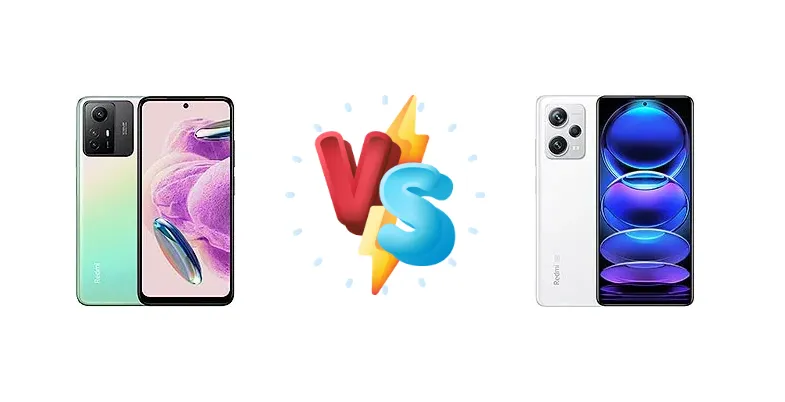
The Xiaomi Redmi Note series consistently delivers impressive features at competitive prices. Two popular contenders, the Redmi Note 12S and the Redmi Note 12 Pro+, offer distinct advantages. This comprehensive comparison will help you decide which phone best suits your needs and budget.
🏆 Quick Verdict
The Redmi Note 12 Pro+ is the clear winner, boasting significantly faster charging, a more powerful processor, and a superior camera system. However, the Redmi Note 12S remains a compelling option for budget-conscious buyers seeking a reliable all-rounder.
| Network |
|---|
| 2G bands | GSM 850 / 900 / 1800 / 1900 | GSM 850 / 900 / 1800 / 1900 - SIM 1 & SIM 2 |
| 3G bands | HSDPA 850 / 900 / 2100 | HSDPA 800 / 850 / 900 / 1900 / 2100 |
| 4G bands | 1, 3, 5, 7, 8, 20, 28, 38, 40, 41 | 1, 3, 5, 8, 19, 34, 38, 39, 40, 41 - International, China |
| 5G bands | - | 1, 3, 5, 8, 28, 38, 40, 41, 77, 78 SA/NSA - International |
| Speed | HSPA, LTE | HSPA, LTE-A (CA), 5G |
| Technology | GSM / HSPA / LTE | GSM / CDMA / HSPA / EVDO / LTE / 5G |
| | - | 1, 3, 5, 8, 28, 38, 41, 77, 78 SA/NSA - China |
| Launch |
|---|
| Announced | 2023, March 06 | 2022, October 27 |
| Status | Available. Released 2023, April 26 | Available. Released 2022, November 01 |
| Body |
|---|
| Build | - | Glass front (Gorilla Glass 5), glass back |
| Dimensions | 159.9 x 73.9 x 8.1 mm (6.30 x 2.91 x 0.32 in) | 162.9 x 76 x 8.9 mm (6.41 x 2.99 x 0.35 in) |
| SIM | Nano-SIM + Nano-SIM | Dual SIM (Nano-SIM, dual stand-by) |
| Weight | 176 g (6.21 oz) | 208.4 g (7.34 oz) |
| | - | IP53, dust and splash resistant |
| Display |
|---|
| Protection | - | Corning Gorilla Glass 5 |
| Resolution | 1080 x 2400 pixels, 20:9 ratio (~409 ppi density) | 1080 x 2400 pixels, 20:9 ratio (~395 ppi density) |
| Size | 6.43 inches, 99.8 cm2 (~84.5% screen-to-body ratio) | 6.67 inches, 107.4 cm2 (~86.8% screen-to-body ratio) |
| Type | AMOLED, 90Hz, 700 nits (HBM), 1000 nits (peak) | OLED, 1B colors, 120Hz, Dolby Vision, HDR10+, 500 nits (typ), 900 nits (HBM) |
| Platform |
|---|
| CPU | Octa-core (2x2.05 GHz Cortex-A76 & 6x2.0 GHz Cortex-A55) | Octa-core (2x2.6 GHz Cortex-A78 & 6x2.0 GHz Cortex-A55) |
| Chipset | Mediatek MT6781 Helio G96 (12 nm) | Mediatek MT6877V Dimensity 1080 (6 nm) |
| GPU | Mali-G57 MC2 | Mali-G68 MC4 |
| OS | Android 13, MIUI 14 | Android 12, MIUI 13 |
| Memory |
|---|
| Card slot | microSDXC (dedicated slot) | No |
| Internal | 64GB 6GB RAM, 128GB 6GB RAM, 256GB 8GB RAM | 256GB 8GB RAM, 256GB 12GB RAM |
| | - | UFS 2.2 |
| Main Camera |
|---|
| Features | LED flash, HDR, panorama | Dual-LED dual-tone flash, HDR, panorama |
| Triple | 108 MP, f/1.9, (wide), 1/1.52", 0.7µm, PDAF
8 MP, f/2.2, 118˚ (ultrawide), 1/4.0", 1.12µm
2 MP (macro) | 200 MP, f/1.7, 24mm (wide), 1/1.4", 0.56µm, PDAF, OIS
8 MP, f/2.2, 120˚ (ultrawide), 1/4", 1.12µm
2 MP, f/2.4, (macro) |
| Video | 1080p@30fps | 4K@30fps, 1080p@30/60/120fps, 720p@960fps |
| Selfie camera |
|---|
| Features | - | HDR |
| Single | 16 MP, f/2.4, (wide) | 16 MP, f/2.5, (wide), 1/3.06", 1.0µm |
| Video | 1080p@30fps | 1080p@30/60fps |
| Sound |
|---|
| 3.5mm jack | Yes | Yes |
| 35mm jack | Yes | - |
| Loudspeaker | Yes, with stereo speakers | Yes, with stereo speakers |
| | - | 24-bit/192kHz audio |
| Comms |
|---|
| Bluetooth | 5.2, A2DP, LE | 5.2, A2DP, LE |
| Infrared port | Yes | Yes |
| NFC | Yes (market/region dependent) | Yes (market/region dependent) |
| Positioning | GPS (L1), GLONASS (G1), GALILEO (E1), BDS (B1) | GPS (L1), GLONASS (G1), BDS (B1I+B1c), GALILEO (E1), QZSS (L1) |
| Radio | Stereo FM radio, recording | No |
| USB | USB Type-C 2.0 | USB Type-C 2.0, OTG |
| WLAN | Wi-Fi 802.11 a/b/g/n/ac, dual-band | Wi-Fi 802.11 a/b/g/n/ac/6, dual-band, Wi-Fi Direct |
| Features |
|---|
| Sensors | Fingerprint (side-mounted), accelerometer, gyro, proximity, compass | Fingerprint (side-mounted), accelerometer, proximity, gyro, compass |
| Battery |
|---|
| Charging | 33W wired | 120W wired, PD3.0, 100% in 19 min (advertised) |
| Type | Li-Po 5000 mAh | Li-Po 5000 mAh, non-removable |
| Misc |
|---|
| Colors | Onyx Black, Ice Blue, Pearl Green | Arctic White, Iceberg Blue, Obsidian Black, Trend edition |
| Models | 2303CRA44A, 23030RAC7Y, 2303ERA42L | 22101316UCP, 22101316UG |
| Price | € 122.47 / $ 149.99 / £ 229.89 | $ 348.00 / £ 439.00 / € 399.00 / ₹ 29,949 |
| Tests |
|---|
| Battery life | - |
Endurance rating 88h
|
| Camera | - |
Photo / Video |
| Display | - |
Contrast ratio: Infinite (nominal) |
| Loudspeaker | - |
-26.7 LUFS (Good)
|
| Performance | - |
AnTuTu: 498710 (v9)
GeekBench: 2208 (v5.1), 2372 (v6)
GFXBench: 22fps (ES 3.1 onscreen) |
Xiaomi Redmi Note 12S
- Affordable price
- Decent performance for everyday tasks
- Reliable battery life
- Good display quality (likely LCD)
- Less powerful processor
- Slower charging speed
- Camera not as advanced as Pro+
- LCD display (likely)
Xiaomi Redmi Note 12 Pro+
- Blazing-fast 120W charging
- Powerful Dimensity 1080 processor
- Superior camera system
- Vibrant AMOLED display
- Excellent battery life (with fast charging)
- Higher price
- Potentially larger and heavier
- Software experience may vary
Display Comparison
The Redmi Note 12 Pro+ features a superior AMOLED display with vibrant colors, deeper blacks, and potentially higher peak brightness compared to the Note 12S's likely LCD panel. The 'Infinite' contrast ratio claim suggests excellent image quality on the Pro+.
Camera Comparison
While both phones offer capable cameras, the Redmi Note 12 Pro+ likely has a more advanced camera system, potentially including a higher resolution main sensor and improved image processing capabilities. The Pro+ is expected to excel in low-light conditions.
Performance
The Dimensity 1080 chipset in the Redmi Note 12 Pro+ offers a substantial performance boost over the Helio G96 in the Note 12S. Expect smoother multitasking, faster app loading times, and better gaming performance on the Pro+.
Battery Life
The Redmi Note 12 Pro+'s 120W charging is a game-changer, allowing for incredibly fast charging times. While the Note 12S's 33W charging is respectable, it pales in comparison. Both phones likely have similar battery capacities (around 5000mAh), but the Pro+'s charging speed provides a significant advantage.
Buying Guide
The Xiaomi Redmi Note 12S is ideal for users prioritizing affordability and a decent all-around experience. It's great for everyday tasks, social media, and casual photography. The Xiaomi Redmi Note 12 Pro+ is perfect for power users, photography enthusiasts, and those who value blazing-fast charging and top-tier performance.
Frequently Asked Questions
❓ Is the Redmi Note 12S good for gaming?
The Redmi Note 12S can handle casual games well, but demanding titles may require lower graphics settings. The Redmi Note 12 Pro+ offers a significantly better gaming experience.
❓ How long does it take to fully charge the Redmi Note 12 Pro+?
Xiaomi advertises a full charge in approximately 19 minutes with the 120W fast charger.
❓ What type of display does the Redmi Note 12S have?
The Redmi Note 12S likely features an LCD display, while the Redmi Note 12 Pro+ has an AMOLED display.
❓ Which phone has better software support?
Both phones will receive MIUI updates, but Xiaomi's update policies can vary. Check Xiaomi's official website for the latest information on software support for each device.