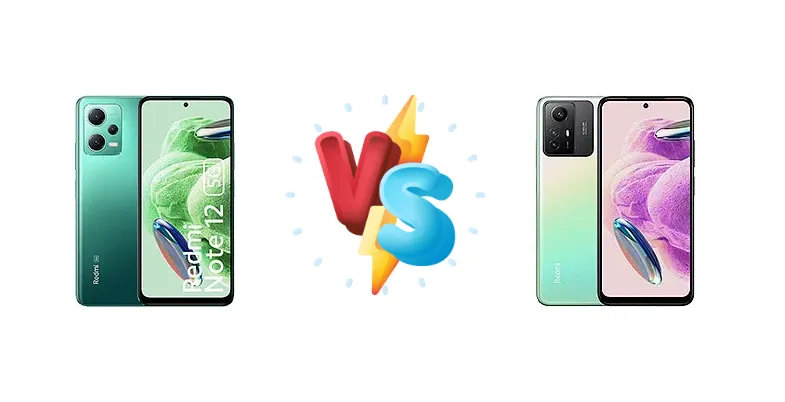
The Xiaomi Redmi Note series consistently delivers excellent value for money. The Note 12 and Note 12S are two compelling options in this lineup, but which one is right for you? This comprehensive comparison will delve into their key differences to help you make an informed decision.
🏆 Quick Verdict
The Redmi Note 12 edges out the 12S thanks to its superior chipset (Snapdragon 4 Gen 1) and faster charging. While the 12S boasts a slightly improved camera sensor, the Note 12's overall performance and charging speed make it the more well-rounded choice for most users.
| Network |
|---|
| 2G bands | GSM 850 / 900 / 1800 / 1900 | GSM 850 / 900 / 1800 / 1900 |
| 3G bands | HSDPA 850 / 900 / 2100 | HSDPA 850 / 900 / 2100 |
| 4G bands | 1, 3, 5, 8, 40, 41 | 1, 3, 5, 7, 8, 20, 28, 38, 40, 41 |
| 5G bands | 1, 3, 5, 8, 28, 40, 78 SA/NSA | - |
| Speed | HSPA, LTE, 5G | HSPA, LTE |
| Technology | GSM / HSPA / LTE / 5G | GSM / HSPA / LTE |
| Launch |
|---|
| Announced | 2022, October 27 | 2023, March 06 |
| Status | Available. Released 2023, January 11 | Available. Released 2023, April 26 |
| Body |
|---|
| Dimensions | 165.9 x 76.2 x 8 mm (6.53 x 3.00 x 0.31 in) | 159.9 x 73.9 x 8.1 mm (6.30 x 2.91 x 0.32 in) |
| SIM | Nano-SIM + Nano-SIM | Nano-SIM + Nano-SIM |
| Weight | 188 g (6.63 oz) | 176 g (6.21 oz) |
| | IP53, dust and splash resistant | - |
| Display |
|---|
| Protection | Corning Gorilla Glass 3 | - |
| Resolution | 1080 x 2400 pixels, 20:9 ratio (~395 ppi density) | 1080 x 2400 pixels, 20:9 ratio (~409 ppi density) |
| Size | 6.67 inches, 107.4 cm2 (~85.0% screen-to-body ratio) | 6.43 inches, 99.8 cm2 (~84.5% screen-to-body ratio) |
| Type | AMOLED, 120Hz, 1200 nits (peak) | AMOLED, 90Hz, 700 nits (HBM), 1000 nits (peak) |
| Platform |
|---|
| CPU | Octa-core (2x2.0 GHz Cortex-A78 & 6x1.8 GHz Cortex-A55) | Octa-core (2x2.05 GHz Cortex-A76 & 6x2.0 GHz Cortex-A55) |
| Chipset | Qualcomm SM4375 Snapdragon 4 Gen 1 (6 nm) | Mediatek MT6781 Helio G96 (12 nm) |
| GPU | Adreno 619 | Mali-G57 MC2 |
| OS | Android 12, MIUI 14 (International), MIUI 13 (India) | Android 13, MIUI 14 |
| Memory |
|---|
| Card slot | microSDXC (uses shared SIM slot) | microSDXC (dedicated slot) |
| Internal | 128GB 4GB RAM, 128GB 6GB RAM, 256GB 8GB RAM | 64GB 6GB RAM, 128GB 6GB RAM, 256GB 8GB RAM |
| | UFS 2.2 | - |
| Main Camera |
|---|
| Features | Dual-LED dual-tone flash, HDR, panorama | LED flash, HDR, panorama |
| Triple | 48 MP, f/1.8, (wide), PDAF
8 MP, f/2.2, 120˚ (ultrawide), 1/4.0", 1.12µm
2 MP (macro) | 108 MP, f/1.9, (wide), 1/1.52", 0.7µm, PDAF
8 MP, f/2.2, 118˚ (ultrawide), 1/4.0", 1.12µm
2 MP (macro) |
| Video | 1080p@30fps | 1080p@30fps |
| Selfie camera |
|---|
| Features | HDR | - |
| Single | 13 MP, f/2.5, (wide), 1/3.0" | 16 MP, f/2.4, (wide) |
| Video | 1080p@30fps | 1080p@30fps |
| Sound |
|---|
| 3.5mm jack | Yes | Yes |
| 35mm jack | Yes | Yes |
| Loudspeaker | Yes | Yes, with stereo speakers |
| | 24-bit/192kHz audio | - |
| Comms |
|---|
| Bluetooth | 5.1, A2DP, LE | 5.2, A2DP, LE |
| Infrared port | Yes | Yes |
| NFC | Yes (market/region dependent) | Yes (market/region dependent) |
| Positioning | GPS, GLONASS | GPS (L1), GLONASS (G1), GALILEO (E1), BDS (B1) |
| Radio | Unspecified | Stereo FM radio, recording |
| USB | USB Type-C 2.0, OTG | USB Type-C 2.0 |
| WLAN | Wi-Fi 802.11 a/b/g/n/ac, dual-band | Wi-Fi 802.11 a/b/g/n/ac, dual-band |
| Features |
|---|
| Sensors | Fingerprint (side-mounted), accelerometer, gyro, proximity, compass | Fingerprint (side-mounted), accelerometer, gyro, proximity, compass |
| Battery |
|---|
| Charging | 33W wired, 50% in 22 min | 33W wired |
| Type | Li-Po 5000 mAh | Li-Po 5000 mAh |
| Misc |
|---|
| Colors | Frosted Green, Matte Black, Mystique Blue | Onyx Black, Ice Blue, Pearl Green |
| Models | 22111317I, 22111317G | 2303CRA44A, 23030RAC7Y, 2303ERA42L |
| Price | € 151.99 / $ 219.99 / ₹ 11,999 | € 122.47 / $ 149.99 / £ 229.89 |
| SAR | 1.09 W/kg (head) 1.05 W/kg (body) | - |
| SAR EU | 0.68 W/kg (head) 0.91 W/kg (body) | - |
| Tests |
|---|
| Battery life |
Endurance rating 101h
| - |
| Camera |
Photo / Video | - |
| Display |
Contrast ratio: Infinite (nominal) | - |
| Loudspeaker |
-28.0 LUFS (Good)
| - |
| Performance |
AnTuTu: 360745 (v9)
GeekBench: 1998 (v5.1), 2017 (v6) | - |
Xiaomi Redmi Note 12
- Faster Charging (33W)
- More Efficient Chipset (Snapdragon 4 Gen 1)
- Brighter Display (706 nits)
- Excellent Battery Life (101h Endurance Rating)
- Camera slightly less impressive than 12S
Xiaomi Redmi Note 12S
- Higher Resolution Main Camera (108MP)
- Potentially slightly better detail in bright light
- Less Efficient Chipset (Helio G96)
- Slower Charging (33W, no time specified)
- Dimmer Display
Display Comparison
Both phones feature a 6.67-inch FHD+ AMOLED display with a 120Hz refresh rate, offering vibrant colors and smooth scrolling. However, the Redmi Note 12 achieves a measured peak brightness of 706 nits, providing better visibility in direct sunlight compared to the 12S. Contrast ratio is excellent on both, appearing 'infinite' nominally.
Camera Comparison
The Redmi Note 12S features a 108MP main camera sensor, a slight upgrade over the Note 12's sensor. While megapixels aren't everything, the 12S *may* offer marginally better detail in well-lit conditions. Both phones include ultrawide and macro lenses, but image quality is generally comparable. Video recording capabilities are similar on both.
Performance
The Redmi Note 12 utilizes a Qualcomm Snapdragon 4 Gen 1 chipset, a more modern and efficient processor built on a 6nm process. This translates to noticeably smoother performance in everyday tasks and gaming compared to the Redmi Note 12S's Mediatek Helio G96 (12nm). The Snapdragon 4 Gen 1's Cortex-A78 core also contributes to better single-core performance.
Battery Life
The Redmi Note 12 demonstrates impressive battery life, with an active use score of 10:58h and an endurance rating of 101h. The Redmi Note 12S lacks detailed battery test data, but is expected to perform similarly. However, the Note 12's 33W wired charging is significantly faster, reaching 50% charge in just 22 minutes, while the 12S only offers 33W charging without a specified time.
Buying Guide
Who should buy the Xiaomi Redmi Note 12? Users prioritizing performance, faster charging, and a slightly brighter display. Who should buy the Xiaomi Redmi Note 12S? Those heavily focused on camera quality and potentially prefer a slightly more refined design (though differences are minimal).
Frequently Asked Questions
❓ Is the Redmi Note 12S camera really better?
While the 12S has a higher resolution main sensor, the difference in real-world image quality is likely to be subtle. The Note 12 still captures good photos, and the 12S's advantage isn't significant enough to outweigh the Note 12's other strengths.
❓ Which phone is better for gaming?
The Redmi Note 12 is the better choice for gaming due to its more powerful and efficient Snapdragon 4 Gen 1 chipset. It will handle games more smoothly and generate less heat.