
Google Pixel 7a vs Xiaomi Redmi Note 12: A Detailed Comparison
| Phones Images | |||||
|---|---|---|---|---|---|
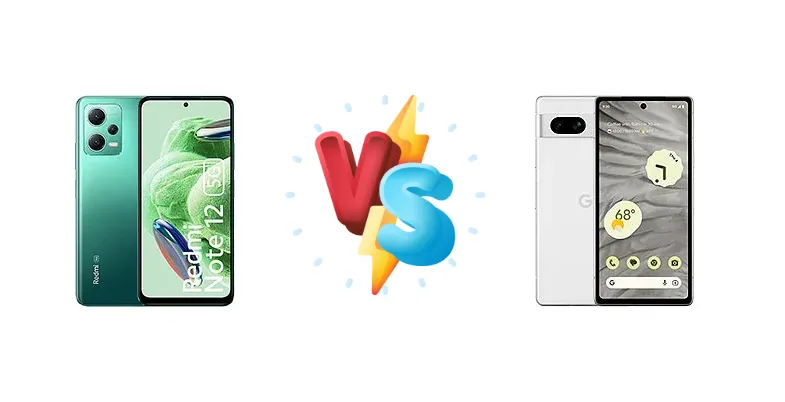
|
🏆 Quick Verdict
For most users, the Google Pixel 7a is the superior choice, primarily due to its significantly better camera capabilities and more powerful processor. However, the Xiaomi Redmi Note 12 excels in battery endurance, lasting nearly twice as long on a single charge, making it ideal for users prioritizing longevity over raw performance.
| PHONES | ||
|---|---|---|
| Phone Names | Xiaomi Redmi Note 12 | Google Pixel 7a |
| Network | ||
|---|---|---|
| 2G bands | GSM 850 / 900 / 1800 / 1900 | GSM 850 / 900 / 1800 / 1900 |
| 3G bands | HSDPA 850 / 900 / 2100 | HSDPA 800 / 850 / 900 / 1700(AWS) / 1900 / 2100 |
| 4G bands | 1, 3, 5, 8, 40, 41 | 1, 2, 3, 4, 5, 7, 8, 12, 13, 14, 17, 20, 25, 26, 28, 29, 30, 38, 40, 41, 48, 66, 71 - GWKK3, G0DZQ |
| 5G bands | 1, 3, 5, 8, 28, 40, 78 SA/NSA | 1, 2, 3, 5, 7, 8, 12, 14, 20, 25, 28, 30, 38, 41, 48, 66, 71, 77, 78 SA/NSA/Sub6 - GWKK3 |
| Speed | HSPA, LTE, 5G | HSPA, LTE, 5G |
| Technology | GSM / HSPA / LTE / 5G | GSM / HSPA / LTE / 5G |
| - | 1, 2, 3, 5, 7, 8, 12, 20, 25, 28, 38, 40, 41, 66, 75, 76, 77, 78, 79 SA/NSA/Sub6 - GHL1X, G82U8 | |
| Launch | ||
|---|---|---|
| Announced | 2022, October 27 | 2023, May 10 |
| Status | Available. Released 2023, January 11 | Available. Released 2023, May 10 |
| Body | ||
|---|---|---|
| Build | - | Glass front (Gorilla Glass 3), aluminum frame, plastic back |
| Dimensions | 165.9 x 76.2 x 8 mm (6.53 x 3.00 x 0.31 in) | 152 x 72.9 x 9 mm (5.98 x 2.87 x 0.35 in) |
| SIM | Nano-SIM + Nano-SIM | Nano-SIM + eSIM |
| Weight | 188 g (6.63 oz) | 193.5 g (6.84 oz) |
| IP53, dust and splash resistant | IP67 dust/water resistant (up to 1m for 30 min) | |
| Display | ||
|---|---|---|
| Protection | Corning Gorilla Glass 3 | Corning Gorilla Glass 3 |
| Resolution | 1080 x 2400 pixels, 20:9 ratio (~395 ppi density) | 1080 x 2400 pixels, 20:9 ratio (~429 ppi density) |
| Size | 6.67 inches, 107.4 cm2 (~85.0% screen-to-body ratio) | 6.1 inches, 90.7 cm2 (~81.8% screen-to-body ratio) |
| Type | AMOLED, 120Hz, 1200 nits (peak) | OLED, HDR, 90Hz |
| - | Always-on display | |
| Platform | ||
|---|---|---|
| CPU | Octa-core (2x2.0 GHz Cortex-A78 & 6x1.8 GHz Cortex-A55) | Octa-core (2x2.85 GHz Cortex-X1 & 2x2.35 GHz Cortex-A78 & 4x1.80 GHz Cortex-A55) |
| Chipset | Qualcomm SM4375 Snapdragon 4 Gen 1 (6 nm) | Google Tensor G2 (5 nm) |
| GPU | Adreno 619 | Mali-G710 MP7 |
| OS | Android 12, MIUI 14 (International), MIUI 13 (India) | Android 13, upgradable to Android 15, up to 5 major Android upgrades |
| Memory | ||
|---|---|---|
| Card slot | microSDXC (uses shared SIM slot) | No |
| Internal | 128GB 4GB RAM, 128GB 6GB RAM, 256GB 8GB RAM | 128GB 8GB RAM |
| UFS 2.2 | UFS 3.1 | |
| Main Camera | ||
|---|---|---|
| Dual | - | 64 MP, f/1.9, 26mm (wide), 1/1.73", 0.8µm, dual pixel PDAF, OIS 13 MP, f/2.2, 120˚ (ultrawide), 1.12µm |
| Features | Dual-LED dual-tone flash, HDR, panorama | Dual-LED flash, Pixel Shift, Auto-HDR, panorama |
| Triple | 48 MP, f/1.8, (wide), PDAF 8 MP, f/2.2, 120˚ (ultrawide), 1/4.0", 1.12µm 2 MP (macro) | - |
| Video | 1080p@30fps | 4K@30/60fps, 1080p@30/60/120/240fps, OIS |
| Selfie camera | ||
|---|---|---|
| Features | HDR | HDR, panorama |
| Single | 13 MP, f/2.5, (wide), 1/3.0" | 13 MP, f/2.2, 20mm (ultrawide), 1.12µm |
| Video | 1080p@30fps | 4K@30fps, 1080p@30fps |
| Sound | ||
|---|---|---|
| 3.5mm jack | Yes | No |
| 35mm jack | Yes | No |
| Loudspeaker | Yes | Yes, with stereo speakers |
| 24-bit/192kHz audio | - | |
| Comms | ||
|---|---|---|
| Bluetooth | 5.1, A2DP, LE | 5.3, A2DP, LE |
| Infrared port | Yes | - |
| NFC | Yes (market/region dependent) | Yes |
| Positioning | GPS, GLONASS | GPS, GLONASS, GALILEO, BDS, QZSS, NavIC |
| Radio | Unspecified | No |
| USB | USB Type-C 2.0, OTG | USB Type-C 3.2 |
| WLAN | Wi-Fi 802.11 a/b/g/n/ac, dual-band | Wi-Fi 802.11 a/b/g/n/ac/6e, tri-band |
| Features | ||
|---|---|---|
| Sensors | Fingerprint (side-mounted), accelerometer, gyro, proximity, compass | Fingerprint (under display, optical), accelerometer, gyro, proximity, compass, barometer |
| Battery | ||
|---|---|---|
| Charging | 33W wired, 50% in 22 min | 18W wired, PD3.0 7.5W wireless |
| Type | Li-Po 5000 mAh | Li-Po 4385 mAh |
| Misc | ||
|---|---|---|
| Colors | Frosted Green, Matte Black, Mystique Blue | Charcoal, Snow, Sea, Coral |
| Models | 22111317I, 22111317G | GWKK3, GHL1X, G0DZQ, G82U8 |
| Price | € 151.99 / $ 219.99 / ₹ 11,999 | € 179.90 / $ 150.00 / £ 170.00 / ₹ 25,980 |
| SAR | 1.09 W/kg (head) 1.05 W/kg (body) | - |
| SAR EU | 0.68 W/kg (head) 0.91 W/kg (body) | - |
| Tests | ||
|---|---|---|
| Battery life | Endurance rating 101h | - |
| Camera | Photo / Video | - |
| Display | Contrast ratio: Infinite (nominal) | - |
| Loudspeaker | -28.0 LUFS (Good) | - |
| Performance | AnTuTu: 360745 (v9) GeekBench: 1998 (v5.1), 2017 (v6) | - |
Xiaomi Redmi Note 12
- Superior camera performance with Google's computational photography.
- More powerful processor for smoother multitasking and gaming.
- Brighter display for better outdoor visibility.
- Significantly shorter battery life compared to the Redmi Note 12.
- Slower charging speed (18W).
Google Pixel 7a
- Exceptional battery life with an endurance rating of 101 hours.
- Faster wired charging (33W).
- More affordable price point.
- Less powerful processor for demanding tasks.
- Inferior camera performance compared to the Pixel 7a.
Display Comparison
The Pixel 7a boasts a brighter display, reaching 1070 nits measured, compared to the Redmi Note 12’s 706 nits. This translates to significantly better visibility outdoors under direct sunlight. While both displays have an infinite (nominal) contrast ratio, the higher peak brightness of the Pixel 7a provides a more vibrant and engaging viewing experience. The Pixel 7a's display is also likely to have better color accuracy, a hallmark of Google's displays, though this isn't explicitly stated in the provided data. The Redmi Note 12's display, while adequate, is clearly positioned as a cost-saving measure.
Camera Comparison
Both phones are listed as having Photo/Video capabilities, but the underlying hardware and software processing differ dramatically. While specific sensor details are missing, the Pixel 7a leverages Google’s renowned computational photography algorithms, powered by the Tensor G2’s image signal processor (ISP). This results in superior image quality, particularly in challenging lighting conditions. The Pixel 7a’s image processing excels in dynamic range, detail preservation, and noise reduction. The Redmi Note 12, while capable of taking decent photos, will likely struggle to match the Pixel 7a’s consistency and overall quality. The Tensor G2’s dedicated hardware for image processing gives the Pixel 7a a clear advantage.
Performance
The performance gap between these two devices is substantial. The Google Pixel 7a’s Tensor G2, built on a 5nm process, features a prime Cortex-X1 core clocked at 2.85 GHz, offering significantly more processing power than the Redmi Note 12’s Snapdragon 4 Gen 1 (6nm). The Snapdragon 4 Gen 1, while efficient, is geared towards everyday tasks, with its Cortex-A78 cores peaking at 2.0 GHz. This difference is reflected in app loading times, multitasking capabilities, and overall system responsiveness. The Tensor G2 also benefits from Google’s AI and machine learning optimizations, enhancing features like voice recognition and image processing. The Redmi Note 12 will handle basic tasks well, but the Pixel 7a provides a noticeably smoother and more fluid experience.
Battery Life
Battery life is where the Redmi Note 12 truly shines. Its endurance rating of 101 hours significantly surpasses the Pixel 7a’s 76 hours. In active use, the Redmi Note 12 lasts a remarkable 10 hours and 58 minutes. This difference is likely due to the more efficient Snapdragon 4 Gen 1 chipset and the Redmi Note 12’s optimized power management. While the Pixel 7a supports 7.5W wireless charging, the Redmi Note 12 offers faster 33W wired charging, reaching 50% charge in just 22 minutes. The Pixel 7a’s 18W charging is comparatively slow, requiring more time to fully replenish the battery.
Buying Guide
Buy the Xiaomi Redmi Note 12 if you prioritize all-day (and then some) battery life, are a casual smartphone user, and don't heavily rely on mobile photography. Buy the Google Pixel 7a if you value a superior camera experience, smoother performance for demanding apps, and benefit from Google’s software features and timely updates.